Q.Consider the charges , , and placed at the vertices of an equilateral triangle. What is the force on each charge?
You're viewing a preview — the full solution, concept, methods & PYQ mapping are locked.
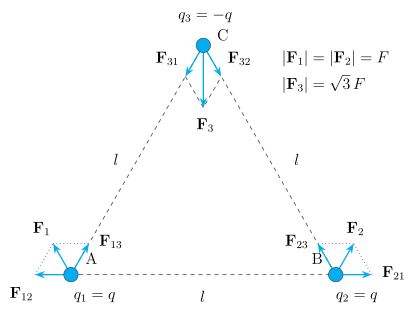
Start your 14-day free trial to unlock the full solution →The net force on each charge is determined by the principle of superposition, which requires vectorially summing the individual Coulomb forces from the other two charges. The charges at the base vertices experience a force of magnitude each, directed parallel to the opposite side. The charge at the top vertex experiences a force of magnitude directed vertically downwards.
Electric charges exert forces on each other as described by Coulomb's Law. When multiple charges are present, the net force on any single charge is the vector sum of the individual forces exerted on it by all other charges. This is known as the Principle of Superposition. Since force is a vector quantity, both its magnitude and direction must be considered when adding forces.
The magnitude of the electrostatic force between two point charges and separated by a distance is given by Coulomb's Law:
where is Coulomb's constant. The force is attractive if the charges have opposite signs and repulsive if they have the same sign.
A common mistake is to simply add the magnitudes of the forces. Remember that force is a vector quantity, and thus forces must always be added vectorially, taking both magnitude and direction into account.
Let the charges be at vertex A (bottom-left), at vertex B (bottom-right), and at vertex C (top). Let the side length of the equilateral triangle be .
The distance between any two charges is .
Let's define a reference force magnitude for convenience:
The magnitude of the force between and will also be .
We will now calculate the net force on each charge using vector addition.
1. Force on charge (at vertex A)
Charge experiences two forces:
- Force from (): Since and are both positive (), the force is repulsive. Its magnitude is . The direction is away from B, along the line AB, pointing horizontally to the left.
- Force from (): Since is positive () and is negative (), the force is attractive. Its magnitude is . The direction is towards C, along the line AC, pointing upwards and to the right.
The angle between the line AB (horizontal) and AC is . Therefore, the angle between (pointing left) and (pointing up-right) is .
To find the net force , we use the parallelogram law of vector addition:
The resultant force has a magnitude of . Since the two component forces have equal magnitudes, the resultant force bisects the angle between them. The angle between (left) and (up-right) is . The resultant will be from each. This means points above the negative x-axis, which is parallel to the side BC.
2. Force on charge (at vertex B)
Charge experiences two forces:
- Force from (): Since and are both positive (), the force is repulsive. Its magnitude is . The direction is away from A, along the line BA, pointing horizontally to the right.
- Force from (): Since is positive () and is negative (), the force is attractive. Its magnitude is . The direction is towards C, along the line BC, pointing upwards and to the left.
The angle between the line BA (horizontal) and BC is . Therefore, the angle between (pointing right) and (pointing up-left) is .
To find the net force :
…
Unlock everything free for 14 days
- Full step-by-step solutions
- Concept-first explanations
- Methods, shortcuts & mistakes
- PYQ mapping + timed mock tests
Full access for 14 days. No credit card required.