Physics · Ch 4 — Moving Charges and Magnetism
Motion in a Magnetic Field
Motion in a Magnetic Field
Magnetic Force Does No Work
The magnetic force is always perpendicular to the velocity of the charged particle.
- Since work and , the magnetic force does zero work.
- Therefore, the speed (magnitude of velocity) of the particle remains constant. Only the direction of motion changes.
- This is different from the electric force , which can have a component along and thus change the kinetic energy.
Motion in a Uniform Magnetic Field
We consider a uniform magnetic field . The motion depends on the angle between and .
Case 1: Velocity Perpendicular to Magnetic Field ()
The magnetic force acts as a centripetal force, causing uniform circular motion in a plane perpendicular to .
- Centripetal force required:
- Magnetic force provided:
- Equating:
- Solving for the radius of the circular path (called the cyclotron radius):
-
= mass of particle, = speed, = charge magnitude, = magnetic field strength.
-
Larger momentum gives a larger radius.
-
Angular frequency (also called cyclotron frequency):
-
Since , substituting gives .
-
Frequency (number of revolutions per second):
-
Key result: is independent of speed or energy — depends only on and .
-
Time period for one revolution:
Case 2: Velocity with a Component Parallel to
If has a component along and a component perpendicular to :
- The parallel component is unaffected by the magnetic field (no force along ). …
Drawn by us to help you understand the concept clearly, and verified to make sure it's accurate. For exams, practice from your textbook's own diagram.
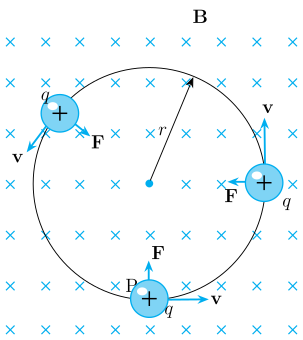
Figure 4.5 is a schematic diagram that illustrates the circular motion of a positively charged particle when it enters a uniform magnetic field perpendicular to its velocity.
The diagram shows a square region filled with cross symbols (×). Each cross represents the tail of an arrow, indicating that the magnetic field is directed into the plane of the page (perpendicular to the page, away from the reader). A bold label "B" at the top reinforces this.
Inside this field region, a large circle is drawn. On this circle, several positive charges are placed at different positions. At each charge, a tangent arrow shows the velocity of the particle — the direction of motion at that instant. A radial arrow points from each charge directly inward toward the centre of the circle, representing the magnetic force acting on the charge. This force is always perpendicular to both and , and here it points toward the centre, acting as a centripetal force.
A radius is drawn from the centre to the circle, and a point P is marked at the lower-left part of the circle (likely to indicate a specific location for reference). The entire diagram is rendered in blue.
Physical idea
The figure teaches that when a charged particle moves perpendicular to a uniform magnetic field, the magnetic force is always perpendicular to the velocity. This force does no work (since it is perpendicular to displacement), so the speed of the particle remains constant, but the direction changes continuously. The force acts as a centripetal force, causing the particle to follow a circular path of constant radius.
Key formula derived from this figure
From the textbook, equating the magnetic force to the centripetal force gives:
Solving for the radius of the circular path:
where:
- = mass of the particle
- = speed (magnitude of velocity)
- = charge of the particle
- = magnitude of the uniform magnetic field …
Drawn by us to help you understand the concept clearly, and verified to make sure it's accurate. For exams, practice from your textbook's own diagram.
What the figure shows
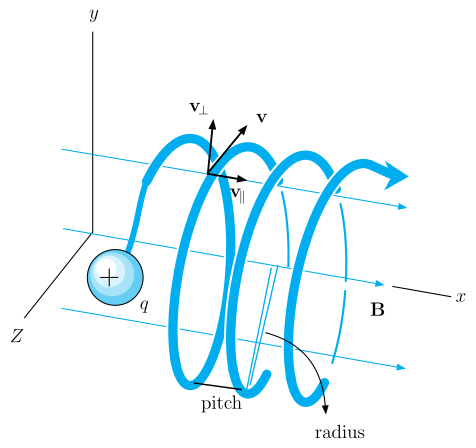
The diagram is a 3‑D sketch with the -axis pointing upward, the -axis to the right, and the -axis slanting toward the lower left. A uniform magnetic field points along the positive -direction (a label “B” sits on the -axis). A blue helix of several turns winds around the -axis. At the left end of the helix a positive charge is shown. Its velocity vector is split into two components: (perpendicular to , drawn in the – plane) and (parallel to , along the -axis). Two labels appear below the helix: pitch (the axial distance the particle advances in one full turn) and radius (the radius of the circular part of the motion).
Physical idea
When a charged particle moves in a uniform magnetic field, the magnetic force is always perpendicular to both and . This force does no work, so the speed stays constant. If the velocity has a component parallel to , that component () is unaffected because the magnetic force has no component along . The perpendicular component () experiences a centripetal force that makes the particle go in a circle. The combination of uniform circular motion in the plane perpendicular to and constant motion along produces a helical path — the particle spirals forward along the field lines.
Key formulas developed from this figure
The radius of the circular part (the helix radius) comes from equating the magnetic force to the centripetal force:
where is the particle’s mass, its charge, the magnetic field strength, and the component of velocity perpendicular to .
The angular frequency (cyclotron frequency) is independent of speed: …