Q.What is meant by mass defect and nuclear binding energy? Draw a graph between mass number and binding energy per nucleon. (1+1+1=3) OR Explain the following in a nuclear reactor based on thermal neutron fission:
You're viewing a preview — the full solution, concept, methods & PYQ mapping are locked.
Start your 14-day free trial to unlock the full solution →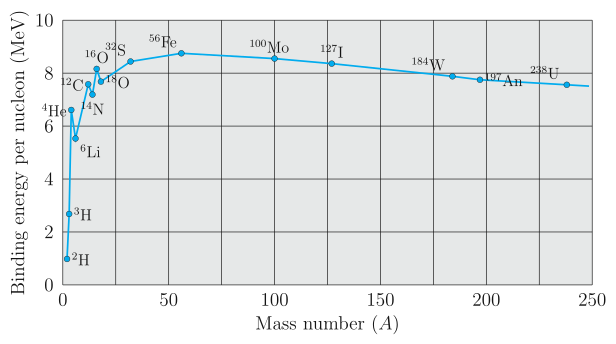
A nucleus's mass is always slightly less than the sum of its free constituent nucleons' masses; this 'missing' mass, converted via E = mc², is the energy that binds the nucleus together — and plotting this binding energy per nucleon against mass number reveals why fission and fusion both release energy.
Mass defect (Δm): If a nucleus contains protons (each of mass ) and neutrons (each of mass ), the sum of the masses of these free, separated nucleons is always found to be greater than the actual measured mass of the nucleus. This difference is the mass defect:
Binding energy: This "missing" mass has been converted into the energy that binds the nucleons together (by Einstein's mass–energy relation):
This is the energy that would have to be supplied to break the nucleus apart into its individual free nucleons.
Binding energy per nucleon vs mass number (A) graph: Plotting against :
- It rises sharply for very light nuclei (from near 0 for H) up to about A ≈ 20. …
Unlock everything free for 14 days
- Full step-by-step solutions
- Concept-first explanations
- Methods, shortcuts & mistakes
- PYQ mapping + timed mock tests
Full access for 14 days. No credit card required.