Q.What is Presbyopia? Describe the construction and working of reflecting telescope. Draw necessary ray diagram. OR What is wave front? Explain laws of refraction of light on the basis of Huygens wave theory. Draw necessary ray diagram.
You're viewing a preview — the full solution, concept, methods & PYQ mapping are locked.
Start your 14-day free trial to unlock the full solution →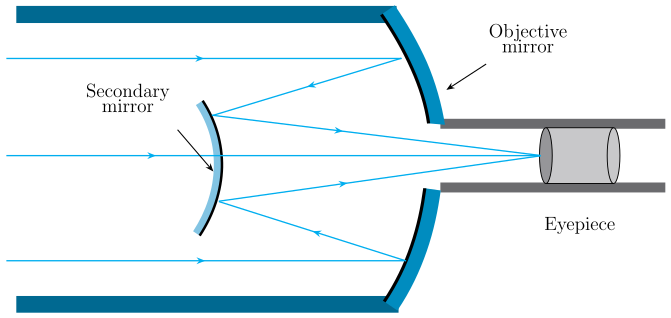
Presbyopia is the age-related loss of the eye's ability to focus on nearby objects, corrected with converging lenses; a reflecting telescope replaces the large objective lens of a refracting telescope with a large concave mirror, avoiding chromatic aberration.
What is Presbyopia?
Presbyopia is a defect of vision, associated with ageing, in which the near point of the eye gradually recedes farther than the normal near point of 25 cm. It occurs because the ciliary muscles weaken and the eye lens gradually loses its elasticity/flexibility with age, so the eye cannot increase its converging power (accommodate) enough to focus on nearby objects. It is corrected using a converging (convex) lens for near work — often prescribed as bifocal lenses, which have an upper portion (diverging/normal, for distant vision) and a lower portion (converging, for near vision) in the same spectacle lens.
Construction and working of a reflecting telescope:
A reflecting telescope uses a large concave (parabolic) mirror as its objective, instead of a large convex lens, to collect and focus light from a distant object.
Construction (Cassegrain-type, the common design): Light from a distant object falls on a large concave primary mirror at the bottom of the telescope tube, which reflects and converges the light. Before reaching the primary mirror's focus, the converging beam is intercepted by a small convex secondary mirror placed near the top of the tube, which reflects the light back down through a small hole in the centre of the primary mirror, forming a real image just behind the primary mirror. This image is then viewed/magnified using an eyepiece (a convex lens).
Working: The concave primary mirror collects a large amount of light (larger apertures are structurally easier to build for mirrors than lenses) and brings it to a focus; the secondary mirror folds the light path to a convenient location, and the eyepiece magnifies the final image formed.
Advantages of a reflecting telescope over a refracting one: …
Unlock everything free for 14 days
- Full step-by-step solutions
- Concept-first explanations
- Methods, shortcuts & mistakes
- PYQ mapping + timed mock tests
Full access for 14 days. No credit card required.