Q.What is meant by compound microscope? Draw a ray diagram of the formation of an image by a compound microscope. Briefly describe its working and derive the formula for its total magnification. (1+1+1+1=4) OR What is meant by Telescope? Draw a ray diagram of image formation by a refracting telescope. Briefly describe its working and derive the formula for its magnifying power.
You're viewing a preview — the full solution, concept, methods & PYQ mapping are locked.
Start your 14-day free trial to unlock the full solution →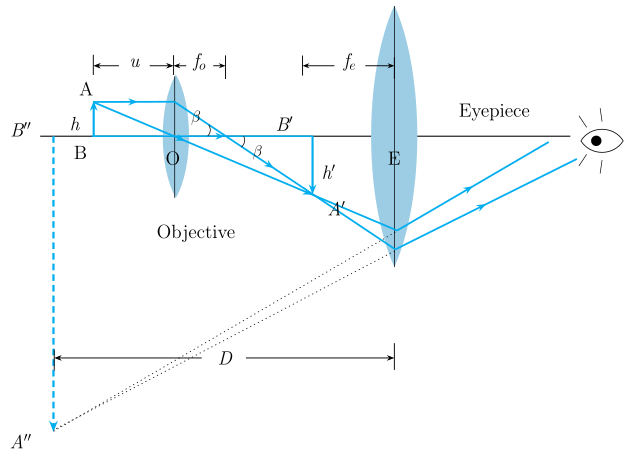
A compound microscope magnifies in two stages — the objective forms a real, magnified image close to the eyepiece's focal point, and the eyepiece then acts as a simple magnifier on that intermediate image — multiplying the two individual magnifications together.
Setup: A compound microscope has two converging lenses: the objective, of short focal length , placed close to the (tiny) object; and the eyepiece, of somewhat larger focal length , through which the observer looks.
(Ray diagram description: the object O is placed just beyond the objective's focal point F₀, so the objective forms a real, inverted, magnified image I₁ inside the eyepiece's focal length. This image I₁ acts as the object for the eyepiece, which — since I₁ lies within its focal length — forms a large, virtual, further-magnified final image I₂. For normal (relaxed-eye) adjustment, I₁ is placed exactly at the eyepiece's focal point so I₂ forms at infinity; alternatively the eyepiece can form I₂ at the near point D.)
Working: The objective, being of very short focal length and placed just outside its focal length from the object, produces a real, inverted, highly magnified intermediate image . This image then serves as the "object" for the eyepiece, which is used essentially as a simple magnifying glass to give a further magnified, virtual final image .
Magnification (final image at the near point D, common derivation):
Magnification by the objective:
…
Unlock everything free for 14 days
- Full step-by-step solutions
- Concept-first explanations
- Methods, shortcuts & mistakes
- PYQ mapping + timed mock tests
Full access for 14 days. No credit card required.