Q.What is angle of deviation? Draw a diagram of ray of light passing through a triangular glass prism. Prove for a prism that minimum deviation Dm = (n21 - 1) A, where n21 is refractive index of prism and A is angle of prism. [1+1+2=4] OR What do you understand by power of lens? Draw a ray diagram for the formation of image by a compound microscope and derive its formula for magnification. [1+1+2=4]
You're viewing a preview — the full solution, concept, methods & PYQ mapping are locked.
Start your 14-day free trial to unlock the full solution →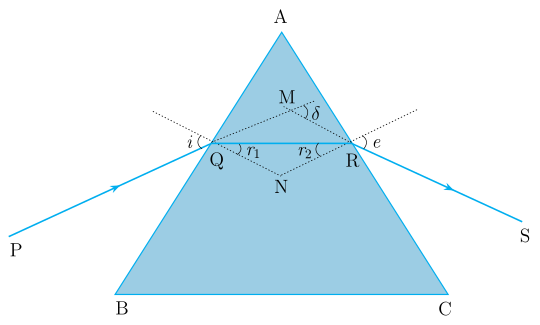
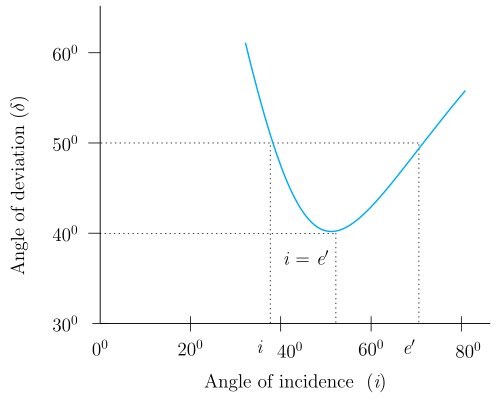
The angle of deviation measures how much a prism bends light overall; for a thin prism with small angles throughout, this bending works out to simply times the prism angle.
Angle of deviation: When a ray of light passes through a prism, it is refracted (bent) at both faces. The angle of deviation is the angle between the direction of the original incident ray (extended forward) and the direction of the final emergent ray.
Diagram (described): A triangular prism of apex angle ; a ray strikes the first face at angle of incidence , refracts to angle inside the prism, travels to the second face, refracts again on exiting at angle of incidence (inside) and angle of emergence (outside). The angle between the extended incident ray and the emergent ray, measured where they (would) cross, is the angle of deviation .
From the geometry of the prism: , and the total deviation is .
Deriving for a thin prism (small-angle case): For a thin prism with small apex angle , and light incident nearly normally (all angles small), Snell's law at each face can be approximated using (in radians):
At the first face:
…
Unlock everything free for 14 days
- Full step-by-step solutions
- Concept-first explanations
- Methods, shortcuts & mistakes
- PYQ mapping + timed mock tests
Full access for 14 days. No credit card required.