Applied Mathematics · Ch 4 — Relations
Types of Relations
Types of Relations
Relations are the backbone of how we connect elements from one set to another, but not all connections are created equal. Some are reflexive, where every element is related to itself; others are symmetric, meaning if relates to , then relates back to ; and still others are transitive, where a chain of relations forces a direct one. The most elegant relations satisfy all three at once — these are called equivalence relations, and they carve a set into neat, non-overlapping groups called equivalence classes. Understanding these types gives you a powerful le …
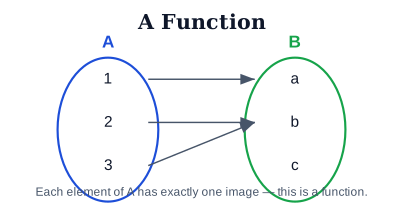
Drawn by us to help you understand the concept clearly, and verified to make sure it's accurate. For exams, practice from your NCERT textbook's own diagram.
A function: every element of A has exactly one im …
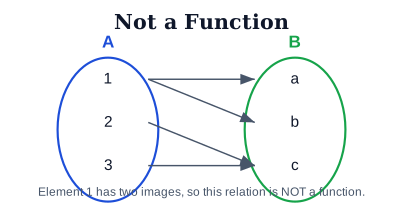
Drawn by us to help you understand the concept clearly, and verified to make sure it's accurate. For exams, practice from your NCERT textbook's own diagram.
Not a function: one element of A has two …