Biology · Ch 8 — Cell: The Unit of Life
Mitochondria
Mitochondria
Mitochondria (a single one is called a mitochondrion) are usually hard to see under an ordinary microscope unless they have been specially stained. Both their number and their form vary from cell to cell.
Number, shape and size
- The number of mitochondria in a cell depends on how physiologically active that cell is, so more active cells tend to have more of them.
- There is also considerable variation in shape and size.
- A typical mitochondrion is sausage-shaped or cylindrical, with a diameter of roughly one-fifth to one micrometre (on average about half a micrometre) and a length of about one to four micrometres.
The double-membrane structure
Each mitochondrion is a double membrane-bound structure, having an outer membrane and an inner membrane. Together these two membranes divide the interior into two distinct fluid-filled compartments:
- The outer compartment
- The inner compartment, which is filled with a dense, uniform material called the matrix
The two membranes have contrasting arrangements:
- The outer membrane forms the continuous outer boundary of the whole organelle.
- The inner membrane is thrown into numerous infoldings projecting towards the matrix, and these folds are called cristae (a single fold is a crista). The cristae are important because they increase the surface area available inside the organelle.
Each membrane carries its own specific set of enzymes that are linked to the working of the mitochondrion.
Function — the power house
Mitochondria are the sites where aerobic respiration takes place. Through this process they generate cellular energy in the form of ATP, and because they supply the cell's energy in this way they are described as the power houses of the cell.
Their own genetic machinery …
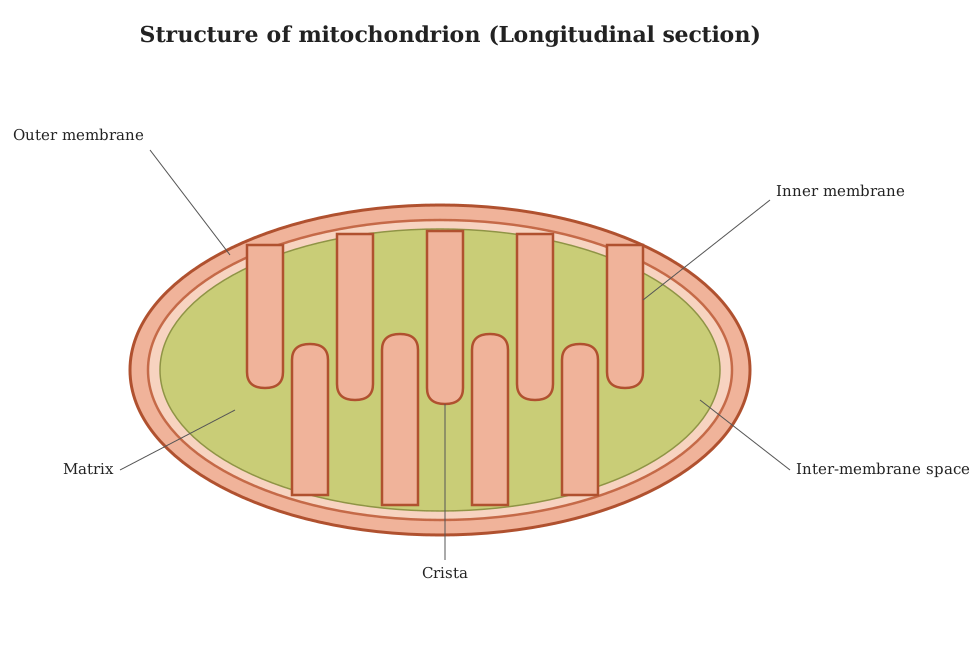
Drawn by us to help you understand the concept clearly, and verified to make sure it's accurate. For exams, practice from your NCERT textbook's own diagram.
This cut-open view shows the internal build of a mitochondrion. It is bounded by two membranes. The outer membrane is smooth and continuous, forming the boundary with the cytoplasm. The inner membrane is thrown into many folds called cristae that project inward, greatly increasing its surface area. The space enclosed by the inner membrane is filled with a dense fluid called the matrix, which holds enzymes, a little DNA and ribosomes. The cristae are where much of aerobic respiration takes place, releasing energy that is stored in ATP. Because the mitochondrion supplies most of the cell's usable energy, it is often called the po …