Chemistry · Ch 6 — Equilibrium
Predicting the Direction of the Reaction
Predicting the Direction of the Reaction
The Reaction Quotient: A Tool for Direction
The equilibrium constant tells us where a reaction ends up — the ratio of products to reactants at equilibrium. But what if the reaction hasn't reached equilibrium yet? How do we know which way it will shift — forward or backward — from a given starting mixture?
The answer lies in a quantity called the reaction quotient, . It is defined exactly like the equilibrium constant, but using the actual concentrations (or partial pressures) present at any moment — not necessarily the equilibrium values.
For a general reaction:
the reaction quotient in terms of molar concentrations is:
If we are working with gases, we use partial pressures instead:
The only difference between and is that uses current concentrations, while uses equilibrium concentrations.
The reaction quotient is a snapshot of the reaction mixture at any instant. Comparing with tells us the direction in which the net reaction will proceed to reach equilibrium.
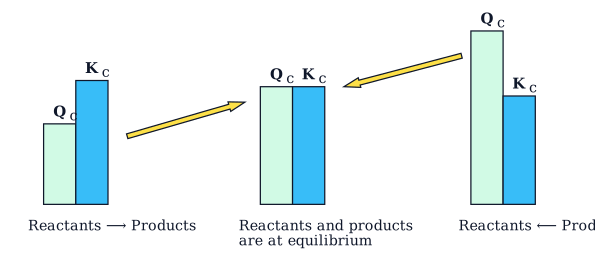
Drawn by us to help you understand the concept clearly, and verified to make sure it's accurate. For exams, practice from your NCERT textbook's own diagram.
The figure is a simple but powerful visual summary of how the reaction quotient compares to the equilibrium constant to decide which way a reaction will shift. It shows three separate bar charts, each with two bars side by side: a green bar for and a blue bar for . The height of each bar represents the numerical value of that quantity.
In the first panel, the green bar () is shorter than the blue bar (). An arrow points from left to right, indicating that the net reaction moves forward — from reactants to products — until rises to meet . In the second panel, the two bars are exactly the same height, and there is no arrow: the system is at equilibrium, with no net change. In the third panel, the green bar () is taller than the blue bar (). The arrow now points from right to left, showing that the net reaction goes backward — from products to reactants — until falls back down to .
The physical idea is that acts like a target or a set point. No matter where you start, the reaction mixture will always adjust its composition until equals . The figure makes this directional rule immediate: if , the reaction proceeds forward; if , it proceeds in reverse; if , the system is already at equilibrium.
The key formula that the textbook develops alongside this figure is the definition of the reaction quotient. For a general reaction
the quotient is written exactly like the equilibrium constant, but using the concentrations present at any moment — not necessarily at equilibrium:
Here, , , , and are the molar concentrations at the instant you measure them. The exponents , , , are the stoichiometric coefficients from the balanced equation. The same idea applies to gases using partial pressures, giving .
A common mistake is to confuse with . They are calculated the same way, but uses only equilibrium concentrations, while uses whatever concentrations are present at the time of measurement. The figure’s entire purpose is to show you how to compare them. …
How to Predict the Direction
The comparison between and (or and ) gives three clear possibilities:
-
If : The ratio of products to reactants is smaller than at equilibrium. The system has too many reactants and too few products. To reach equilibrium, the net reaction must go from left to right — the forward reaction is favoured.
-
If : The ratio of products to reactants is larger than at equilibrium. The system has too many products. To reach equilibrium, the net reaction must go from right to left — the reverse reaction is favoured.
-
If : The system is already at equilibrium. No net reaction occurs in either direction. …