Chemistry · Ch 6 — Equilibrium
Predicting the Extent of a Reaction
Predicting the Extent of a Reaction
The Meaning of the Equilibrium Constant's Magnitude
The equilibrium constant (or ) is not just a number you calculate from concentrations at equilibrium — it tells you, at a glance, how far a reaction will go before it stops. A large means the numerator (product concentrations) is large relative to the denominator (reactant concentrations). A small means the opposite.
But here is a critical point that students often miss: tells you nothing about speed. A reaction with might take years to reach equilibrium if the activation energy is high. The equilibrium constant is a thermodynamic quantity, not a kinetic one. It describes where the reaction ends up, not how fast it gets there.
Never confuse the equilibrium constant with the rate constant. A huge does not mean a fast reaction. Catalysts affect rate, not .
General Rules for Predicting Reaction Extent
The textbook gives three clear categories based on the magnitude of . These are not arbitrary — they follow directly from the structure of the equilibrium expression.
Rule 1: — Reaction Goes Nearly to Completion
When exceeds , the product concentrations in the numerator are at least a thousand times larger than the reactant concentrations in the denominator. The equilibrium mixture consists almost entirely of products. We say the reaction "lies to the right" or "proceeds nearly to completion."
The textbook gives three striking examples:
| Reaction | Temperature | |
|---|---|---|
| 500 K | ||
| 300 K | ||
| 300 K |
Look at the first example. means that at equilibrium, the ratio is astronomically large. For all practical purposes, the hydrogen and oxygen are completely consumed — the reaction goes to completion.
The threshold is a convention, not a physical law. A reaction with still heavily favours products, but the textbook uses as a clean dividing line for "nearly complete."
Rule 2: — Reaction Hardly Proceeds
When is smaller than , the denominator dominates the numerator. The equilibrium mixture contains mostly reactants. We say the reaction "lies to the left" or "proceeds rarely."
Consider a reaction like at room temperature. Its is on the order of . This means that at equilibrium, the concentration of NO is vanishingly small compared to and . The reaction essentially does not happen under these conditions.
The two thresholds are symmetric: and are reciprocals. This is not a coincidence — it reflects the fact that if you reverse a reaction, becomes . A reaction with going forward has going backward.
Rule 3: — Both Reactants and Products Are Present
This is the intermediate range. Neither side dominates completely. The equilibrium mixture contains significant amounts of both reactants and products. Most reactions you will analyse in detail fall into this category — they are the ones where you actually need to calculate equilibrium concentrations using an ICE table.
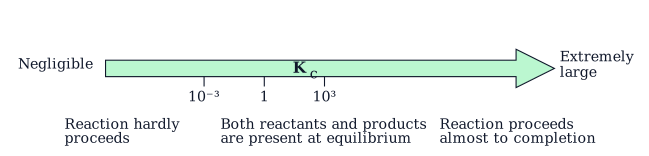
Drawn by us to help you understand the concept clearly, and verified to make sure it's accurate. For exams, practice from your NCERT textbook's own diagram.
The figure is a simple horizontal line — a number line for the equilibrium constant . It is divided into three regions by two breakpoints: and . The line itself represents the possible values of , from extremely small (left) to extremely large (right). There is no curve, no second axis, and no plotted data points. The entire teaching point is the position of on this line and what that position tells you about the reaction mixture at equilibrium.
The physical idea is direct: the equilibrium constant is a ratio of product concentrations to reactant concentrations (each raised to their stoichiometric coefficients). A large means the numerator is much larger than the denominator — products dominate. A small means the denominator dominates — reactants dominate. The figure makes this quantitative by giving you the thresholds that chemists commonly use.
Left region: — the reaction "hardly proceeds." At equilibrium, the mixture contains almost entirely reactants. The forward reaction has occurred to such a tiny extent that product concentrations are negligible for most practical purposes. The textbook calls this "negligible."
Middle region: — both reactants and products are present in appreciable amounts. Neither side overwhelmingly dominates. This is the region where the equilibrium mixture is truly a mixture, and small changes in conditions can shift the balance noticeably.
Right region: — the reaction "proceeds almost to completion." At equilibrium, the mixture contains almost entirely products. The forward reaction has gone so far that reactant concentrations are vanishingly small.
The figure shows only the composition at equilibrium, not the speed at which equilibrium is reached. A reaction with might take milliseconds or millions of years to get there — the equilibrium constant gives no information about kinetics.
The key formula that this figure illustrates is the equilibrium constant expression itself. For a general reaction
the equilibrium constant in terms of concentration is
where denotes the equilibrium concentration of species X in mol L, and the exponents are the stoichiometric coefficients from the balanced equation. The figure is a visual translation of this ratio: when is large, the numerator (products) is much larger than the denominator (reactants); when is small, the opposite is true. …
The Logic Behind These Rules
The reasoning is straightforward. The equilibrium constant expression for a general reaction
is
The numerator contains only product concentrations, the denominator only reactant concentrations. If is large, the numerator must be large relative to the denominator — meaning products are abundant. If is small, the denominator dominates — meaning reactants are abundant.
…