Chemistry · Ch 8 — Organic Chemistry – Some Basic Principles and Techniques
Classification of Organic Compounds
Classification of Organic Compounds
The sheer number of organic compounds — already in the millions and growing — makes it impossible to study them one by one. Classification brings order. Organic compounds are grouped first by the skeleton of carbon atoms in the molecule, and then by the functional groups attached to that skeleton.
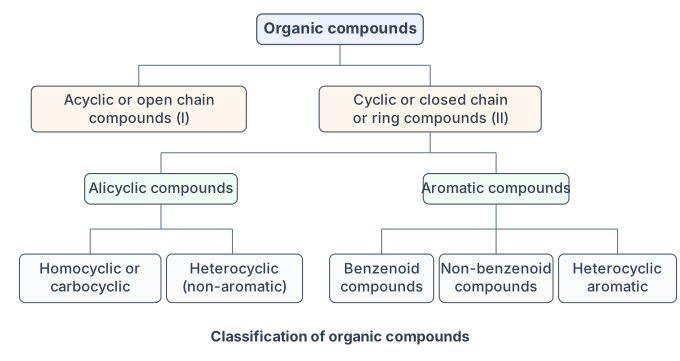
Reading the chart top-down: organic compounds first split by skeleton into acyclic (open-chain, also called aliphatic — straight or branched chains such as ethane, isobutane, acetaldehyde and acetic acid) and cyclic (closed-chain / ring) compounds. Cyclic compounds divide into alicyclic rings, which behave much like aliphatic compounds, and aromatic rings with their special stability. An alicyclic ring may be homocyclic (carbon only — cyclopropane, cyclohexane, cyclohexene) or heterocyclic non-aromatic (a non-carbon atom in the ring, like tetrahydrofuran). Aromatic compounds may be benzenoid (containing a benzene ring — benzene, aniline, naphthalene), **n …
I. Acyclic or Open-Chain Compounds
These are compounds in which the carbon atoms are joined to form straight chains or branched chains, but the chain does not close into a ring. Because the carbon chain is open, these are also called open-chain compounds.
Historically, the first organic compounds studied were fats, which have long open chains. The word "aliphatic" comes from the Greek aleiphar meaning fat. So acyclic compounds are also known as aliphatic compounds.
Examples:
- Ethane:
- Isobutane:
- Acetaldehyde:
- Acetic acid:
The chain can be straight (like ethane) or branched (like isobutane). Both are acyclic because there is no ring.
II. Cyclic or Closed-Chain or Ring Compounds
In these compounds, the carbon atoms are joined to form one or more rings. Cyclic compounds are further divided into two major classes.
(a) Alicyclic Compounds
Alicyclic compounds contain carbon atoms joined in a ring. The ring may contain only carbon atoms (a homocyclic ring) or it may contain atoms other than carbon, such as oxygen, nitrogen, or sulphur (a heterocyclic ring).
The name "alicyclic" is a blend of "aliphatic" and "cyclic". These compounds share some chemical properties with aliphatic compounds — for example, they can undergo addition reactions similar to those of open-chain alkenes.
Example: Tetrahydrofuran (THF) — a five-membered ring containing four carbon atoms and one oxygen atom.
Do not confuse "alicyclic" with "aromatic". Alicyclic compounds do not have the special stability (aromaticity) that benzene and its relatives possess. They behave more like aliphatic compounds.
(b) Aromatic Compounds
Aromatic compounds are a special class of cyclic compounds. They are defined by a unique stability and a tendency to undergo substitution reactions rather than addition reactions. You will study the detailed theory of aromaticity in Unit 9.
Aromatic compounds are divided into two types based on the ring structure:
-
Benzenoid aromatic compounds: These contain one or more benzene rings (six-membered rings with alternating double bonds). Examples: Benzene (), Aniline (), Naphthalene ( — two fused benzene rings).
-
Non-benzenoid aromatic compounds: These are aromatic compounds that do not contain a benzene ring. Example: Tropone ( — a seven-membered ring with a carbonyl group).
-
Heterocyclic aromatic compounds: These are aromatic rings that contain atoms other than carbon (heteroatoms) as part of the ring. Examples: Furan (five-membered ring with one oxygen), Thiophene (five-membered ring with one sulphur), Pyridine (six-membered ring with one nitrogen).
The key distinction between alicyclic and aromatic compounds is aromaticity. Aromatic compounds are unusually stable and undergo substitution reactions, while alicyclic compounds are more reactive and undergo addition reactions. This difference will be explained fully in Unit 9.