Chemistry · Ch 8 — Organic Chemistry – Some Basic Principles and Techniques
Nitrogen
Nitrogen
Estimation of Nitrogen in Organic Compounds
The percentage of nitrogen in an organic compound is determined by one of two classical methods: the Dumas method or the Kjeldahl method. Each works on a different chemical principle and has its own scope and limitations.
Dumas Method
This method is based on the complete combustion of the organic compound in the presence of copper oxide. The nitrogen present in the compound is converted into free nitrogen gas, which is then collected and measured.
Principle and Procedure
A known mass of the organic compound is heated strongly with excess copper oxide in an atmosphere of carbon dioxide. The carbon and hydrogen in the compound are oxidised to carbon dioxide and water respectively, while the nitrogen is liberated as free nitrogen gas. The overall reaction can be represented as:
Any traces of nitrogen oxides that may form during combustion are reduced back to nitrogen by passing the gaseous mixture over a heated copper gauze. The entire mixture of gases — carbon dioxide, water vapour, and nitrogen — is then passed through a solution of potassium hydroxide. The KOH solution absorbs carbon dioxide completely. The nitrogen gas, being chemically inert under these conditions, is collected in the upper part of a graduated tube. The volume of nitrogen collected is measured at the prevailing room temperature and pressure.
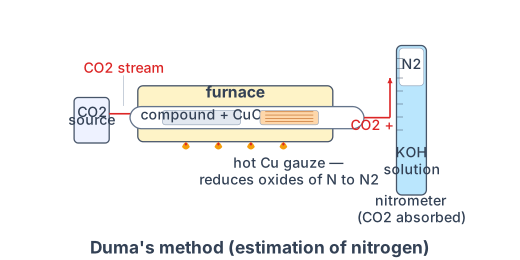
Drawn by us to help you understand the concept clearly, and verified to make sure it's accurate. For exams, practice from your NCERT textbook's own diagram.
The figure in your textbook is a schematic of the apparatus used in Dumas method for the quantitative estimation of nitrogen in an organic compound. It is not a graph with axes or curves; it is a labelled diagram of a train of connected glassware. The key components shown are a hard-glass combustion tube, a copper oxide (CuO) bed, a roll of hot copper gauze, a stream of carbon dioxide (CO₂) gas, and a nitrometer (a graduated tube inverted over a trough of concentrated potassium hydroxide solution, KOH).
The physical idea the figure teaches is simple: when an organic compound is heated strongly with excess CuO in an atmosphere of CO₂, all the carbon and hydrogen in the compound are oxidised to CO₂ and H₂O, while the nitrogen is converted into elemental N₂ gas. Any nitrogen oxides (NO, NO₂) that might form are reduced back to N₂ by passing the hot gases over metallic copper gauze. The CO₂ stream serves two purposes: it sweeps out all air from the apparatus before the reaction begins (so no atmospheric N₂ contaminates the measurement), and it carries the product gases forward. After the combustion, the mixture of CO₂ and N₂ passes into the nitrometer. The KOH solution absorbs all the CO₂, leaving only the nitrogen gas to collect at the top of the graduated tube. The volume of N₂ is then measured at room temperature and atmospheric pressure.
The entire method relies on the fact that KOH absorbs CO₂ but does not react with N₂. The measured volume of gas is therefore pure nitrogen.
From this measured volume, the textbook develops the formula for the percentage of nitrogen in the compound. Let the volume of N₂ collected be mL at room temperature °C and atmospheric pressure mm Hg. The aqueous tension (water vapour pressure) at °C is mm Hg, so the dry N₂ pressure is mm Hg. First, convert the volume to STP (0 °C, 760 mm Hg) using the combined gas law:
At STP, 22.4 L (22,400 mL) of N₂ has a mass of 28 g (the molar mass of N₂). Therefore, the mass of nitrogen in the sample is:
If the mass of the organic compound taken is g, then the percentage of nitrogen is:
Where:
- = volume of N₂ in mL at STP (calculated from the measured volume)
- = mass of the organic compound in grams
- 28 = molar mass of N₂ in g mol⁻¹
- 22400 = volume in mL occupied by 1 mole of any gas at STP …
The pressure of the collected nitrogen gas is not equal to the atmospheric pressure. The gas is collected over water, so it is saturated with water vapour. The pressure of dry nitrogen is obtained by subtracting the aqueous tension (the vapour pressure of water at that temperature) from the atmospheric pressure.
Calculation
Let the mass of the organic compound taken be grams. Let the volume of nitrogen collected be mL at a temperature K and a pressure mm Hg.
The pressure of the dry nitrogen is given by:
The volume of this nitrogen at STP (Standard Temperature and Pressure: 273 K and 760 mm Hg) is calculated using the gas equation:
Rearranging for , the volume at STP:
Now, we use the fact that 22400 mL of any gas at STP contains 1 mole of molecules. For nitrogen, 22400 mL of gas at STP weighs 28 grams (the molar mass of ).
Therefore, the mass of nitrogen in the collected mL is:
The percentage of nitrogen in the compound is then:
Where is the volume of nitrogen in mL at STP and is the mass of the compound in grams.
Kjeldahl's Method
This method is a wet-chemical method that converts the nitrogen in the compound into ammonia, which is then estimated by titration. It is generally faster than the Dumas method but has a narrower scope.
Principle and Procedure
The organic compound is heated strongly with concentrated sulphuric acid. This process, called digestion, converts the nitrogen present into ammonium sulphate.
The resulting acid mixture is then cooled and treated with an excess of sodium hydroxide solution. This liberates ammonia gas from the ammonium sulphate.
The liberated ammonia gas is distilled and absorbed into a known volume of a standard solution of sulphuric acid. The ammonia reacts with the acid to form ammonium sulphate again.
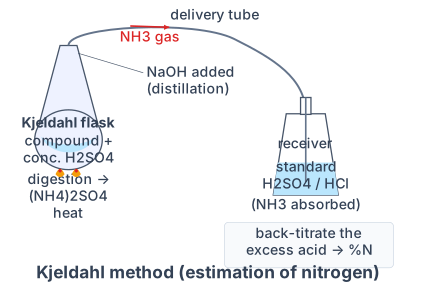
Drawn by us to help you understand the concept clearly, and verified to make sure it's accurate. For exams, practice from your NCERT textbook's own diagram.
The Kjeldahl method is the standard wet-chemical technique for estimating nitrogen in organic compounds. Figure 8.16 in your textbook is a schematic of the entire apparatus, not a graph with axes. It shows three connected stages: the digestion flask, the distillation setup, and the receiver flask. Understanding what each part does is the key to mastering the calculation.
The figure begins with a round-bottom flask (the Kjeldahl flask) where the organic compound is heated with concentrated sulphuric acid. This is the digestion step. The acid destroys the organic matter, and all the nitrogen in the compound is converted into ammonium sulphate, . The diagram shows this flask being heated, often with a catalyst like copper sulphate or selenium to speed up the reaction.
Next, the figure shows the digested mixture being transferred to a larger distillation flask. Here, an excess of sodium hydroxide (NaOH) is added. The strong base reacts with the ammonium ions:
The ammonia gas () is liberated. The diagram shows this flask being heated, and a delivery tube carries the ammonia vapour away. The tube is often shown dipping into a receiver flask that contains a known volume of a standard acid — typically or — of known concentration. The ammonia gas dissolves completely in this acid, reacting with it:
The figure makes it clear that the receiver contains an excess of acid. Some of the acid is neutralised by the ammonia; the rest remains unreacted.
The final step, which the figure implies but does not show as a separate drawing, is the back-titration. The unreacted acid in the receiver is titrated against a standard base (like NaOH) using a suitable indicator (methyl orange or methyl red). The volume of base consumed tells you how much acid was left over. From this, you calculate the amount of acid that was neutralised by the ammonia, and hence the amount of nitrogen in the original sample.
The central formula derived from this figure is:
where:
- = molarity of the standard acid used in the receiver (in mol/L).
- = volume of standard acid taken in the receiver (in mL).
- = volume of standard base required to neutralise the unreacted acid (in mL). This is converted to an equivalent volume of the same acid.
- = mass of the organic compound taken (in g).
- The factor 1.4 comes from: gives millimoles of acid neutralised. Since 1 mole of reacts with 2 moles of , and 1 mole of contains 1 mole of N (14 g), the mass of nitrogen in mg is . Dividing by 1000 converts mg to g, and multiplying by 100 gives the percentage, yielding the factor . …
The amount of ammonia produced is determined by finding out how much sulphuric acid was consumed in the reaction. This is done by titrating the unreacted sulphuric acid (the acid left over after all the ammonia has been absorbed) with a standard alkali solution (e.g., NaOH). The difference between the initial amount of acid taken and the amount left after the reaction gives the amount of acid that actually reacted with the ammonia.
The key to the calculation is to work backwards: the volume of alkali used in the titration tells you how much acid was unused. Subtracting this from the initial acid gives the acid that reacted with ammonia, which is directly proportional to the nitrogen content.
Calculation
Let the mass of the organic compound taken be grams.
Let the volume of sulphuric acid of molarity taken initially be mL.
Let the volume of sodium hydroxide of molarity used to titrate the excess acid be mL.
Step 1: Find the volume of excess acid.
The reaction between NaOH and is:
This means 2 moles of NaOH neutralise 1 mole of . Since both solutions have the same molarity , the volume of acid neutralised by mL of NaOH is half the volume of the alkali.
Step 2: Find the volume of acid that reacted with ammonia.
Step 3: Relate the acid volume to the volume of ammonia.
From the reaction , 1 mole of reacts with 2 moles of . Therefore, the volume of solution of the same molarity that would react with this acid is twice the volume of the acid.
Step 4: Calculate the mass of nitrogen. …