Chemistry · Ch 2 — Structure of Atom
Causes of Stability of Completely Filled and Half-filled Subshells
Causes of Stability of Completely Filled and Half-filled Subshells
2.6.6a Causes of Stability of Completely Filled and Half-filled Subshells
Consider a set of degenerate orbitals, say the three orbitals. According to Hund's rule, electrons occupy each orbital singly with parallel spins before pairing occurs. Why? Because when electrons have parallel spins, they are effectively kept apart by the Pauli principle — they cannot occupy the same orbital, so they experience less electrostatic repulsion. But there is a second, more subtle effect.
When two electrons with parallel spins exchange their positions, the quantum mechanical calculation shows that the energy of the system is lowered by an amount called the exchange energy. The more such exchanges are possible, the greater the stabilisation. In a half-filled subshell (e.g., , , ), the number of possible exchanges is maximised because all electrons have parallel spins.
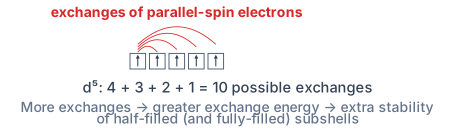
Drawn by us to help you understand the concept clearly, and verified to make sure it's accurate. For exams, practice from your NCERT textbook's own diagram.
Fig. 2.18 is a schematic that explains why a half-filled subshell (like d⁵ or p³) has extra stability — a fact you will use constantly in periodic trends and coordination chemistry. The figure does not plot a curve or show an energy axis. Instead, it shows five degenerate d-orbital boxes in a row, each containing one electron with spin up (all parallel spins). This is the d⁵ configuration in its highest-spin state (Hund’s rule obeyed).
The key visual element is a set of red curved arrows. Each arrow represents a possible exchange of positions between two electrons that have the same spin. Because electrons are indistinguishable, swapping two parallel-spin electrons does not change the physical state — but in quantum mechanics, such exchanges lower the total energy of the system. This energy lowering is called exchange energy.
The figure labels the electrons 1 through 4 (the fifth electron is present but not labelled for exchange counting). Electron 1 can exchange with any of the other four — that gives 4 possible exchanges. Electron 2 can exchange with electrons 3, 4, and 5 (but not with electron 1, because that pair was already counted) — that gives 3. Electron 3 gives 2, and electron 4 gives 1. The total number of distinct exchange pairs is:
For a general half-filled subshell with electrons (all parallel spins), the number of exchanges is the number of ways to choose 2 electrons from :
For d⁵, , so . For p³, , giving exchanges.
Each exchange contributes a negative term to the total energy. More exchanges mean greater stabilisation. That is why a half-filled subshell (maximum number of parallel spins, hence maximum exchanges) is more stable than a configuration with one fewer or one more electron.
The physical idea is this: when electrons have the same spin, the Pauli exclusion principle keeps them apart spatially (they cannot occupy the same orbital with the same spin). This reduces electron-electron repulsion. The exchange energy is a purely quantum mechanical effect — it has no classical analogue. It arises because the wavefunction for identical fermions must be antisymmetric, and the exchange term in the energy calculation (the exchange integral) is negative for parallel spins.
Do not confuse exchange energy with pairing energy. Exchange energy stabilises parallel spins; pairing energy is the cost of putting two electrons (opposite spins) in the same orbital. The extra stability of half-filled subshells comes from having many exchanges and zero pairing energy.
The formula that captures this stabilisation is not given in the NCERT text at this stage, but the concept is foundational. The total stabilisation from exchange for a configuration with parallel-spin electrons is proportional to times the exchange integral (a positive quantity). So:
…
In a completely filled subshell (e.g., , , ), although the spins are paired, the symmetry of the filled shell also provides extra stability — but through a different mechanism: the spherical symmetry of the electron cloud and the minimisation of repulsion.
The extra stability of half-filled and completely filled subshells is a direct consequence of quantum mechanics. It is not predicted by the simple Aufbau principle alone, and it explains many anomalies in electronic configurations.
Anomalous Configurations: Chromium and Copper
The most famous examples of this stability are found in the transition series. Let us examine two cases from the series.
Chromium ()
The expected configuration based on the Aufbau principle would be:
But the actual configuration is:
Why does one electron from the orbital "jump" into the subshell? Because the configuration is exactly half-filled — five electrons, one in each of the five orbitals, all with parallel spins. This half-filled subshell provides exceptional stability due to maximum exchange energy. The energy gained by this stabilisation more than compensates for the small energy cost of promoting an electron from the to the orbital.
Copper ()
The expected configuration is:
But the actual configuration is:
Here, the configuration is completely filled. The spherical symmetry of a filled subshell, combined with the exchange energy among the five pairs of electrons (though paired, exchanges still contribute), makes this configuration more stable than the arrangement.
A common mistake is to think that the orbital is always filled before the orbital. While this is true for neutral atoms in their ground states, the energy ordering changes when electrons are removed (ionisation). For transition metal ions, the orbital is actually higher in energy than the orbital, so electrons are removed from the orbital first.
Other Examples
The same principle applies to other series:
- Molybdenum (): Expected , actual (half-filled subshell).
- Silver (): Expected , actual (completely filled subshell).
- Gold (): Expected , actual (completely filled subshell).
In the lanthanide and actinide series, similar anomalies occur for half-filled and completely filled subshells. For example, gadolinium () has the configuration rather than , because the half-filled subshell is exceptionally stable.
When writing electronic configurations for elements in the -block and -block, always check whether a half-filled or completely filled subshell is possible by promoting one electron from the outermost orbital. If it is, that configuration is usually the ground state.
Summary of the Principle
| Subshell occupancy | Example | Stability reason |
|---|---|---|
| Half-filled | , , | Maximum exchange energy due to maximum number of parallel spins |
| Completely filled | , , | Spherical symmetry of electron cloud; exchange energy among paired electrons; minimum repulsion |
The extra stability is not absolute — it is a relative stabilisation compared to configurations that are one electron short of half-filling or one electron short of complete filling. That is why the "anomalous" configurations involve the movement of one electron, not two or more.
…