Physics · Ch 4 — Laws of Motion
Newton's Second Law of Motion
Newton's Second Law of Motion
Newton's Second Law of Motion
The first law told us what happens when no net external force acts — the body stays at rest or moves uniformly. But the interesting cases in physics involve forces. The second law answers the central question: how exactly does a net external force change the motion of a body?
Momentum — The Key Quantity
Before stating the law, Newton introduced a quantity that captures both mass and velocity together. Momentum of a body is defined as the product of its mass and velocity :
Momentum is a vector — it points in the same direction as the velocity. Why is this product so important? Everyday experience shows why:
- A small car and a loaded truck parked on a road need very different forces to reach the same speed in the same time. The truck, with its larger mass, requires a much greater push. Similarly, stopping a heavy body moving at a given speed needs a greater opposing force than stopping a light body at the same speed.
- Drop a light stone and a heavy stone from a building. Catching the light one is easy; catching the heavy one is hard, even though both fall with the same acceleration. Mass clearly matters.
- Speed matters too. A bullet fired at high speed pierces tissue easily; the same bullet fired gently does little damage. For a fixed mass, greater speed means a larger opposing force is needed to stop it in a given time.
- A seasoned cricketer catches a fast ball easily by letting her hands move back with the ball, increasing the time over which the momentum changes. A novice keeps his hands rigid — the same momentum change happens in a much shorter time, producing a much larger force that hurts.
Taken together, the product — momentum — is the natural variable. The greater the change in momentum in a given time, the greater the force needed.
In all the examples above, the momentum change is along the same line as the original motion. But that is not always the case. When you whirl a stone in a horizontal circle at uniform speed, the magnitude of momentum is constant, but its direction keeps changing. A force is needed for this change in the momentum vector — you feel it through the string. The faster you rotate the stone, or the smaller the circle, the greater the force you must exert. This corresponds to a greater rate of change of the momentum vector.
Statement of the Second Law
Newton expressed the second law as follows:
The rate of change of momentum of a body is directly proportional to the applied force and takes place in the direction in which the force acts.
Let us translate this into mathematics. Suppose a force acts for a time interval . The velocity of a body of mass changes from to , so its momentum changes from to . The change in momentum is .
According to the law:
or
where is a constant of proportionality.
Taking the limit , the ratio becomes the derivative . So:
For a body of fixed mass :
Thus:
Force is proportional to the product of mass and acceleration.
Choosing the Unit of Force
The unit of force has not yet been defined. Equation (4.4) gives us the opportunity to define it. We are free to choose any value for . For simplicity, we choose . This gives the second law in its most familiar form:
In SI units, one newton (1 N) is the force that causes an acceleration of on a mass of :
Important Points About the Second Law
1. Consistency with the First Law
If , then . The second law therefore implies the first law as a special case. A body with no net force on it has zero acceleration — it remains at rest or moves with constant velocity.
2. The Second Law is a Vector Law
Equation (4.5) is a vector equation. It is equivalent to three scalar equations, one for each component:
This has an important consequence: if a force is not parallel to the velocity but makes some angle with it, the force changes only the component of velocity along its own direction. The component of velocity perpendicular to the force remains unchanged.
This is why, in projectile motion under gravity (a vertical force), the horizontal component of velocity stays constant throughout the flight (ignoring air resistance). The vertical force has no component horizontally, so it cannot change the horizontal velocity.
3. Applicability to Particles and Systems
Equation (4.5) is stated for a single point particle. The force is the net external force on the particle, and is the acceleration of that particle.
Remarkably, the same form applies to a rigid body, or even to a system of particles. In that case:
- refers to the total external force on the system
- refers to the acceleration of the system as a whole — more precisely, the acceleration of its centre of mass (studied in detail in Chapter 6)
Internal forces — forces that parts of the system exert on each other — are not included in . Only forces from outside the system count.
4. The Second Law is a Local Relation
The force at a point in space at a certain instant is related to the acceleration at that same point at that same instant. Acceleration here and now is determined by the force here and now. The particle carries no memory of its past motion. …
Drawn by us to help you understand the concept clearly, and verified to make sure it's accurate. For exams, practice from your NCERT textbook's own diagram.
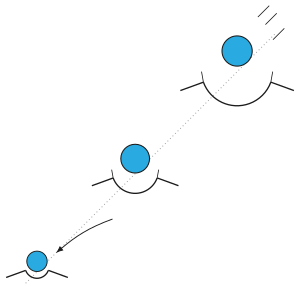
The figure shows a cricketer catching a fast-moving ball, drawn as a sequence of three positions of the hands: first stretched out to meet the ball, then drawn inward, and finally fully drawn back close to the body. The ball's incoming path is shown arriving at speed from the upper right.
The point of the figure is that force depends not just on how much the momentum changes, but on how quickly that change happens. The ball's momentum goes from some large value (moving fast toward the hands) to zero (caught, at rest) either way — a novice keeping the hands rigid, or a seasoned player drawing them back. The change in momentum, , is the same in both cases. What differs is the time over which that change happens.
By Newton's second law in its rate form,
for the same , a smaller (the novice's rigid, near-instant stop) produces a much larger average force on the hands — which is exactly why it hurts. A seasoned cricketer draws the hands backward while catching, which stretches out . With a longer time for the same change in momentum, the force on the hands is smaller.
A common mistake is to think a 'softer' catch somehow absorbs less momentum. It doesn't — the ball still loses exactly the same momentum either way (it goes from its incoming value to zero). What changes is only the time over which that fixed change happens, and therefore the force felt by the hands. …
Drawn by us to help you understand the concept clearly, and verified to make sure it's accurate. For exams, practice from your NCERT textbook's own diagram.
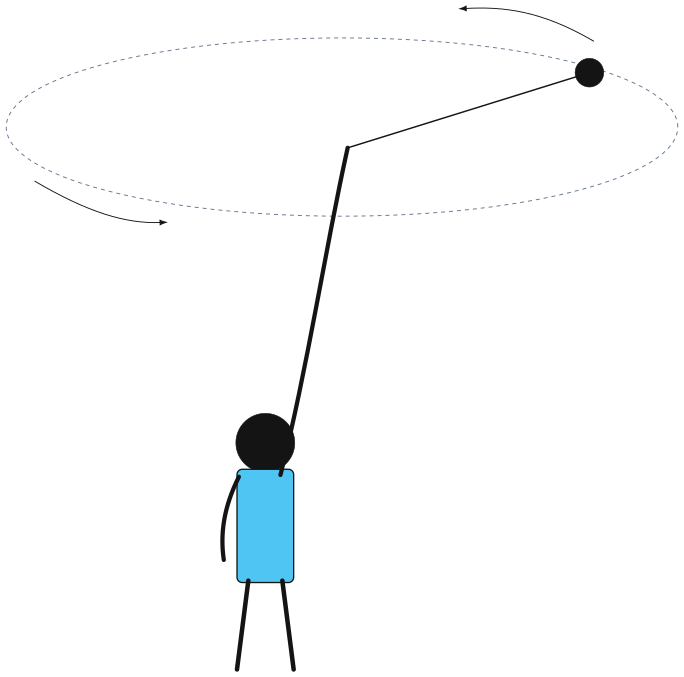
The figure shows a stone being whirled in a horizontal circle at the end of a string. The drawing is a perspective view — the circle is drawn as an ellipse to give depth, with the string shown running from the stone back to a hand at the centre. Arrows along the path indicate the direction of rotation. The key visual point is that the stone’s speed (the magnitude of its velocity) is constant, but its direction changes continuously. The string is taut, and the hand at the centre must pull inward to keep the stone moving in a circle.
The physical idea is that a force is needed to change the direction of momentum, even when the magnitude of momentum stays the same. Momentum is , so if the direction of changes, the direction of changes too. That change in momentum requires a net external force — in this case, the tension in the string, which points radially inward toward the centre. Without that inward force, the stone would fly off in a straight line (Newton’s first law).
The textbook uses this figure to develop the expression for centripetal force. For an object of mass moving with constant speed in a circle of radius , the magnitude of the centripetal acceleration is , directed toward the centre. From Newton’s second law, the net force required is therefore
where is the magnitude of the centripetal force, is the mass of the stone, is its constant speed along the circular path, and is the radius of the circle (the length of the string). The direction of this force is always perpendicular to the instantaneous velocity, pointing toward the centre of the circle.
A common mistake is to think that because the speed is constant, there is no net force. That is false — the velocity vector changes direction, so there is a nonzero acceleration and therefore a nonzero net force. The force does no work (it is perpendicular to displacement), so the kinetic energy stays the same, but the momentum changes direction. …
Drawn by us to help you understand the concept clearly, and verified to make sure it's accurate. For exams, practice from your NCERT textbook's own diagram.
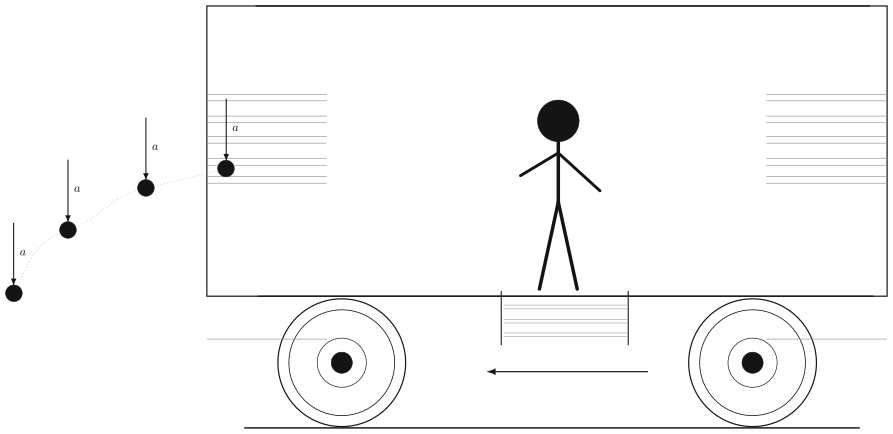
The figure shows a railway car moving to the right on a horizontal track. A person stands at the open doorway of the car. The car is accelerating to the right — that is, its velocity is increasing in the forward direction. A stone is dropped from the person's hand at the instant the car passes a certain point on the ground.
Below the car, a dashed curved line traces the path of the stone as it falls. Along this path, several positions of the stone are marked at equal time intervals. At each marked position, a single arrow points straight downward, labelled (for acceleration). There is no horizontal arrow at any of these positions.
The key point: the stone's path is not a straight vertical line. It curves forward, because the stone inherits the horizontal velocity of the train at the moment it is released. But the only acceleration acting on the stone after release is gravity — straight down. The figure drives home the idea that acceleration at an instant is determined by the force at that instant, not by the velocity.
A common mistake is to think the stone continues to accelerate horizontally because the train does. It does not. Once released, the stone has no horizontal force on it (ignoring air resistance), so its horizontal acceleration is zero. The train's acceleration after release does not affect the stone.
The textbook uses this figure to introduce the concept of instantaneous acceleration and to separate the ideas of velocity and acceleration. The stone's horizontal velocity remains constant (equal to the train's velocity at the instant of release), while its vertical velocity increases due to gravity. The resulting path is a parabola.
The central formula that emerges from this analysis is the equation for the stone's trajectory relative to the ground. If the train's velocity at the moment of release is (horizontal), and the stone is released from height , then:
Here:
- is the vertical position of the stone (height above ground), measured downward from the release point.
- is the horizontal distance from the release point.
- is the acceleration due to gravity ( downward).
- is the horizontal velocity of the train (and therefore of the stone) at the instant of release.
- is the initial height from which the stone is dropped.
This formula comes from combining the two independent motions:
- Horizontal: (no acceleration, constant velocity) …