Q.Find the centre of mass of a uniform L-shaped lamina (a thin flat plate) with dimensions as shown. The mass of the lamina is 3 kg.
You're viewing a preview — the full solution, concept, methods & PYQ mapping are locked.
Start your 14-day free trial to unlock the full solution →The uniform L-shaped plate can be cut into three identical squares, each of mass 1 kg. Treating each square's mass as concentrated at its own centre and averaging gives the centre of mass at .
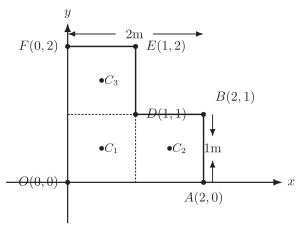
The figure shows an L-shaped lamina — a flat, rigid sheet of uniform density — placed on an -coordinate grid. The shape occupies three unit squares, each of side length , arranged to form an L. The outline runs from the origin to , then up to , left to , up to , left to , and back down to . The axes are labelled and , and the dimensions given are along the longer arms and along the shorter ones.
Three dots mark the centres of the individual unit squares: at , at , and at . Each centre is the geometric centroid of its square — the point where the square’s mass would be concentrated if it were a uniform lamina. Because the whole L-shaped lamina has uniform density, the mass of each square is the same, and the total mass is simply three times the mass of one square.
The physical idea the figure teaches is this: for a system of discrete particles (or, as here, for a continuous body broken into equal-mass pieces), the centre of mass is the weighted average of the positions of the individual masses. Since each square has equal mass, the centre of mass of the whole L-shaped lamina is just the average of the three centre coordinates:
With , this simplifies to
Substituting the coordinates:
So the centre of mass of the L-shaped lamina lies at , a point inside the shape but not at any of the square centres — it is pulled toward the corner where the three squares meet.
The centre of mass of a uniform body is the same as its geometric centroid only when the body is symmetric or when the mass distribution is uniform and the shape is simple. For an L-shaped lamina, the centroid is not at the obvious geometric centre of the bounding rectangle; you must compute it by breaking the shape into known pieces.
A common mistake is to take the centre of mass as the midpoint of the L’s bounding box (which would be ). The figure shows clearly that the three square centres are not symmetric about , so the average shifts toward the re-entrant corner — the corner where the missing square would have been.
The textbook uses this figure in Example 6.3 to demonstrate the method of dividing a continuous body into discrete, equal-mass parts and then applying the centre-of-mass formula. The key formula the example develops is the one above: for equal masses, the centre of mass is simply the arithmetic mean of their position vectors.
Concept
For a composite rigid body, the centre of mass is the mass-weighted average of the centres of mass of its parts:
Because the lamina is uniform, mass is proportional to area, so equal-area pieces carry equal mass.
Why this method …
Unlock everything free for 14 days
- Full step-by-step solutions
- Concept-first explanations
- Methods, shortcuts & mistakes
- PYQ mapping + timed mock tests
Full access for 14 days. No credit card required.