Physics · Ch 10 — Thermal Properties of Matter
Latent Heat
Latent Heat
The Idea of Change of State
Matter exists in three common states — solid, liquid, and gas. A change from one state to another is not a gradual, continuous process at the microscopic level. Instead, it happens at a fixed temperature for a given substance at a given pressure. For example, ice melts at and water boils at (at standard atmospheric pressure). During the entire phase change, the temperature of the substance remains constant even though heat is being continuously added or removed.
Why does the temperature stay constant? The heat supplied during a phase change does not go into raising the kinetic energy (temperature) of the particles. Instead, it is used to overcome the intermolecular forces that hold the particles together in the original state. This hidden heat is called latent heat (from the Latin latere, meaning "to lie hidden").
The term "latent" means hidden. The heat is "hidden" because it does not show up as a temperature rise — it is stored as potential energy in the new arrangement of molecules.
Latent Heat — Definition
The latent heat of a substance is the quantity of heat required to change the state of unit mass of the substance from one state to another without any change in temperature.
If a mass of a substance undergoes a complete change of state, and the heat absorbed or released is , then the latent heat is given by:
The SI unit of latent heat is (joule per kilogram). In the CGS system, it is often expressed in .
This is the fundamental equation linking heat exchanged, mass, and latent heat. The sign of is positive when heat is absorbed (melting, vaporisation, sublimation) and negative when heat is released (freezing, condensation, deposition).
Two Specific Latent Heats
The section focuses on two important phase changes:
- Fusion — change from solid to liquid (melting) or liquid to solid (freezing).
- Vaporisation — change from liquid to vapour (boiling/evaporation) or vapour to liquid (condensation).
Correspondingly, we define two specific latent heats:
- Latent heat of fusion (): The heat required to convert 1 kg of a solid into liquid at its melting point, without any temperature change.
- Latent heat of vaporisation (): The heat required to convert 1 kg of a liquid into vapour at its boiling point, without any temperature change.
The latent heat of fusion is always less than the latent heat of vaporisation for the same substance. For example, for water: (or 80 cal g), while (or 540 cal g). This is because the change in intermolecular separation (and hence the work done against intermolecular forces) is much larger when going from liquid to gas than from solid to liquid.
Standard Values for Water (at 1 atm)
The textbook provides these standard values, which are essential for numerical problems:
| Phase Change | Latent Heat | Value in SI | Value in CGS |
|---|---|---|---|
| Fusion (ice water) | 80 cal g | ||
| Vaporisation (water steam) | 540 cal g |
In calorimetry problems, you will often use these values. Remember that 1 cal = 4.186 J. So, .
Melting Points, Boiling Points, and Latent Heats of Other Substances
Table 10.5 gives the melting point, latent heat of fusion, boiling point, and latent heat of vaporisation for a few common substances besides water, at 1 atmosphere pressure.
Table 10.5 Temperatures of change of state and latent heats
| Substance | Melting point | () | Boiling point | () |
|---|---|---|---|---|
| Ethanol | 1.0 | 8.5 | ||
| Gold | 0.645 | 15.8 | ||
| Lead | 0.25 | 8.7 | ||
| Mercury | 0.12 | 2.7 | ||
| Nitrogen | 0.26 | 2.0 | ||
| Oxygen | 0.14 | 2.1 | ||
| Water | 3.33 | 22.6 |
Properties of Latent Heat (with Derivations)
The textbook lists and proves several important properties. Each is derived from the definition and the principle of calorimetry (heat lost = heat gained).
›Proof
Property 1: Heat required to melt a solid at its melting point.
If a mass of a solid at its melting point is completely converted into liquid at the same temperature, the heat required is:
Derivation: This follows directly from the definition of latent heat of fusion. The heat absorbed per unit mass is , so for mass , the total heat is .
›Proof
Property 2: Heat required to vaporise a liquid at its boiling point.
If a mass of a liquid at its boiling point is completely converted into vapour at the same temperature, the heat required is:
Derivation: This follows directly from the definition of latent heat of vaporisation. The heat absorbed per unit mass is , so for mass , the total heat is .
›Proof
Property 3: Heat released during freezing (solidification).
If a mass of a liquid at its freezing point solidifies completely at the same temperature, the heat released is:
…
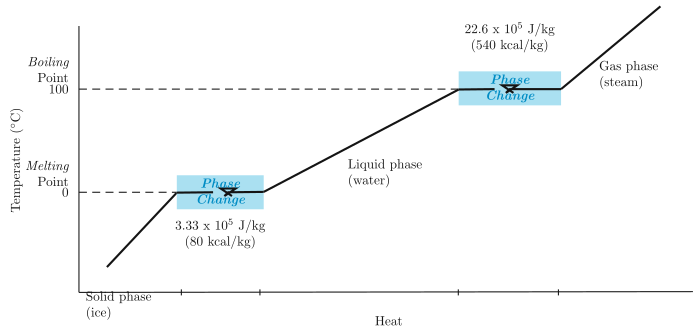
Drawn by us to help you understand the concept clearly, and verified to make sure it's accurate. For exams, practice from your NCERT textbook's own diagram.
The figure plots temperature (in °C) on the vertical axis against heat added (in joules, per unit mass) on the horizontal axis. The temperature scale shows two key horizontal lines: one at 0 °C and one at 100 °C. The heat axis is not drawn to scale — the lengths of the plateaus are chosen for clarity, not for exact proportion.
The curve itself is a series of five distinct segments, read from left to right:
-
Rising ice line — a sloping upward segment where solid ice absorbs heat and its temperature rises from below 0 °C up to 0 °C. The specific heat capacity of ice governs the slope: .
-
Melting plateau — a flat horizontal segment at 0 °C. Here, all added heat goes into breaking the crystal lattice of ice, not into raising temperature. The heat absorbed per unit mass is the latent heat of fusion, . The formula is .
-
Rising water line — a sloping upward segment where liquid water heats from 0 °C to 100 °C. The specific heat capacity of water is , so .
-
Boiling plateau — a flat horizontal segment at 100 °C. Heat now supplies the energy needed to overcome intermolecular forces and turn liquid into vapour, without any temperature change. The latent heat of vaporisation is , and .
-
Rising steam line — a final sloping segment where steam (water vapour) heats above 100 °C, with its own specific heat capacity .
The flat plateaus are the central physical lesson: during a phase change, temperature stays constant even though heat continues to flow. The heat is “hidden” (latent) — it changes the internal potential energy of the substance, not its kinetic energy (which is what temperature measures).
The textbook uses this figure to introduce the two key formulas for phase changes:
where is the heat absorbed or released during a phase change, is the mass of the substance, and is the specific latent heat (in J/kg). For melting/freezing, ; for boiling/condensation, . …