Physics · Ch 11 — Thermodynamics
Heat, Internal Energy and Work
Heat, Internal Energy and Work
The Triad of Thermodynamics: Heat, Internal Energy, and Work
Thermodynamics studies how energy moves and changes form. At its heart lie three quantities that are intimately connected: heat (), internal energy (), and work (). Understanding how these three interact is the foundation of the entire subject.
Heat and work are not "stored" in a system — they are processes, forms of energy transfer across the system boundary. Internal energy, by contrast, is a property of the system itself, a measure of the energy it holds at any given moment.
Heat () and work () are path-dependent quantities — their values depend on how a process is carried out. Internal energy () is a state function — its value depends only on the current state of the system, not on how it got there.
Internal Energy ()
Every thermodynamic system possesses some amount of energy that resides within it. This is the internal energy — the sum of all molecular kinetic energies (translational, rotational, vibrational) and all molecular potential energies (due to intermolecular forces).
For an ideal gas, the internal energy is particularly simple: it depends only on temperature. For a monatomic ideal gas, the internal energy of moles is:
For diatomic or polyatomic gases, the factor changes (more on this when you study kinetic theory), but the key point remains: is a function of temperature alone for an ideal gas.
Internal energy is an extensive property — it scales with the size (mass, number of moles) of the system. If you double the amount of gas, you double its internal energy at the same temperature.
Heat ()
Heat is energy transferred between a system and its surroundings due to a temperature difference. The sign convention is universal in thermodynamics:
- : heat flows into the system (the system gains energy)
- : heat flows out of the system (the system loses energy)
Heat is not a substance that a system "contains." A system does not have "heat" — it has internal energy. Heat is the transfer of that energy.
Work ()
Work is energy transferred between a system and its surroundings by any mechanism other than a temperature difference. In thermodynamics, the most common form is mechanical work done by (or on) a fluid as it expands or contracts.
The sign convention for work:
- : work is done by the system on the surroundings (the system loses energy)
- : work is done on the system by the surroundings (the system gains energy)
Different textbooks use different sign conventions for work. The convention used here (positive = work done by the system) is the one followed by NCERT and most Indian exam syllabi. Always check which convention a problem uses before solving.
Work Done During Volume Change — The Key Derivation
Consider a gas confined in a cylinder fitted with a movable, frictionless piston of cross-sectional area . The gas exerts pressure on the piston. The force on the piston is .
Now let the piston move outward by an infinitesimal distance . The infinitesimal work done by the gas is:
But , the infinitesimal increase in volume of the gas. Therefore:
For a finite change in volume from to , the total work done by the gas is:
This is the fundamental expression for work in thermodynamics.
The value of this integral depends entirely on the path — that is, on how changes with during the process. This is why work is a path-dependent quantity.
Graphical Interpretation of Work
On a - diagram (pressure on the y-axis, volume on the x-axis), the integral has a clear geometric meaning:
- The work done by the system during a process equals the area under the curve on the - diagram, between the initial and final volumes.
If the volume increases (expansion), the area is positive — work is done by the system. If the volume decreases (compression), the area is negative — work is done on the system. …
Drawn by us to help you understand the concept clearly, and verified to make sure it's accurate. For exams, practice from your NCERT textbook's own diagram.
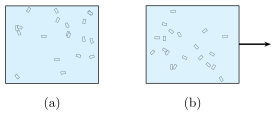
Figure 11.3 makes a single, sharp point: the internal energy of a gas is defined for the gas in its own rest frame. It does not include the kinetic energy of the whole container.
The left panel, (a), shows a box at rest. Inside it, molecules are scattered in all directions. The internal energy of this gas is the sum of two contributions: the random translational, rotational, and vibrational kinetic energies of the molecules, plus the potential energy due to intermolecular forces. Because the box is stationary, there is no bulk motion to worry about — accounts for everything.
The right panel, (b), shows the same box now moving to the right with velocity , indicated by an arrow drawn to the right of the box. The molecules inside are still jostling randomly, but the entire system is also translating. The critical idea is that the kinetic energy of the box as a whole — , where is the mass of the box — is not part of . Internal energy concerns only the energy stored within the system due to its microscopic configuration and random motion, not the energy of its centre-of-mass motion.
Internal energy is a state variable defined in the rest frame of the system. If the system moves as a whole, its bulk kinetic energy is excluded from .
This distinction becomes essential when applying the first law of thermodynamics. The textbook writes the first law as:
where is the heat added to the system and is the work done by the system. Here refers only to the change in internal energy — the change in the sum of molecular kinetic and potential energies. If the system also gains or loses bulk kinetic energy (for example, a gas expanding against a moving piston that itself accelerates), that energy transfer is accounted for separately, not inside . …
Drawn by us to help you understand the concept clearly, and verified to make sure it's accurate. For exams, practice from your NCERT textbook's own diagram.
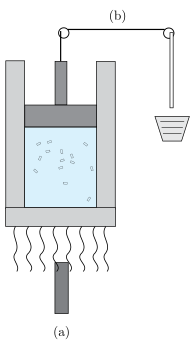
The figure shows a single experimental setup — one gas-filled cylinder fitted with a movable piston — used to illustrate two different ways of changing the state of the same system. A burner sits beneath the cylinder, labelled (a) Heat — the flame transfers energy to the gas purely because the burner is hotter than the gas. Above the cylinder, the piston rod runs up, over two ceiling-mounted pulleys, and down to a hanging weight pan, labelled (b) Work — raising or lowering the pan raises or lowers the piston, compressing or expanding the gas without any temperature difference between the gas and its surroundings.
The core teaching of the diagram is that heat and work are two distinct modes of energy transfer across the boundary of a system. Both can change the internal energy of the gas, but they do so through different mechanisms. Heat requires a temperature difference; work requires a mechanical displacement against a force. The same gas cylinder is the system in both cases — the figure simply isolates each mode, one at the bottom and one at the top of the same setup, to make the distinction clear.
Heat and work are not "forms of energy" stored inside the system. They are path-dependent transfers of energy across the system boundary. A system does not "contain" heat or work; it contains internal energy.
The textbook uses this figure to introduce the first law of thermodynamics. If the gas in the cylinder gains an amount of heat from the burner and does an amount of work on its surroundings (for instance, by expanding and lifting the weight), the change in the gas's internal energy is:
Here:
- is the change in internal energy of the system (the gas). It depends only on the initial and final states, not on how the change occurred.
- is the heat added to the system. By convention, when heat flows into the system (from the burner into the gas).
- is the work done by the system. By convention, when the gas itself expands and pushes back on its surroundings (e.g. lifting the weight); work done on the gas by its surroundings (e.g. the weight being lowered, compressing the gas) counts as negative .
Some other textbooks use the alternative form , where is the work done on the system instead of by it. The NCERT Class 11 text uses the convention shown above: , with positive when work is done by the system. Always check which convention your exam follows — mixing them up is the single most common error in thermodynamics problems.
The figure also reinforces a subtle but crucial point: the piston-and-weight arrangement is a way for the gas to do (or have done on it) mechanical work. If the gas expands slowly and raises the weight, the work done by the gas equals the increase in gravitational potential energy of the weight. For a quasi-static process, the work done by the gas when the piston moves through a small distance is:
…