Physics · Ch 11 — Thermodynamics
Zeroth Law of Thermodynamics
Zeroth Law of Thermodynamics
The Concept of Thermal Equilibrium
Before the Zeroth Law can be stated, you need a clear picture of what "thermal equilibrium" means. Two systems are in thermal equilibrium when they are separated by a diathermic wall — a wall that allows heat to flow through it — and no net heat flows between them. If you place a hot metal block and a cold metal block in contact through a diathermic wall, heat flows from the hot block to the cold one until both reach the same temperature. At that point, the blocks are in thermal equilibrium with each other.
A wall that does not allow heat to flow is called an adiabatic wall. If two systems are separated by an adiabatic wall, they can have different temperatures indefinitely — no heat exchange occurs, and they are not in thermal equilibrium.
The Zeroth Law is called "Zeroth" because it was formulated after the First and Second Laws of Thermodynamics were already established. Physicists realised that this law — establishing the concept of temperature — was logically more fundamental, so it was numbered 0.
The Zeroth Law of Thermodynamics — Statement
The Zeroth Law of Thermodynamics states:
If two systems A and B are each in thermal equilibrium with a third system C, then A and B are in thermal equilibrium with each other.
This statement seems almost trivial, but it is the foundation on which the entire concept of temperature rests. Without it, you could not define a universal property called "temperature" that all systems share when in thermal equilibrium.
Why the Zeroth Law Matters — The Logical Chain
The law allows you to build a thermometer. Here is the reasoning step by step:
-
Take a system C — a mercury-in-glass thermometer, for example. Let it come to thermal equilibrium with a reference system, say a mixture of ice and water at standard atmospheric pressure. Mark the height of the mercury column — that is the "ice point."
-
Now bring the same thermometer C into thermal equilibrium with another reference system — steam above boiling water at standard atmospheric pressure. Mark that height — the "steam point."
-
Divide the length between these two marks into 100 equal divisions. You have now constructed a temperature scale (the Celsius scale) with 0°C at the ice point and 100°C at the steam point.
-
Now, when you place this thermometer C in contact with any unknown system A, wait until C and A reach thermal equilibrium. The mercury column stabilises at some height. You read the corresponding temperature from your scale.
-
The Zeroth Law guarantees that if system A is in thermal equilibrium with C (the thermometer), and system B is also in thermal equilibrium with the same C at the same reading, then A and B are in thermal equilibrium with each other. They share the same temperature.
The Zeroth Law is what makes temperature a measurable and reproducible property. Without it, you could never be sure that two systems at the same thermometer reading are actually in thermal equilibrium with each other.
The Property of Temperature
Temperature is not defined by the Zeroth Law itself — the law simply establishes that a property called temperature exists and is the same for all systems in thermal equilibrium. The formal definition comes later, but the Zeroth Law provides the logical basis:
- Temperature is a thermodynamic coordinate — a measurable property of a system.
- It is intensive — it does not depend on the size or mass of the system.
- Two systems in thermal equilibrium have equal temperatures.
A Common Misconception
Do not confuse "thermal equilibrium" with "mechanical equilibrium." Two systems can be in mechanical equilibrium (no net force between them) without being in thermal equilibrium — for example, a hot gas in a rigid container and a cold gas in another rigid container, separated by an adiabatic wall. The Zeroth Law deals only with thermal equilibrium, which requires a diathermic wall and equal temperatures.
Summary of the Section's Core Ideas
| Concept | Explanation |
|---------|-------------| …
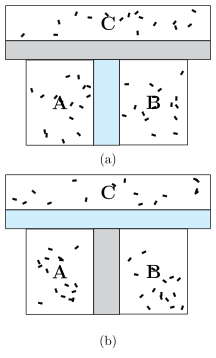
Drawn by us to help you understand the concept clearly, and verified to make sure it's accurate. For exams, practice from your NCERT textbook's own diagram.
The figure is a before-and-after sketch that makes the Zeroth Law of Thermodynamics almost obvious by sight. It shows three systems — A, B, and C — arranged in two different configurations.
In the top panel (a), system C sits above a horizontal conducting wall (grey). Below that wall, systems A and B are separated from each other by a vertical adiabatic wall (blue). So in this first arrangement, C can exchange heat with both A and B, but A and B cannot exchange heat with each other. If you wait long enough, A and B will each come to thermal equilibrium with C — but not necessarily with each other.
In the bottom panel (b), the roles of the walls are swapped. C is now separated from A and B by a horizontal adiabatic wall (blue), while the vertical wall between A and B has been replaced by a conducting wall (grey). Now A and B can exchange heat directly, but neither can exchange heat with C.
The physical point is this: if in panel (a) both A and B are in thermal equilibrium with C (meaning no net heat flows across either conducting wall), then in panel (b) you will find that A and B are already in thermal equilibrium with each other — no heat flows across the conducting wall between them. The figure illustrates that thermal equilibrium is transitive.
The Zeroth Law states: If system A is in thermal equilibrium with system C, and system B is also in thermal equilibrium with system C, then A and B are in thermal equilibrium with each other.
This transitivity is what makes temperature a meaningful concept. Because of it, we can assign a single number — temperature — to each system such that two systems have the same temperature if and only if they are in thermal equilibrium. The figure shows exactly this: in panel (a), A and B each have the same temperature as C; in panel (b), they therefore have the same temperature as each other.
The key formula that emerges from this idea is the definition of temperature through the Zeroth Law:
…