Applied Mathematics · Ch 4 — Integration and Its Application
Definite Integral
Definite Integral
So far we have dealt with indefinite integrals — families of functions differing by a constant . A definite integral, written , is different: it has one fixed numerical value, determined by a lower limit and an upper limit .
One way to make sense of this value is through the area function. If is continuous on , define as the area of the region bounded by the curve , the ordinates at and at the variable point , and the -axis. This connects directly back to differentiation:
First Fundamental Theorem of Calculus: for every .
In other words, the rate at which the area function grows is exactly the height of the curve at that point — differentiating the area function returns the original function. This theorem is what links the geometric idea of "area under a curve" back to anti-derivatives, and leads to the practical rule actually used to evaluate definite integrals:
Second Fundamental Theorem of Calculus: If is any anti-derivative of , then . …
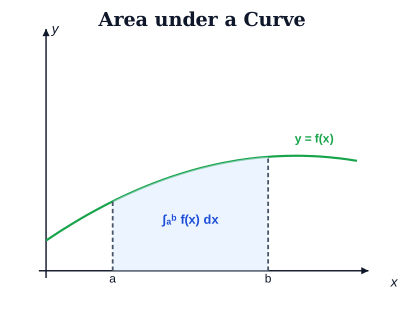
Drawn by us to help you understand the concept clearly, and verified to make sure it's accurate. For exams, practice from your NCERT textbook's own diagram.
The definite integral ∫ₐᵇ f(x) dx equals the shaded area under the curve between x …