Applied Mathematics · Ch 1 — Numbers, Quantification and Numerical Applications
Congruence Modulo
Congruence Modulo
Two positive integers and are said to be congruent modulo if they leave the same remainder when divided by . Formally, and are congruent modulo when either of two equivalent conditions holds: the difference is exactly divisible by , or . This relationship is written using the congruence notation , and it is a natural extension of the modulo operator you've just seen — instead of asking for the remainder of a single number, congruence modulo asks whether two different numbers land on the same remainder when both are divided by .
Raising a congruence to a power
Congruences behave well under exponentiation, which is captured by Property 5:
Property 5: If , then for every positive integer .
This turns otherwise-heavy power calculations into one-line arguments. To find , note that ; raising both sides to the sixth power gives .
Congruence as an equivalence relation
Fix a modulus and relate two integers whenever they are congruent modulo . This relation is an equivalence relation, because it satisfies all three required properties:
- Reflexive: , so for every integer .
- Symmetric: if , then also divides , so forces .
- Transitive: if and , then and are both multiples of , hence so is their sum , giving .
Equivalence classes
Because congruence modulo is an equivalence relation, it partitions the integers into disjoint groups. The equivalence class of an integer collects every integer that leaves the same remainder as :
For , for instance, , and ; these classes never overlap and together cover all the integers. In general there are exactly equivalence classes modulo , namely - one for each possible remainder.
Illustration 6. Take the two positive integers and and divide each by :
Both leave the same remainder, 2. Subtracting (ii) from (i):
and is a multiple of .
Generalising: suppose and are two positive integers that leave the same remainder when divided by a positive integer :
Subtracting (iv) from (iii) gives , so divides , written . Equivalently , which we record with the congruence notation
read as " is congruent to modulo ." For our numbers, .
Illustration 7. Complete Table 6 to verify Property 5: if , then for every positive integer .
| ? | Does ? | ||||||
|---|---|---|---|---|---|---|---|
| 5 | 2 | 3 | Yes () | 3 | Holds true | ||
| 5 | 2 | 3 | Yes () | 5 | Holds true | ||
| 18 | 32 | 7 | Yes () | 2 | Holds true | ||
| 18 | 32 | 7 | Yes () | 4 | Holds true | ||
| 17 | 32 | 5 | Yes () | 3 | Holds true |
Each row confirms the property: whenever and share the same remainder modulo , their -th powers also share the same remainder. (For the last row, even though and look unrelated, and , so and the property applies.)
Activity — sorting the first 50 integers by their remainder . …
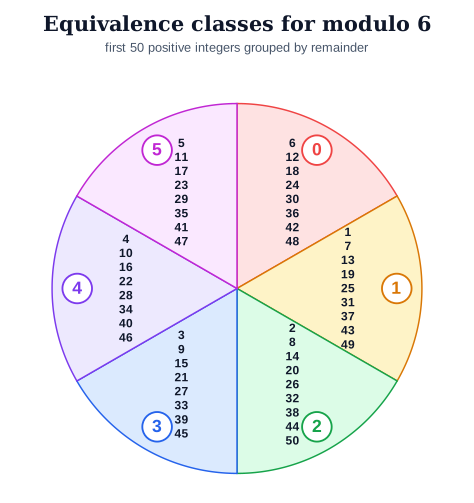
Drawn by us to help you understand the concept clearly, and verified to make sure it's accurate. For exams, practice from your NCERT textbook's own diagram.
The first 50 positive integers split into six equivalence classes by their rema …