Applied Mathematics · Ch 1 — Numbers, Quantification and Numerical Applications
Application of Modulo Arithmetic
Application of Modulo Arithmetic
Modulo arithmetic is not just a classroom idea — because it captures the way many real systems "wrap around" after reaching a fixed size, it shows up across everyday life, mathematics, science and technology.
- Error-detecting checksums. Serial-number identifiers use a check digit computed with modulo arithmetic so that a mistyped digit can be caught automatically. A 10-digit ISBN (International Standard Book Number) uses arithmetic , while the 13-digit ISBN uses . International Bank Account Numbers (IBANs) use arithmetic to flag typing errors before a transfer is processed.
- Computer science. Modular arithmetic underlies bitwise operations and much low-level computation. The "modulo" (or
mod,%) operator built into virtually every programming language and calculator is a direct application of it. - Music. In the twelve-tone equal-temperament system, notes repeat every octave, so pitches are counted using arithmetic .
- Calendars. A week repeats every 7 days, so algorithms that work out the day of the week for any given date rely on arithmetic .
- Beyond STEM. The same wrap-around idea appears in areas such as law (apportionment), economics (game theory) and other social sciences.
Why a clock is the perfect example. On an ordinary wrist watch the hours run and then start again at — the numbers cycle. Suppose it is o'clock and we want the time hours later. Simply adding gives
but there is no "15" on a 12-hour dial. We reduce modulo 12:
…
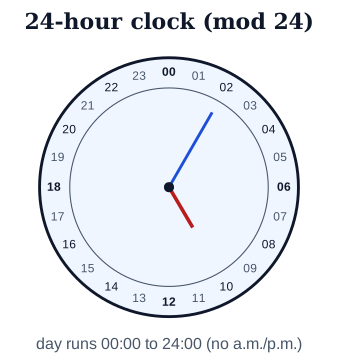
Drawn by us to help you understand the concept clearly, and verified to make sure it's accurate. For exams, practice from your NCERT textbook's own diagram.
A 24-hour clock reads time as hours 00-24 with no a.m./p.m. — modulo 24 arithmetic i …