Business Studies · Ch 1 — Nature and Significance of Management
Functions of Management
Functions of Management
The Five Functions of Management
Management is a continuous process built around five core functions: Planning, Organising, Staffing, Directing, and Controlling. These functions are not performed in isolation — they are deeply interrelated and often overlap in practice. A manager may work on several functions simultaneously, and it is difficult to say where one ends and another begins.
1. Planning
Planning is the function of deciding in advance what is to be done and who is to do it. It involves setting goals and developing a way to achieve them efficiently and effectively.
- Key idea: Planning is about looking ahead. It determines the objectives and the steps needed to reach them.
- Example from the book: In Smita’s organisation, the goal is production and sale of candles. She must decide the quantities, variety, and colour of candles, then allocate resources for purchasing from different suppliers.
- Important point: Planning cannot prevent problems, but it can predict them and prepare contingency plans to deal with them if they occur.
2. Organising
Organising is the management function of assigning duties, grouping tasks, establishing authority, and allocating resources required to carry out a specific plan.
- What it does: Once a plan is set, organising examines the activities and resources needed to implement it. It decides:
- What activities and resources are required
- Who will do a particular task
- Where and when it will be done
- How it works: Tasks are grouped into manageable departments or work units. Authority and reporting relationships are established within the organisational hierarchy.
- Why it matters: Proper organising helps accomplish work and promotes both efficiency of operations and effectiveness of results.
- Note: Different kinds of business require different structures according to the nature of work.
3. Staffing
Staffing is simply stated as finding the right people for the right job. It ensures that the right people with the right qualifications are available at the right places and times to accomplish organisational goals.
- Also known as: The human resource function.
- Activities involved:
- Recruitment
- Selection
- Placement
- Training of personnel
- Example from the book: Infosys Technologies, which develops software, needs systems analysts and programmers — staffing ensures these roles are filled by qualified people.
4. Directing
Directing involves leading, influencing, and motivating employees to perform the tasks assigned to them. It requires establishing an atmosphere that encourages employees to do their best.
- Two key components:
- Motivation: Creating an environment that makes employees want to work.
- Leadership: Influencing others to do what the leader wants them to do.
- Other elements: Directing also involves communicating effectively and supervising employees at work.
- Good directing: A good manager directs through praise and criticism in such a way that it brings out the best in the employee.
5. Controlling
Controlling is the management function of monitoring organisational performance towards the attainment of organisational goals.
- The task involves four steps:
- Establishing standards of performance
- Measuring current performance
- Comparing this with established standards …
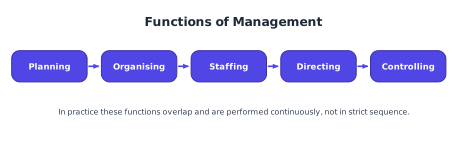
What the Diagram Shows
The diagram presents the five functions of management as a left-to-right flow:
Planning → Organising → Staffing → Directing → Controlling
Each function is shown in a separate box or panel, connected by arrows that point from one to the next. The arrows indicate a sequential order — the order in which these functions are usually discussed in textbooks.
What the Labels Mean
- Planning: Deciding what to do and how to do it in advance.
- Organising: Grouping tasks, assigning duties, and allocating resources to execute the plan.
- Staffing: Finding the right people for the right jobs (recruitment, selection, placement, training).
- Directing: Leading, motivating, and supervising employees to perform their tasks.
- Controlling: Monitoring performance, comparing it with standards, and taking corrective action.
What the Diagram Teaches
The diagram illustrates two key ideas:
-
Theoretical sequence: In a textbook explanation, managers are said to first plan, then organise, then staff, then direct, and finally control. This is the logical order for understanding each function separately.
-
Reality is different: The arrows and the linear flow are not meant to be taken literally. The accompanying text explicitly states that in practice, these functions overlap and are performed simultaneously and continuously. A manager may be controlling while also planning, or directing while organising. The diagram’s linearity is a teaching tool — it helps you learn each function one at a time, but you must remember that real management is interrelated and dynamic.