Informatics Practices · Ch 7 — Project Based Learning
Approaches for Solving Projects
Approaches for Solving Projects
The Core Idea
A project is not just a final product — it is a process. How you choose to build that process determines whether the project succeeds or becomes a mess. The textbook presents three fundamental approaches to structuring project work, followed by a five-step lifecycle that every student team should follow.
Three Approaches to Project Execution
The book identifies three distinct ways to break down and carry out a project:
- Modular approach – The project is split into several manageable modules. Each module has a clearly defined task and a specific set of inputs. When all modules are completed and integrated, they produce the desired final outcome. This is the most structured method and is often the safest for student projects.
- Top-down approach – Work starts from the overall project and moves toward the details. You first define the project's high-level goal and structure, then progressively break it into smaller and smaller modules until you reach tasks simple enough to implement directly. This keeps the big picture in view throughout, which helps when the overall shape of the problem is already well understood.
- Bottom-up approach – Work starts from the smallest, most concrete pieces and builds upward. You first design, build, and test individual low-level components, then combine them into larger sub-modules, and finally assemble the complete project from these tested building blocks. This suits situations where some components already exist or are well understood in isolation, even if the full project design is not yet finalised.
The textbook does not rank these approaches. The choice depends on the nature of the project, the team's experience, and how well the problem is understood at the outset.
The Five Steps of Project-Based Learning
The book presents a clear, sequential process (illustrated in Figure 7.1 of the NCERT text). Every student team should work through these steps in order.
1. Identification of a Project
The project idea must come from a real-life situation. For example, you might decide to build a system for organising a seminar. Before proceeding, you must understand two things: the usefulness of the project (why does it matter?) and its impact (what difference will it make?). The book specifically encourages students to take up interdisciplinary projects — those that cross subject boundaries — because they reflect real-world problems more accurately.
2. Defining a Plan
Most projects involve multiple members. The first task is to identify one project leader. Then, the roles of the leader and every other member must be clearly defined. Each student must be assigned specific activities. The team must also know what tools are available to execute those activities. A practical tip from the book: to arrive at a better solution, always think about extreme situations — what happens at the boundaries of your design?
3. Fixing a Time Frame and Processing
Every project has a time relevance — it must be completed within a deadline. Students must understand that each activity takes a certain amount of time. The project must be well structured, but at the same time, its time frame must be flexible. Rigid deadlines that allow no room for adjustment often lead to failure. The balance between structure and flexibility is key.
4. Providing Guidance and Monitoring
At some point, participants will get stuck. The book acknowledges this directly: "many times, the participants in the project get stuck up with a particular process and it becomes impossible to proceed further." When this happens, guidance can come from three sources:
- Books
- Websites
- Experts in the field
Monitoring is a shared responsibility. The project leader must ensure the project stays on track, and the guide teacher also helps monitor progress. This is not a one-person job.
5. Outcome of a Project
The outcome must be thoroughly understood. It can be single (one clear result) or multiple (several results from the same project). Once produced, the output should be peer reviewed — examined by other students or team members — and then modified based on feedback from the guide teacher or other users. This feedback loop is what turns a good project into a great one.
A Quick Reference Table …
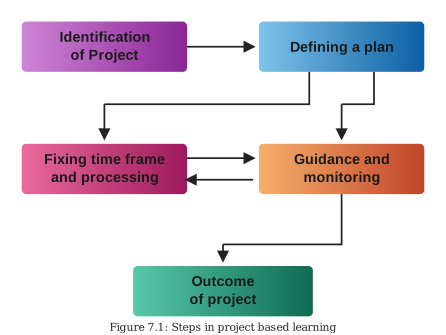
Drawn by us to help you understand the concept clearly, and verified to make sure it's accurate. For exams, practice from your NCERT textbook's own diagram.
Figure 7.1 'Steps in project based learning' is a 5-box flowchart: Identification of Project flows into Defining a plan; from there, two parallel boxes — Fixing time frame and processing and Guidance and monitoring — connect to each other with bidirectional arrows; both fl …