Physical Education · Ch 2 — Children and Women in Sports
Bow Legs
Bow Legs
Meaning and Definition
Bow legs, medically termed Genu Varum, is a postural deformity of the lower limbs in which the knees remain widely separated when the ankles are brought together while standing. In a normal standing posture, the knees and ankles should touch each other with the legs straight. In bow legs, the tibia (shin bone) and femur (thigh bone) curve outward, creating a visible gap between the knees.
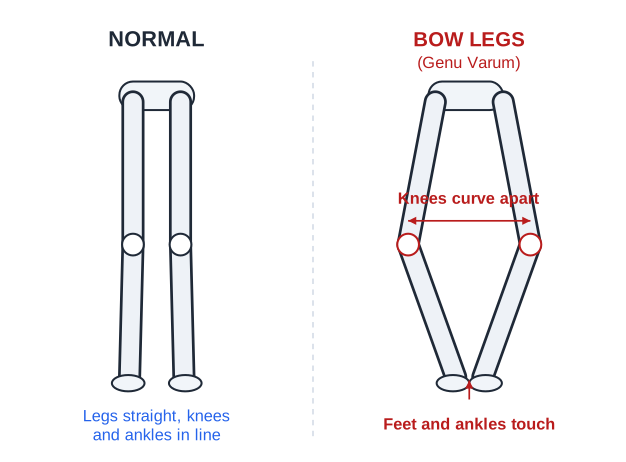
Drawn by us to help you understand the concept clearly, and verified to make sure it's accurate. For exams, practice from your NCERT textbook's own diagram.
A front view of the two leg bones in which the legs bow outward at the knees while the ankles and feet come together, resembling an archer's bow - the classic Bow Legs / Genu Varum shape. It is the mirror …
The condition is most easily observed when a person stands with feet together — the ankles touch, but the knees do not. The legs take on a bowed or arched appearance, resembling the shape of a bow used in archery, which gives the deformity its common name.
In a normal standing posture, the medial malleoli (inner ankle bones) and the medial condyles of the femur (inner knee points) should touch simultaneously. In Genu Varum, the ankles touch but the knees remain apart — this is the defining diagnostic feature.
Recognition and Testing
The standard clinical test for bow legs is straightforward and can be performed without any equipment.
Procedure:
- The individual stands barefoot on a flat surface with feet together and legs straight.
- The examiner observes the position of the knees relative to the ankles.
- The distance between the inner surfaces of the knees is measured.
Interpretation:
- If the ankles touch and the knees also touch, the alignment is normal.
- If the ankles touch but the knees remain separated by a gap, bow legs is present.
- The severity is graded by the width of the gap between the knees — a larger gap indicates a more pronounced deformity.
A small degree of bowing is normal in infants and toddlers up to about 2 years of age. This typically corrects itself as the child begins walking and the leg bones remodel. Persistent bowing beyond age 3-4, or bowing that worsens, requires attention.
Causes
Bow legs can develop from multiple factors, and understanding the cause is essential for selecting the correct treatment approach.
Nutritional Causes:
- Vitamin D deficiency — This is the most common cause. Vitamin D is essential for calcium absorption in the intestines. Without adequate vitamin D, the body cannot mineralise bone properly, leading to soft, weak bones (a condition called rickets in children). The softened weight-bearing bones of the legs bend outward under the body's weight.
- Calcium deficiency — Even with sufficient vitamin D, inadequate dietary calcium prevents proper bone hardening. The bones remain soft and deform under load.
- Combined deficiency — Often, vitamin D and calcium deficiencies occur together, compounding the problem.
Developmental and Mechanical Causes:
- Premature weight-bearing — Putting an infant on their feet before the leg bones are strong enough to support body weight can cause bowing.
- Improper sitting postures — Habitually sitting in a W-position (knees bent, feet splayed outward to the sides) or with feet turned outward can contribute to the deformity.
- Rapid growth spurts — During periods of fast growth, if nutrition does not keep pace, the bones may not mineralise adequately.
Pathological Causes:
- Blount's disease — A growth disorder of the tibia that affects the inner part of the growth plate, causing progressive bowing. This is more common in children who start walking early and in those who are overweight.
- Rickets — The bone-softening disease caused by vitamin D deficiency, as described above.
- Arthritis — In adults, osteoarthritis of the knee can wear down the inner compartment of the joint, gradually producing a varus (bow-legged) alignment.
| Cause Category | Specific Cause | Mechanism |
|----------------|----------------|-----------|
| Nutritional | Vitamin D deficiency | Reduced calcium absorption → soft bones → bending under weight |
| Nutritional | Calcium deficiency | Inadequate bone mineral → soft bones → bending under weight |
| Developmental | Premature weight-bearing | Immature bones unable to support load |
| Developmental | Improper sitting postures | Sustained abnormal alignment during growth |
| Pathological | Blount's disease | Abnormal growth plate on inner tibia |
| Pathological | Rickets | Generalised bone softening from vitamin D deficiency |
Problems Created for Movement and Sport
Bow legs significantly impair movement efficiency and increase injury risk in physical activity and sport.
Biomechanical Problems:
- Abnormal weight distribution — Body weight is transferred through the outer edge of the foot rather than being distributed evenly across the sole. This shifts the centre of pressure laterally.
- Reduced shock absorption — The normal alignment of the knee joint allows the leg to act as a spring during walking and running. In bow legs, the misalignment reduces the knee's ability to absorb impact forces, transmitting more shock up the leg to the hip and spine.
- Altered gait pattern — The individual walks with a waddling or rolling gait, often with the feet turned inward to compensate. This is inefficient and consumes more energy.
Sport-Specific Problems:
- Running and jumping — The lateral shift of weight increases stress on the outer knee ligaments (lateral collateral ligament) and the outer meniscus. Repeated impact can lead to ligament sprains and meniscal tears.
- Balance and stability — The reduced base of support and altered weight distribution make it harder to maintain balance during dynamic movements. This is particularly problematic in sports requiring quick direction changes, such as basketball, football, and tennis.
- Foot problems — The abnormal weight distribution often leads to flat feet (pes planus), ankle instability, and calluses on the outer edge of the foot.
- Joint pain — Chronic stress on the knee joint can cause pain in the outer knee, and compensatory changes can lead to hip and lower back pain.
| Activity | Specific Risk |
|----------|---------------|
| Long-distance running | Lateral knee pain, IT band syndrome |
| Jumping sports | Lateral meniscus injury, ankle sprains |
| Contact sports | Increased risk of knee ligament injury |
| Gymnastics | Difficulty maintaining alignment in landings |
Corrective Measures
Correction of bow legs requires a multi-pronged approach addressing both the underlying cause and the mechanical deformity.
Nutritional Correction:
- Vitamin D supplementation — As prescribed by a physician. The typical dose for deficiency is 600-2000 IU daily for children, but the exact dose depends on the severity of deficiency and should be determined by blood tests.
- Calcium-rich diet — Include milk, yoghurt, cheese, leafy green vegetables, ragi (finger millet), and fortified foods.
- Sunlight exposure — 15-20 minutes of sunlight on the face and arms in the morning (before 10 AM) helps the skin synthesise vitamin D naturally.
- Dietary sources of vitamin D — Egg yolks, fatty fish (salmon, mackerel), liver, and fortified milk.
| Nutrient | Function | Sources |
|----------|----------|---------|
| Vitamin D | Enhances calcium absorption from intestines | Sunlight, egg yolks, fatty fish, fortified milk |
| Calcium | Provides hardness to bone mineral | Milk, curd, cheese, ragi, leafy greens, almonds |
Postural and Mechanical Correction:
- Avoiding aggravating postures — Do not sit in the W-position. Sit cross-legged or with legs straight.
- Proper footwear — Shoes with good arch support and a firm heel counter help align the foot and reduce stress on the knees.
- Weight management — Excess body weight increases the load on the legs and worsens the deformity. Maintaining a healthy weight reduces the bending force on the bones.
Medical Intervention (for severe cases):
- Bracing — In children with progressive bowing, a knee-ankle-foot orthosis (KAFO) may be prescribed to guide bone growth into proper alignment.
- Surgery — For severe, persistent cases (especially Blount's disease), osteotomy (cutting and realigning the bone) may be necessary. This is rare and only considered after growth is complete or if the deformity is causing significant functional problems.
Corrective Exercises
Exercises for bow legs aim to strengthen the muscles that pull the knees inward and stretch the tight structures on the outer side of the legs.
Walking on the Inner Edge of the Feet
This exercise retrains the foot and ankle to bear weight on the inner side, counteracting the lateral weight shift.
Procedure:
- Stand with feet hip-width apart.
- Roll the weight onto the inner edges of both feet, lifting the outer edges slightly off the ground.
- Walk forward slowly, maintaining this position for 10-15 steps.
- Rest and repeat 3-4 times.
How it works: By forcing the foot to bear weight on its inner edge, this exercise strengthens the invertor muscles of the foot (tibialis posterior) and encourages the lower leg to align more vertically. Over time, this helps reduce the outward bowing of the tibia.
| Exercise | Sets/Reps | Frequency |
|----------|-----------|-----------|
| Walking on inner edge | 3-4 sets of 10-15 steps | Twice daily |
| Hold time per step | 2-3 seconds | — |
Ardha Chakrasana (Half Wheel Pose)
This yoga asana stretches the entire front of the body and strengthens the legs, particularly the inner thigh muscles.
Procedure:
- Stand straight with feet together.
- Raise both arms overhead.
- Slowly bend backward from the upper back, keeping the hips forward and legs straight.
- Look up at the hands.
- Hold for 10-15 seconds, breathing normally.
- Return to the starting position slowly.
- Repeat 3-4 times.
How it works: Ardha Chakrasana stretches the quadriceps and hip flexors, which are often tight in bow legs. The backward bend also opens the chest and improves spinal flexibility. The leg muscles are engaged isometrically, strengthening the inner thigh muscles (adductors) that help pull the knees together.
| Common Mistake | Correction |
|----------------|------------|
| Bending from the lower back | Bend from the upper back/thoracic spine |
| Letting knees bend | Keep legs straight throughout |
| Holding breath | Breathe normally — inhale while raising arms, exhale while bending back |
Garudasana (Eagle Pose)
This balancing pose strengthens the legs and improves alignment of the lower limbs.
Procedure:
- Stand straight with feet together.
- Bend the right knee slightly and wrap the left leg around the right leg, hooking the left foot behind the right calf.
- Extend both arms forward, cross the right arm over the left, and bend the elbows to bring the palms together.
- Hold the position for 15-20 seconds, maintaining balance.
- Slowly unwind and repeat on the opposite side.
- Perform 2-3 rounds on each side.
How it works: Garudasana requires the legs to be wrapped tightly together, which actively engages the adductor muscles of both thighs. This strengthens the muscles that pull the knees inward, directly counteracting the outward bowing. The pose also improves balance and proprioception, helping the individual develop better awareness of leg alignment.
| Variation | Difficulty | Benefit |
|-----------|------------|---------|
| Full Garudasana (legs wrapped) | Advanced | Maximum adductor engagement | …