Physical Education · Ch 1 — Management of Sporting Events
Procedure to Draw League or Round Robin Fixture
Procedure to Draw League or Round Robin Fixture
In a league or round robin tournament every team plays each of the other teams once, so the fixture must pair up all the teams systematically.
Step 1 - Find the total number of matches. With n teams:
Total number of matches = n(n - 1) / 2
For 6 teams: 6(6 - 1) / 2 = 30 / 2 = 15 matches. For 7 teams: 7(7 - 1) / 2 = 42 / 2 = 21 matches.
Step 2 - Fix the teams using one of two methods.
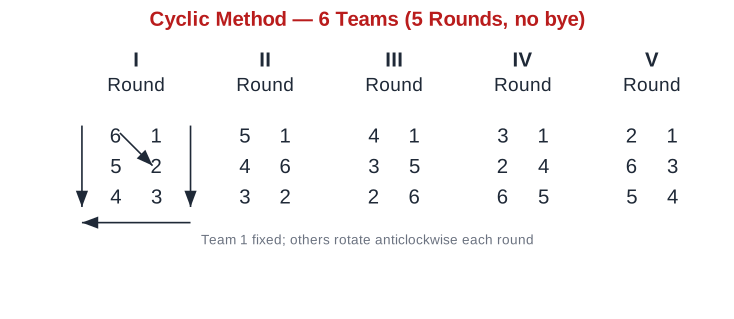
Cyclic Method. One team is kept fixed in its position while the others rotate around it, moving one place each round, until the cycle is complete. Two situations arise:
- Even number of teams: no bye is needed, and the number of rounds = number of teams - 1. For 6 teams, rounds = 6 - 1 = 5.
Drawn by us to help you understand the concept clearly, and verified to make sure it's accurate. For exams, practice from your NCERT textbook's own diagram.
Five rounds of pairings drawn by the cyclic method for six teams, team 1 fixed and the rest rotating. Round I: 6-1, 5-2, 4-3; Round II: 5-1, 4-6, 3-2; Round III: 4-1, 3-5, 2-6; Round IV: 3-1, …
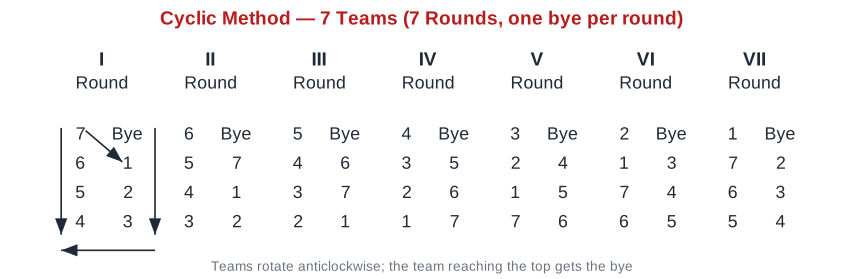
- Odd number of teams: one team takes a bye in each round (a different team every round), and the number of rounds equals the number of teams. For 7 teams, rounds = 7.
Drawn by us to help you understand the concept clearly, and verified to make sure it's accurate. For exams, practice from your NCERT textbook's own diagram.
Seven rounds of pairings by the cyclic method for seven teams; a different team takes a bye each round. Round I: 7-Bye, 6-1, 5-2, 4-3; Round II: 6-Bye, 5-7, 4-1, 3-2; Round III: 5-Bye, 4-6, 3-7, 2-1; Round IV: 4-Bye, 3-5, 2-6, 1-7; Round V: 3-Bye, 2-4, 1-5, 7-6; Round VI: 2-By …
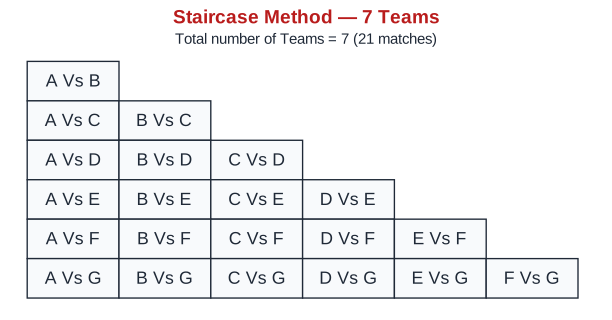
Staircase Method. The teams are arranged like a descending staircase. The team on the top step is paired with every other team; the team on the next step down is then paired with all the teams below it, and so on until every possible pairing has been listed. This method never needs a bye and works the same way whether the number of teams is odd or even. The staircase for 7 teams (A to G) is shown below.
Drawn by us to help you understand the concept clearly, and verified to make sure it's accurate. For exams, practice from your NCERT textbook's own diagram.
A descending staircase of all round-robin pairings for seven teams: A vs B; A vs C, B vs C; A vs D, B vs D, C vs D; A vs E, B vs E, C vs E, D vs E; A vs F, B vs F, C vs F, D vs F, E vs F; A vs G, B v …
Once the pairings are fixed, the organising committee records each match on a schedule such as the one below, entering the date, time and venue before the tournament.
Details of Matches
| Match No. | Team A vs Team B | Date | Time | Venue | Result |
|---|---|---|---|---|---|
Step 3 - Decide the winner on points. In a league the winner and the full merit order are decided by points, not by elimination. A common scheme is Win = 5, Draw = 3, Loss = 0. After all matches, the points are totalled and the teams are ranked. A sample points tally for 6 teams (A to F) is shown below.
| S. No. | Team | Matches Played | Won | Lost | Drawn | Total Points | Ranking |
|---|---|---|---|---|---|---|---|
| 1 | A | 5 | 4 | 0 | 1 | 23 | I |
| 2 | B | 5 | 3 | 1 | 1 | 18 | II |
| 3 | C | 5 | 1 | 2 | 2 | 11 | IV |
| 4 | D | 5 | 0 | 4 | 1 | 3 | V |