Physical Education · Ch 7 — Physiology and Injuries in Sports
Effect of Exercise on Muscular System
Effect of Exercise on Muscular System
Exercise is a series of sustained muscle contractions, either long or short depending on the nature of the activity. The effects of these contractions on the muscles can be grouped into two kinds: short-term (immediate) effects, felt during and shortly after exercise, and long-term (lasting) effects, which build up with regular training.
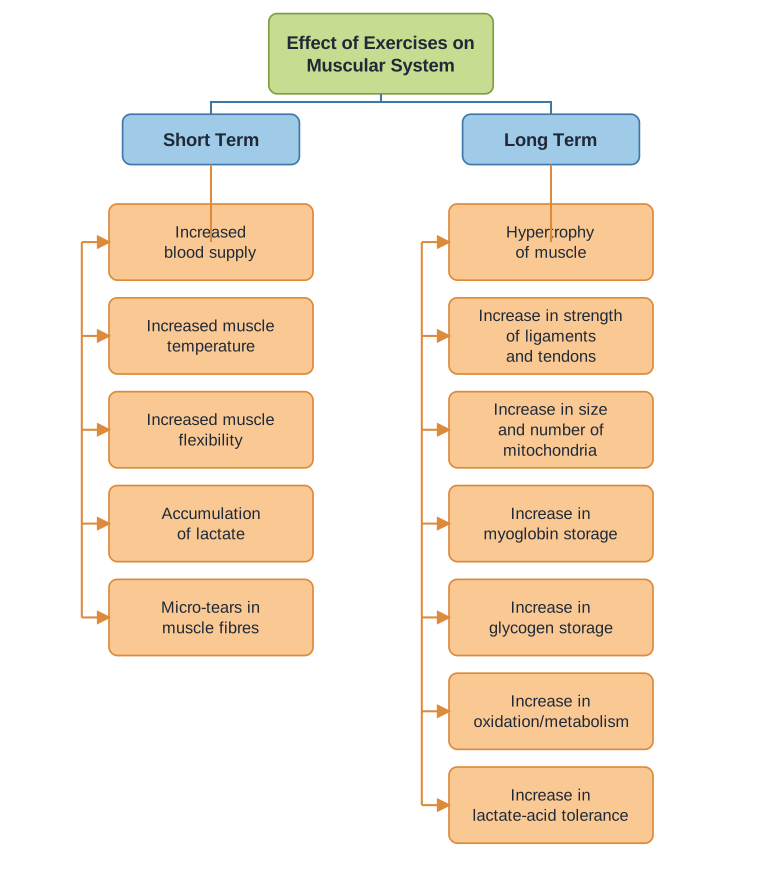
Drawn by us to help you understand the concept clearly, and verified to make sure it's accurate. For exams, practice from your NCERT textbook's own diagram.
A flow diagram headed 'Effect of Exercises on Muscular System' (green parent box). It branches into two blue category boxes. 'Short Term' branches to five orange boxes: Increased blood supply; Increased muscle temperature; Increased muscle flexibility; Accumulation of lactate; Micro-tears in muscle fibres. 'Long term' branches to seven orange boxes: Hypertrophy of muscle; Increase in strength of ligaments and tendons; Increase in size and number of mitochondria; Increase in myoglobin storage; Increase …
Short-term effects of exercise on the muscular system
- Increased blood supply — To match the muscles' rising demand for fuel, the supply of blood increases, either across the whole body or in the particular muscle group doing the work.
- Increased muscle temperature — Contracting muscles generate a great deal of heat as they produce energy, raising the temperature of the muscles and of the body.
- Increased muscle flexibility — The greater blood flow and higher temperature increase the elasticity of the muscles; stretching and mobility work add to this effect.
- Accumulation of lactate — When blood cannot supply enough oxygen to the working muscles, lactic acid builds up, causing pain and soreness.
- Micro-tears in muscle fibres — The stress of exercise creates tiny tears in the muscle fibres. The body repairs them and makes the fibres larger, a growth process known as hypertrophy.
Long-term effects of exercise on the muscular system
- Hypertrophy of muscle — Systematic training thickens the muscle fibres, increasing overall muscle size.
- Increased strength of ligaments and tendons — Regular exercise strengthens bones, ligaments and tendons, helping to prevent injury and improve performance.
- Increase in size and number of mitochondria — Aerobic training raises both the size and the number of mitochondria, so the muscles take in more oxygen and produce more ATP and energy.
- Increased myoglobin storage — Aerobic training increases the store of myoglobin, which carries oxygen to the mitochondria; more myoglobin means more oxygen and therefore more energy.
- Increased glycogen storage — Regular exercise raises the amount of glycogen stored in the muscles and liver, which can supply continuous energy for roughly 90 to 120 minutes.
- Increase in oxidation / metabolism — Endurance training raises the muscles' capacity to oxidise fat by increasing mitochondrial density, so metabolism increases to meet the higher energy demand. …
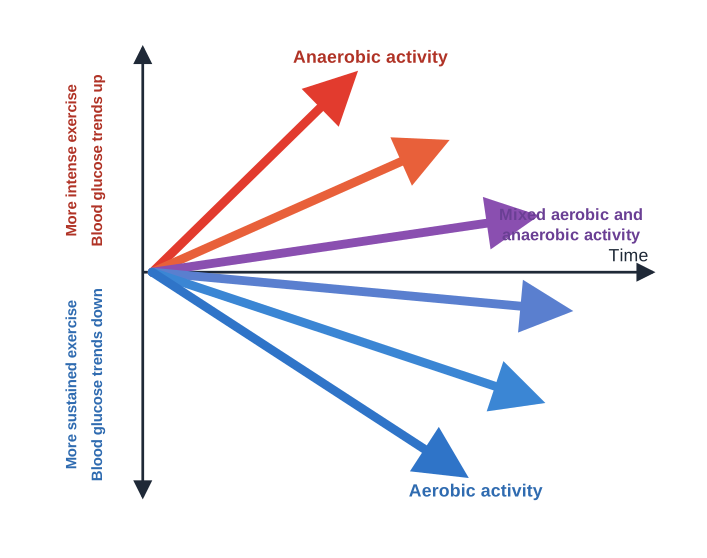
Drawn by us to help you understand the concept clearly, and verified to make sure it's accurate. For exams, practice from your NCERT textbook's own diagram.
A concept chart with a vertical intensity axis and a horizontal Time axis. The vertical axis is labelled, from top to bottom: 'More intense exercise / Blood glucose trends up' at the top and 'More sustained exercise / Blood glucose trends down' at the bottom. A fan of arrows spreads out from the axis origin, coloured in a gradient from red at the top to blue at the bottom. The top red arrows point to 'Anaerobic activity'; the middle purple arrow points to 'Mixed aerobic and anaerobic activity'; the lower blue arrows point to 'Aerobic activity'. Drawn as our ow …