Physical Education · Ch 6 — Test and Measurement in Sports
Foot Up and Go
Foot Up and Go
Foot Up and Go
- Purpose: to determine physical mobility - power, speed, agility and balance.
- Objective: to stand up and walk about 16 feet (out and back) and sit again as fast as possible, without running.
- Equipment: a straight-back chair without arms, a cone, and a stopwatch.
Procedure
The chair is placed where it stays stable. The participant sits with both feet on the floor. On the command "Go" the person walks as fast as possible (not running) to and around a cone placed 8 feet away from the chair, then returns and sits down. There must be enough space around the cone to allow an easy turn.
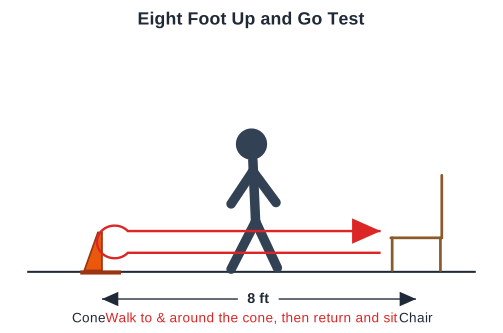
Drawn by us to help you understand the concept clearly, and verified to make sure it's accurate. For exams, practice from your NCERT textbook's own diagram.
A line drawing of the eight foot up and go test. A straight-back armless chair is on the left; a cone stands 8 feet to the right. An older adult is shown rising from the chair and walking to and around the cone, with a curved path arrow showing the route out, around the cone, and back to the chair. The fa …
Scoring
Two attempts are made and the best (fastest) score is recorded. The time is measured from the command "Go" until the participant returns and sits back on the chair.
The heading reads "Foot Up and Go"; the unit overview calls it the Eight Foot Up and Go test and the norms table lists it as "8-Ft Up-&-Go" - the "8 feet" refers to the distance to the cone.
Why It Matters (Physiological Rationale)
This is the only item in the Rikli and Jones battery that combines several fitness components in one movement: standing up (lower-body power), walking quickly (speed), turning around the cone (agility and dynamic balance) and sitting back down under control (balance again). Because real falls most often happen during exactly this kind of multi-step transitional movement, rather than during a single isolated action, the Eight Foot Up and Go Test is considered one of the strongest simple predictors of fall risk in the whole battery.
Benefits of Regular Testing
- Gives a single composite score that reflects everyday functional mobility better than any one single-component test on its own.
- Is widely used in clinical and community settings as a quick fall-risk screening tool for older adults.
- Taking the best of two attempts reduces the chance that an unfamiliar first attempt unfairly lowers the recorded score.
Common Mistakes & Precautions
- Allowing the participant to run rather than walk quickly; running invalidates the controlled, functional nature of the test and also raises fall risk.
- Placing the cone too close to a wall or obstacle, leaving no room for an easy turn, which can cause a stumble.
- Using a chair with wheels, arms, or an unstable base, instead of a stable straight-back chair without arms. …