Physical Education · Ch 10 — Training in Sports
Strength
Strength
Strength is one of the most important motor components of fitness and plays a major role in sport, because it is a direct product of muscular contraction. It is a conditional ability that depends on the process of energy liberation in the muscles. Put simply, strength is the force a group of muscles can produce to overcome resistance. Since every movement in sport is caused by muscular contraction, strength is bound up with all motor abilities, technical skills and tactical actions.
Definitions
- H. Singh: strength is the ability to overcome resistance or to act against resistance.
- Barrow and McGee: strength is the capacity of the whole body, or any of its parts, to exert force.
- Mathews: the force that a muscle or group of muscles can exert against a resistance in one maximum effort.
Different sports demand different kinds of strength. Commonly it is classified into two broad forms — static and dynamic — as shown below.
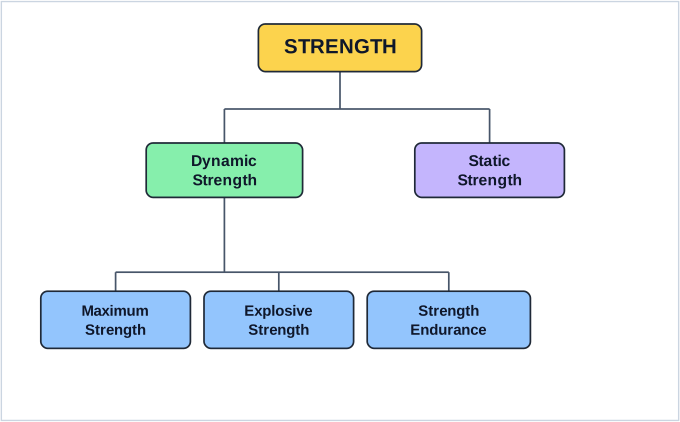
Drawn by us to help you understand the concept clearly, and verified to make sure it's accurate. For exams, practice from your NCERT textbook's own diagram.
A top-down tree. 'STRENGTH' at the top splits into 'Dynamic Strength' and 'Static Strength'. 'Dynamic Strength' branches down into three boxes: 'Maximum Strength', 'Explosive Str …
Static Strength
Also called isometric strength, this is the ability of the muscles to act against resistance without visible movement. It can be measured with a dynamometer. It is not usually applied directly in sport but appears in phases of events such as weightlifting. Examples: holding a plank or a yoga asana.
Dynamic Strength
Also known as isotonic strength, this is used in movements such as pull-ups and push-ups. During such work there is a diminishing tendency — after some time the muscles refuse to do more and not even one extra repetition is possible. Movement is clearly visible, produced by rhythmic muscular contractions with changes in muscle length using a relatively small force. Examples: push-ups and full squats. Dynamic strength is divided into three parts:
- Maximum Strength — the ability to overcome maximum resistance in a single contraction, exerting force against resistance in one maximal effort. It is not important in most sports but is essential where heavy resistance must be tackled, such as long jump, shot put, javelin throw, weightlifting and discus throw.
- Explosive Strength — the ability to overcome resistance as fast as possible; in effect, a combination of strength and speed. It is strongly influenced by inter- and intra-muscular coordination and is used in actions like volleyball spiking, basketball jumps and sprint events.
- Strength Endurance — the ability to overcome resistance under fatigue, for as long as possible; a product of strength and endurance. It can be static or dynamic depending on whether the movement is isometric or isotonic, and it is used in long-distance running, swimming and distance cycling.
Note
Different training goals call for different loads. The textbook summarises this in a load-to-goal table:
| Goal | Frequency (times/wk) | Intensity (% RM) | Volume | Rest |
|---|---|---|---|---|
| Power | 1-2 | 30-60 | 3-6 reps, 3-6 sets | 2-5 min |
| Strength | 3-5 | > 85 | 2-6 reps, 2-5 sets | 2-3 min |
| Hypertrophy | 4-6 | 67-85 | 6-12 reps, 3-6 sets | 30-90 s |
| Endurance | 5-7 | < 65 | 15-25 reps, 2-3 sets | < 30 s |
Adjusting training load to training goals.
Methods to Develop Strength
Strength is highly trainable, and specific methods help an athlete build it:
- Isometric Exercise — exercises with no visible movement, so the work cannot be observed directly (for example, pushing against a wall: force is exerted but the wall does not move). There is no change in muscle length, which is why they are called 'iso-metric'. They need little time or equipment, can be done almost anywhere, and are valuable for maintaining strength during injury; done regularly they may change muscle size and shape.
- Isotonic Exercise — exercises in which movement is clearly visible, producing toned muscles and increased muscle length. This is considered the best method to develop strength. Examples include running and jumping on the spot, weight-training exercises and calisthenics.
- Isokinetic Exercise — introduced by J.J. Perrine in 1968, this uses a special form of contraction (isokinetic contraction) on specially designed machines, as in rowing and swimming. Here the muscles apply maximal force throughout the whole range of motion, unlike isotonic contraction where force is applied at a particular angle. Its use is limited, so its contribution to developing strength is still to be scientifically proved.
Preventive measures in strength training
Because strength training carries a high risk of injury, supervision is essential. The key precautions are:
- Always train after a proper warm-up.
- Ensure strong, stable joints first through general, low-intensity strength work.
- Use correct technique with heavy weights, or serious injury can result.
- Include a variety of exercises, preferably working agonist and antagonist muscles one after the other. …