Physical Education · Ch 3 — Yoga as Preventive Measure for Lifestyle Disease
Gomukhasana
Gomukhasana
The name Gomukhasana comes from the Sanskrit words Go, meaning cow, and Mukha, meaning face or mouth. The asana gets its name because the folded thighs and calves of the person performing it resemble a cow's face - wide at one end and tapering towards the other.
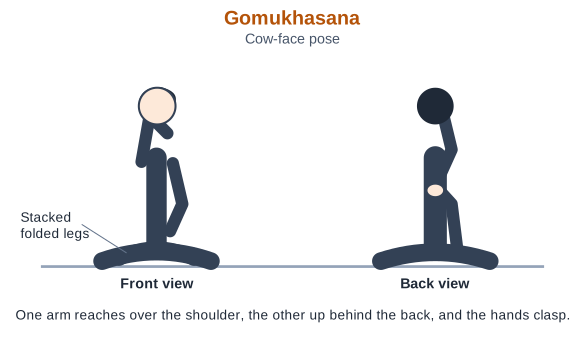
Drawn by us to help you understand the concept clearly, and verified to make sure it's accurate. For exams, practice from your NCERT textbook's own diagram.
Two side-by-side line drawings of the same seated posture. The left panel is a front view showing the stacked folded legs; the right panel is a back view showing one arm reaching down over the shoulder and the other coming up behind the back so the hands clasp between the sho …
Technique
- Sit on the floor with the legs extended and the spine straight.
- Place the palms on the floor, bend the left leg at the knee and place the left foot below the right hip, raising the body a little and sitting on the left foot with the ankle and toes tucked deep inside.
- Bend the right leg at the knee and place the right thigh over the left thigh, bringing the right foot close to the left hip on the floor.
- Stretch the left arm above the shoulder and head, then bend it and place the left palm on the back, close to the shoulder blade.
- Raise the right arm and take it behind the back from below, bending at the elbow, and try to reach and clasp the left palm. Once comfortable, hold the clasp and feel the stretch in the shoulders and elbows.
- Gradually pull the palms closer, bring the chest out and raise the upper body, keeping the neck in line with the shoulders and chest rather than bending it forward.
- Feel the stretch at the thighs, knees, chest, abdomen, shoulders, arms, neck and elbows.
- Hold for a few breaths and slowly release, then relax by stretching the legs out in front and bringing the arms down.
- Repeat the whole process on the other side, reversing the position of the legs and arms.
Breath Awareness
- Inhale as you cross the legs and settle into the asana; exhale completely while expanding the spine.
- Inhale again as you bring the arms behind the back.
- Exhale while taking the other arm from below to hold the palms.
- With every exhalation, stretch deeper into the asana, and loosen the body with each inhalation.
Benefits
- The hamstring stretch helps gain flexibility.
- Enables greater flexibility of the hip joint.
- Stretches and tones the muscles of the chest.
- Increases the blood supply to the legs and arms.
- The flexion of the knee joint can help heal certain kinds of knee weakness (provided there is no ligament tear).
- Improves the functioning of the abdominal organs and digestion.
- Burns excess fat around the tummy and tones the entire torso.
- Strengthens the biceps and triceps and increases flexibility of the shoulders and upper arms. …