Chemistry · Ch 8 — Aldehydes, Ketones and Carboxylic Acids
Chemical Reactions
Chemical Reactions
Aldehydes and ketones both carry the carbonyl group, , as their functional group, and this shared group is why the two classes undergo largely parallel chemistry. Everything that follows traces back to one structural fact: the carbonyl carbon is hybridised, planar, and strongly polarised, with oxygen pulling electron density toward itself. That single feature governs nearly every reaction discussed below.
1. Nucleophilic Addition Reactions
Alkenes, which also have a planar, -bonded carbon framework, characteristically undergo electrophilic addition — their electron-rich double bond attracts electrophiles. The carbonyl double bond behaves in the opposite sense. Because oxygen is far more electronegative than carbon, the bond is strongly polarised: the carbon end carries a partial positive charge () and is electron-deficient, while the oxygen end carries a partial negative charge (). This makes the carbonyl carbon an electrophilic centre, and it is therefore attacked preferentially by electron-rich species — nucleophiles. Aldehydes and ketones thus characteristically undergo nucleophilic addition reactions, the defining reaction type of the carbonyl group.
(i) Mechanism of Nucleophilic Addition
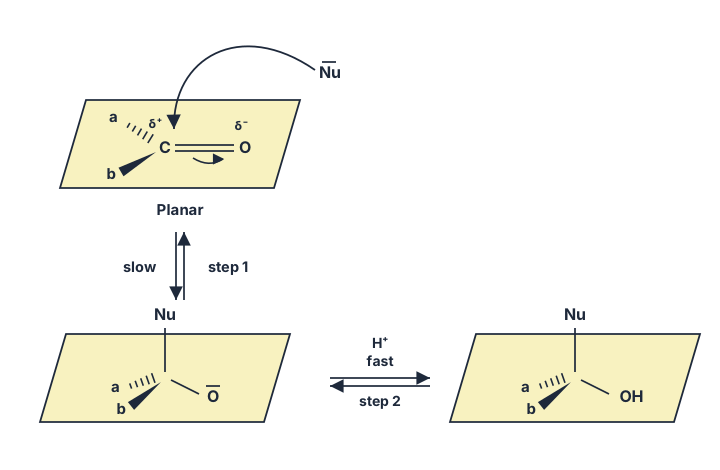
Before addition, the carbonyl carbon is hybridised and, together with the two atoms/groups attached to it and the oxygen, lies in one plane. A nucleophile does not approach this planar carbon from directly above or below the plane; instead, it attacks from a direction roughly perpendicular to the plane of the orbitals (the geometry is set by the need for the incoming nucleophile's lone pair to overlap correctly with the emptying orbital of the carbonyl — shown schematically in fig-8-2 of this chapter). As the nucleophile bonds to carbon, the carbon's hybridisation changes from to , and the -electrons of the bond are pushed entirely onto oxygen. This generates a negatively charged, tetrahedral alkoxide intermediate.
This addition step (step 1) is the slow, rate-determining step of the overall reaction. The alkoxide intermediate is basic and rapidly (step 2) picks up a proton — typically from the solvent or reaction medium — to give a neutral, tetrahedral addition product bearing an group in place of the original .
Drawn by us to help you understand the concept clearly, and verified to make sure it's accurate. For exams, practice from your NCERT textbook's own diagram.
The figure shows the nucleophilic addition mechanism for a carbonyl compound () in three sequential frames, illustrating how the planar carbonyl carbon becomes tetrahedral.
Frame 1: The planar carbonyl and the approaching nucleophile
The carbonyl group is drawn as a flat triangle: the carbon is (partially positive) and the oxygen is (partially negative). Two substituents are shown: one on a wedge (coming out of the page) and one on a dash (going behind the page), indicating the trigonal planar geometry around the carbonyl carbon. A nucleophile () approaches from above or below the plane of the carbonyl — not along the bond axis. This side-on attack is key: the nucleophile donates its electron pair to the electron-deficient carbon.
Frame 2: The slow step — formation of the tetrahedral intermediate
The nucleophile has bonded to the carbonyl carbon, breaking the -bond. The oxygen now carries a full negative charge (), and the carbon has become tetrahedral — the wedge/dash substituents are now arranged around a central carbon with four bonds (to , , and the two original substituents). This step is rate-determining (slow) because it involves bond-breaking and charge separation.
Frame 3: The fast step — protonation to give the addition product
A proton () from the medium quickly attacks the negatively charged oxygen, forming an group. The final product is a tetrahedral alcohol: the carbonyl carbon now bears the nucleophile () and a hydroxyl group (), along with the original two substituents.
Physical idea taught by the figure
The carbonyl carbon is electrophilic (electron-poor) due to the polarity of the bond ( on C, on O). A nucleophile attacks this carbon from a direction perpendicular to the -bond, leading to a high-energy tetrahedral intermediate. The intermediate is stabilised by protonation of the alkoxide () to give a neutral alcohol. This two-step mechanism (addition + protonation) is the foundation of all nucleophilic addition reactions of aldehydes and ketones.
Key formula(s) developed with this figure
The general reaction for nucleophilic addition to a carbonyl compound is:
where:
- is the aldehyde or ketone (with = H, alkyl, or aryl)
- is the nucleophile (e.g., , , , ) …
The net transformation, in every case discussed in this section, is the addition of a nucleophile () and a proton () across the two atoms of the carbon–oxygen double bond:
This two-step addition–protonation sequence (slow nucleophilic attack forming a tetrahedral alkoxide, followed by fast protonation) is the template mechanism behind every reaction in this section — cyanohydrin formation, bisulphite addition, Grignard addition, hemiacetal/acetal formation, and imine-type condensation with ammonia derivatives are all variations on it, differing mainly in what the nucleophile is and whether the initial tetrahedral product is stable or goes on to lose water.
(ii) Reactivity: Why Aldehydes Are More Reactive Than Ketones
As a class, aldehydes are more reactive than ketones toward nucleophilic addition, for two compounding reasons — one steric, one electronic.
- Steric factor. A ketone carbon bears two carbon substituents (alkyl and/or aryl groups) flanking the carbonyl, whereas an aldehyde carbon bears only one such substituent (the other position is occupied by a hydrogen). Two comparatively bulky groups crowd the carbonyl carbon and physically hinder a nucleophile's approach to it far more than a single substituent does. Aldehydes, with only one flanking group, present a more open, accessible carbonyl carbon.
- Electronic factor. Alkyl groups are weakly electron-releasing (+I effect). Because a ketone carbonyl carbon carries two alkyl (or aryl) groups feeding electron density toward it, its electrophilicity is reduced more than in an aldehyde, which has only one such electron-donating group (or none, in formaldehyde). A less electrophilic carbonyl carbon is a poorer target for a nucleophile.
Together, these effects mean aldehydes react faster and more completely with a given nucleophile than the analogous ketone does. Within a series of aldehydes or ketones, bulkier or more electron-donating substituents further depress reactivity, while electron-withdrawing substituents on the carbon chain (or, in aromatic carbonyl compounds, on the ring) enhance it by making the carbonyl carbon more electron-poor.
In aromatic aldehydes and ketones, the carbonyl group is conjugated with the benzene ring. Resonance delocalises electron density from the ring into the carbonyl group, partially cancelling the character of the carbonyl carbon. This resonance donation makes an aromatic carbonyl carbon less electrophilic — and hence less reactive in nucleophilic addition — than the carbonyl carbon of a comparable aliphatic (non-conjugated) aldehyde or ketone. This is on top of, and independent of, the aldehyde-vs-ketone steric/electronic ordering above.
(iii) Some Important Examples of Nucleophilic Addition and Addition–Elimination Reactions
(a) Addition of Hydrogen Cyanide (HCN)
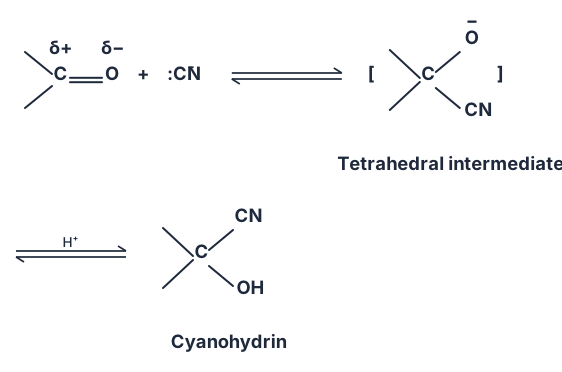
Aldehydes and ketones add hydrogen cyanide across the carbonyl group to give cyanohydrins, compounds bearing both a hydroxyl and a nitrile group on the same carbon:
Drawn by us to help you understand the concept clearly, and verified to make sure it's accurate. For exams, practice from your NCERT textbook's own diagram.
Redrawn from the NCERT page with the structures, printed labels (δ+, δ−, C, O, curved arrow from C=O pi bond onto O (print only, omitted here), lone-pair colon before C, overbar negative charge on C, O with overbar charge, CN, OH) and reagent placement exactly as the textbook prints them. Every element of this display was checked against the printed page during the sweep's blind-judge ver …
The direct reaction with molecular, un-ionised HCN is intrinsically very slow. This is because the actual attacking nucleophile is the cyanide ion, , not neutral HCN, and pure HCN provides very little of the ion. The reaction is therefore catalysed by base:
Base deprotonates HCN to generate the cyanide ion, which — being a considerably stronger nucleophile than neutral HCN — adds rapidly to the carbonyl carbon of aldehydes and ketones to give the corresponding cyanohydrin.
Cyanohydrins are valuable synthetic intermediates: the nitrile group can subsequently be hydrolysed to a carboxylic acid or reduced to an amine, and the adjacent hydroxyl allows further elaboration, so cyanohydrin formation is a standard way of adding one carbon (and a new functional handle) to a carbonyl compound.
(b) Addition of Sodium Hydrogensulphite (NaHSO₃)
Aldehydes and (most) ketones add sodium hydrogensulphite (sodium bisulphite) to give a crystalline bisulphite addition compound:

Drawn by us to help you understand the concept clearly, and verified to make sure it's accurate. For exams, practice from your NCERT textbook's own diagram.
Redrawn from the NCERT page with the structures, printed labels (C, O, OSO₂H, ONa, OSO₂Na, OH) and reagent placement exactly as the textbook prints them. Every element of this display was checked against the printed page during the sweep's blind-judge verification pass, so w …
The position of this equilibrium is not the same for all carbonyl compounds: it lies largely to the right (favouring the addition product) for most aldehydes, but to the left (favouring the free carbonyl compound) for most ketones. This difference is again a steric effect — the same crowding around the carbonyl carbon that slows nucleophilic attack on ketones in general also destabilises the bulky bisulphite adduct relative to the corresponding aldehyde adduct.
The bisulphite addition compound is water-soluble, and — critically — it can be converted back to the original, free carbonyl compound simply by treating it with dilute mineral acid or dilute alkali. This reversibility is what makes the reaction preparatively useful: bisulphite addition compounds are used to separate and purify aldehydes (and reactive ketones) from mixtures, since the carbonyl compound is "locked away" as a water-soluble solid and can be released cleanly on demand.
(c) Addition of Grignard Reagents
Grignard reagents () add to the carbonyl group of aldehydes and ketones in the same nucleophilic-addition manner, with the carbanion-like alkyl/aryl group of the Grignard reagent acting as the nucleophile that attacks the electrophilic carbonyl carbon. The initial addition product is a magnesium alkoxide, which on hydrolysis (aqueous acid work-up) liberates an alcohol.
The class of alcohol obtained depends on the carbonyl compound used, mirroring exactly the pattern already established for alcohol synthesis via Grignard reagents:
- Formaldehyde () with a Grignard reagent, followed by hydrolysis, gives a primary alcohol.
- Any other aldehyde () gives a secondary alcohol.
- A ketone () gives a tertiary alcohol.
This is because formaldehyde's carbonyl carbon starts out attached only to hydrogens, an aldehyde's carbonyl carbon starts out attached to one carbon substituent, and a ketone's carbonyl carbon starts out attached to two — and the Grignard reagent's alkyl/aryl group adds a further carbon substituent to whichever carbon count was already present, fixing the degree of substitution (and hence the class) of the resulting alcohol.
(d) Addition of Alcohols: Hemiacetals and Acetals
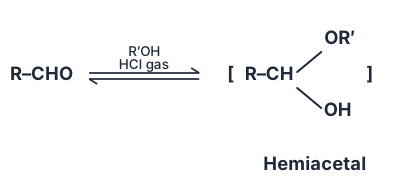
With aldehydes. An aldehyde reacts with one equivalent of a monohydric alcohol in the presence of dry hydrogen chloride gas to give an alkoxyalcohol intermediate called a hemiacetal:
Drawn by us to help you understand the concept clearly, and verified to make sure it's accurate. For exams, practice from your NCERT textbook's own diagram.
Redrawn from the NCERT page with the structures, printed labels (both labels printed stacked above the harpoons, R-CH, OR′, OH, square brackets) and reagent placement exactly as the textbook prints them. Every element of this display was checked against the printed page during the sweep's blind-judge verification pa …
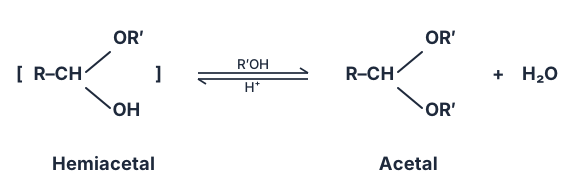
The hemiacetal then reacts with a second molecule of alcohol (again under acid catalysis) to give a gem-dialkoxy compound — one carbon bearing two groups — known as an acetal:
Drawn by us to help you understand the concept clearly, and verified to make sure it's accurate. For exams, practice from your NCERT textbook's own diagram.
Redrawn from the NCERT page with the structures, printed labels (R-CH, OR′, OH, R–CH) and reagent placement exactly as the textbook prints them. Every element of this display was checked against the printed page during the sweep's blind-judge verification pass, so wh …
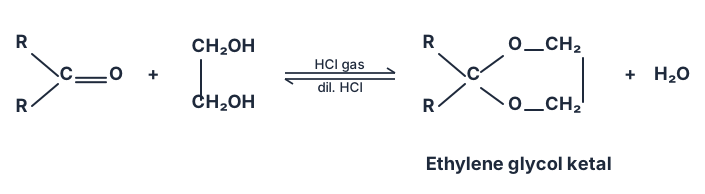
With ketones. Ketones react with ethylene glycol under similarly acid-catalysed conditions to form cyclic products known as ethylene glycol ketals (the ketone analogue of an acetal, formed with a diol instead of two separate molecules of a monohydric alcohol):
Drawn by us to help you understand the concept clearly, and verified to make sure it's accurate. For exams, practice from your NCERT textbook's own diagram.
Redrawn from the NCERT page with the structures, printed labels (R, C, O, CH₂OH, vertical bond bar joins the two CH₂, O — CH₂) and reagent placement exactly as the textbook prints them. Every element of this display was checked against the printed page during the sweep's blind-judge verification pass, …
Why acid catalysis works. Dry hydrogen chloride protonates the carbonyl oxygen. This protonation increases the electrophilicity of the carbonyl carbon — a protonated carbonyl is a much stronger electrophile than a neutral one — and this facilitates the nucleophilic attack of the (comparatively weak nucleophile) alcohol on the carbonyl carbon.
Acetals and ketals are stable to base but are hydrolysed back to the parent aldehyde or ketone on treatment with aqueous mineral acid — the reverse of their formation. Because of this, acetal/ketal formation is used as a reversible way to "protect" a carbonyl group during a synthetic sequence: the carbonyl can be masked as the acid-labile but base-stable acetal, taken through other reactions, and then unmasked by aqueous acid when the free carbonyl is needed again.
(e) Addition of Ammonia and Its Derivatives
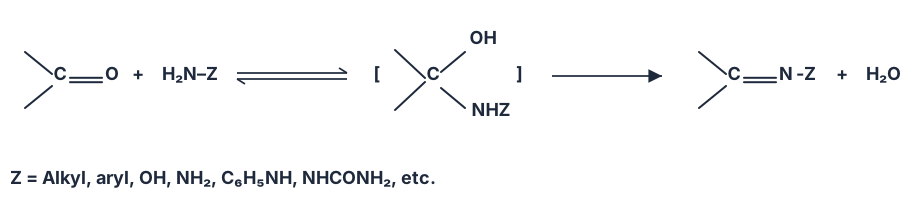
Nucleophiles of the general type — ammonia itself and a family of nitrogen nucleophiles derived from it — add to the carbonyl group of aldehydes and ketones. The reaction is reversible and is catalysed by acid.
Drawn by us to help you understand the concept clearly, and verified to make sure it's accurate. For exams, practice from your NCERT textbook's own diagram.
Redrawn from the NCERT page with the structures, printed labels (C, O, OH, NHZ, square brackets, N-Z) and reagent placement exactly as the textbook prints them. Every element of this display was checked against the printed page during the sweep's blind-judge verification pass, so …
Unlike the simple addition reactions above, this is an addition–elimination sequence. The nitrogen nucleophile first adds to the carbonyl carbon in the usual way, giving a tetrahedral intermediate bearing both an and an group on the same carbon. This intermediate is generally not isolated: it rapidly and irreversibly dehydrates (loses a molecule of water) to give a carbon–nitrogen double bond, . Because this dehydration step is fast and essentially drives the equilibrium forward, the overall equilibrium favours formation of the product even though the initial addition step is reversible.
Here can stand for a range of groups — alkyl, aryl, , , , , and others — and each choice of defines a distinct nitrogen nucleophile, a distinct name for the reagent, and a distinct name for the product formed:
| Z | Reagent | Carbonyl derivative (product) | Product name |
|---|---|---|---|
| Ammonia | Imine | ||
| (a primary) Amine | Substituted imine (Schiff's base) | ||
| Hydroxylamine | Oxime | ||
| Hydrazine | Hydrazone | ||
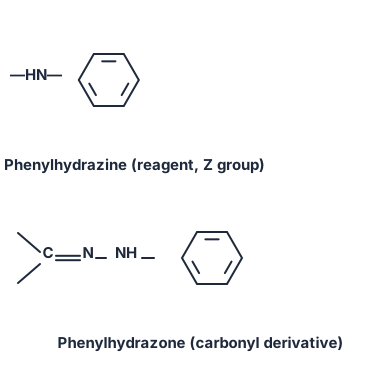
| Phenylhydrazine | Phenylhydrazone |
Drawn by us to help you understand the concept clearly, and verified to make sure it's accurate. For exams, practice from your NCERT textbook's own diagram.
Redrawn from the NCERT page with the structures, printed labels (HN, print draws Kekulé alternating double bonds, attachment at the ring's left vertex, C=N-NH, Kekulé ring, attachment at left vertex) and reagent placement exactly as the textbook prints them. Every element of this display was checked against the printed page during the sweep's blind-judge verific …
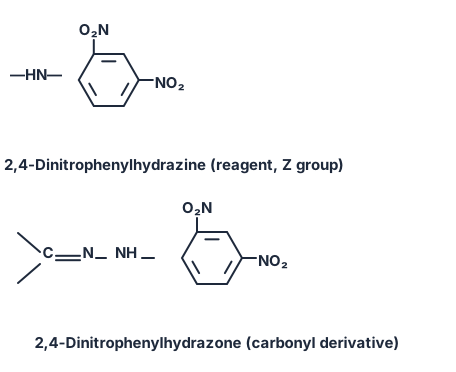
| | 2,4-Dinitrophenylhydrazine (2,4-DNP)
Drawn by us to help you understand the concept clearly, and verified to make sure it's accurate. For exams, practice from your NCERT textbook's own diagram.
Redrawn from the NCERT page with the structures, printed labels (HN, O₂N, NO₂, Kekulé alternating double bonds; O₂N label printed to the upper-left, NO₂ to the right, C=N-NH) and reagent placement exactly as the textbook prints them. Every element of this display was checked against the printed page during the sweep's blind-judge verificatio …
| | 2,4-Dinitrophenylhydrazone (2,4-DNP derivative) |
| | Semicarbazide | | Semicarbazone |
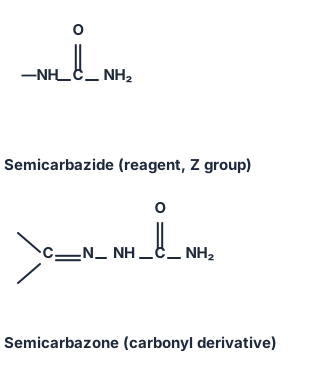
Drawn by us to help you understand the concept clearly, and verified to make sure it's accurate. For exams, practice from your NCERT textbook's own diagram.
Redrawn from the NCERT page with the structures, printed labels (NH, O, C, NH₂, vertical double bar C=O, C=N-NH) and reagent placement exactly as the textbook prints them. Every element of this display was checked against the printed page during the sweep's blind-judge verification pass, s …
2,4-DNP derivatives are yellow, orange, or red crystalline solids with sharp, characteristic melting points, which makes them extremely useful for the qualitative characterisation of aldehydes and ketones — an unknown carbonyl compound's identity can be confirmed by converting it to its 2,4-DNP derivative and comparing the derivative's melting point against tabulated values. This is the classical, pre-spectroscopic use of the 2,4-DNP addition–elimination reaction, and it is why 2,4-DNP is singled out among the many possible ammonia derivatives.
2. Reduction
(i) Reduction to Alcohols
Aldehydes and ketones are reduced to primary and secondary alcohols respectively, most commonly by the hydride reducing agents sodium borohydride () or lithium aluminium hydride (), or alternatively by catalytic hydrogenation (addition of over a metal catalyst). In every case the carbonyl is simply reduced to :
An aldehyde, having one carbon substituent on the carbonyl carbon, is reduced to a primary alcohol; a ketone, having two, is reduced to a secondary alcohol — the same substitution logic seen with Grignard addition, but here the "nucleophile" delivered is a hydride ion () rather than a carbanion, so no new carbon–carbon bond is formed.
(ii) Reduction to Hydrocarbons
The carbonyl group of an aldehyde or ketone can be reduced all the way to a group — complete deoxygenation — by two named methods:
Clemmensen reduction. Treatment with zinc amalgam () and concentrated hydrochloric acid:
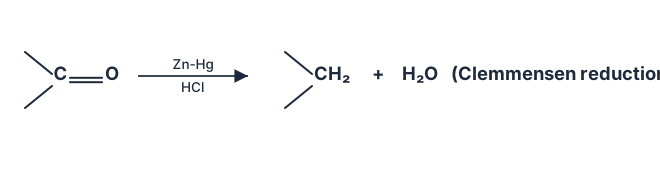
Drawn by us to help you understand the concept clearly, and verified to make sure it's accurate. For exams, practice from your NCERT textbook's own diagram.
Redrawn from the NCERT page with the structures, printed labels (C, O, CH₂) and reagent placement exactly as the textbook prints them. Every element of this display was checked against the printed page during the sweep's blind-judge verification pass, so what …
Wolff–Kishner reduction. Treatment with hydrazine to form the hydrazone, followed by heating that hydrazone with sodium or potassium hydroxide in a high-boiling solvent such as ethylene glycol:
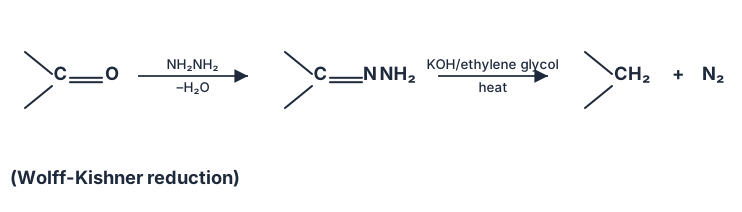
Drawn by us to help you understand the concept clearly, and verified to make sure it's accurate. For exams, practice from your NCERT textbook's own diagram.
Redrawn from the NCERT page with the structures, printed labels (C, O, NNH₂, CH₂) and reagent placement exactly as the textbook prints them. Every element of this display was checked against the printed page during the sweep's blind-judge verification pass, so wha …
The Wolff–Kishner sequence is a direct continuation of the ammonia-derivative addition–elimination chemistry above: the hydrazone intermediate () formed in the first step is exactly the "hydrazone" row of the ammonia-derivatives table; the KOH/heat step then decomposes that hydrazone, expelling nitrogen gas and delivering the two electrons back to carbon as a bond, so the net conversion is carbonyl methylene.
Both methods achieve the same overall outcome — full reduction of to — but under very different conditions (strongly acidic for Clemmensen, strongly basic for Wolff–Kishner), which makes one or the other the practical choice depending on what other functional groups are present in the molecule and whether they can tolerate strong acid or strong base.
3. Oxidation
Oxidation is where aldehydes and ketones part company sharply in reactivity, and this difference is exploited as a standard chemical test to distinguish the two classes.
Aldehydes are easily oxidised to carboxylic acids having the same number of carbon atoms, by essentially any common oxidising agent — nitric acid, potassium permanganate, potassium dichromate, and so on — and, notably, even by mild oxidising agents such as Tollens' reagent and Fehling's reagent:
Ketones, by contrast, resist oxidation under these mild conditions and require vigorous conditions — strong oxidising agents and elevated temperature — to oxidise at all. Because a ketone has no hydrogen directly on the carbonyl carbon (unlike an aldehyde), oxidation cannot simply add an oxygen there; instead it proceeds by carbon–carbon bond cleavage on either side of the carbonyl carbon, breaking the molecule into a mixture of smaller carboxylic acids, each with fewer carbon atoms than the parent ketone:
![Oxidative carbon-carbon cleavage of a ketone: R—CH₂—C(—CH₂-R′) drawn with the C=O as a vertical double bar DOWN to O beneath the chain and locant numerals 1, 2, 3 printed above the CH₂, C, CH₂ positions; [O] above the arrow; products printed as two typed stacked lines joined by '+', each with its parenthetical cleavage caption beneath (C₁-C₂ and C₂-C₃).](/figures/aldehydes-ketones-and-carboxylic-acids/ketone-oxidative-cleavage-locants-sec-8-4.svg)
Drawn by us to help you understand the concept clearly, and verified to make sure it's accurate. For exams, practice from your NCERT textbook's own diagram.
Redrawn from the NCERT page with the structures, printed labels (1, 2, 3, R—CH₂—C—CH₂-R′, O (vertical double bar below the central C)) and reagent placement exactly as the textbook prints them. Every element of this display was checked against the printed page during the sweep's blind-judge verification pass …
Because cleavage can occur on either side of the carbonyl carbon, oxidative cleavage of an unsymmetrical ketone typically gives a mixture of carboxylic acid products (from both possible cleavage sites), which limits its usefulness as a clean synthetic method but is diagnostic of ketone structure.
Mild Oxidising Agents: Distinguishing Aldehydes from Ketones
Because aldehydes (but not ketones) respond to mild oxidants, two classical wet-chemistry tests exploit this difference:
- Tollens' test. Warming an aldehyde with freshly prepared ammoniacal silver nitrate solution (Tollens' reagent) produces a bright silver mirror on the inside of the test vessel, from silver metal deposited as the aldehyde is oxidised to the carboxylate anion. The reaction takes place in alkaline medium:
- Fehling's test. Fehling's reagent is made of two separate solutions mixed in equal amounts immediately before use: Fehling solution A is aqueous copper sulphate, and Fehling solution B is alkaline sodium potassium tartarate (Rochelle salt). On heating an aldehyde with Fehling's reagent, a characteristic reddish-brown precipitate (of copper(I) oxide) is obtained, again with the aldehyde being oxidised to the carboxylate anion:
Important
Tollens' and Fehling's tests are specific to aldehydes, not a general property of the carbonyl group: ketones do not reduce either reagent under these conditions. Aromatic aldehydes (e.g., benzaldehyde) give a positive Tollens' test but do not respond to the Fehling's test — so a positive silver-mirror test together with a negative Fehling's test is itself diagnostic evidence that the aldehyde in question is aromatic rather than aliphatic. Do not treat "gives Tollens'/Fehling's test" as equivalent to "is oxidised" in general — these are mild-oxidant-specific tests that ketones simply fail, while strong oxidants (KMnO₄, HNO₃, dichromate) oxidise aldehydes regardless of this distinction.
(iii) Oxidation of Methyl Ketones by the Haloform Reaction
A separate, more specialised oxidation applies to aldehydes and ketones that carry at least one methyl group directly attached to the carbonyl carbon ("methyl ketones," and acetaldehyde among aldehydes). Such compounds are oxidised by sodium hypohalite (, generated in situ from a halogen and alkali) to the sodium salt of a carboxylic acid having one carbon atom fewer than the parent carbonyl compound, with the methyl group itself being converted into a haloform:
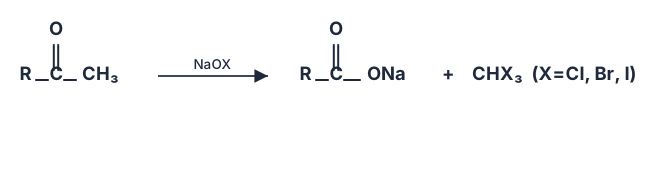
Drawn by us to help you understand the concept clearly, and verified to make sure it's accurate. For exams, practice from your NCERT textbook's own diagram.
Redrawn from the NCERT page with the structures, printed labels (O, R—C—CH₃, vertical double bar C=O upward, R—C—ONa) and reagent placement exactly as the textbook prints them. Every element of this display was checked against the printed page during the sweep's blind-judge verification pass, …
A key feature of this oxidation is its selectivity: it cleaves specifically the bond to the methyl group and does not affect a carbon–carbon double bond elsewhere in the molecule, if one is present — a genuinely -unsaturated methyl ketone can be oxidised this way while its survives intact
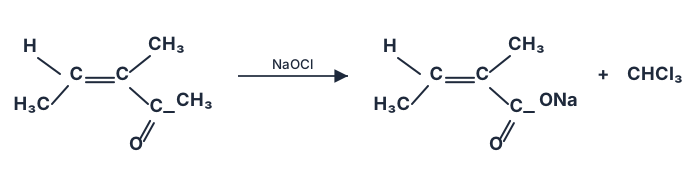
Drawn by us to help you understand the concept clearly, and verified to make sure it's accurate. For exams, practice from your NCERT textbook's own diagram.
Redrawn from the NCERT page with the structures, printed labels (H, CH₃, H₃C, C, O, ONa) and reagent placement exactly as the textbook prints them. Every element of this display was checked against the printed page during the sweep's blind-judge verification pass, so wh …
.
When the hypohalite used is sodium hypoiodite, the haloform produced is iodoform (), a pale-yellow solid with a distinctive odour. This particular version — the iodoform reaction/test — is used as a diagnostic test not only for methyl ketones ( group) directly, but also for any compound bearing a group, since such a group is first oxidised in situ by the hypoiodite to the requisite group before the haloform cleavage occurs.
The haloform reaction is best understood as sitting alongside — not identical to — the general oxidation of ketones discussed above. General ketone oxidation is a harsh, non-selective carbon–carbon cleavage requiring vigorous conditions and giving a mixture of acids; the haloform reaction is comparatively mild, is possible only when a methyl group sits on the carbonyl carbon, and is clean and selective for that one bond, which is precisely why it doubles as a structural test (a positive iodoform test signals a or group in the molecule).
4. Reactions Due to the α-Hydrogen
Acidity of α-Hydrogens
The hydrogen atoms on the carbon directly adjacent to a carbonyl group — the α-carbon — are unusually acidic compared with ordinary C–H hydrogens elsewhere in a hydrocarbon chain. This acidity has two compounding origins:
- The inductive (electron-withdrawing) effect of the carbonyl group. The carbonyl group is strongly electron-withdrawing, and this pulls electron density away from the α-C–H bond, weakening it and making the α-hydrogen easier to remove as a proton.
- Resonance stabilisation of the resulting conjugate base. Once an α-hydrogen is removed by a base, the negative charge left on the α-carbon is not localised there — it is delocalised onto the electronegative carbonyl oxygen through resonance, giving an enolate-type anion in which the negative charge sits predominantly on oxygen (the more stable location for it):
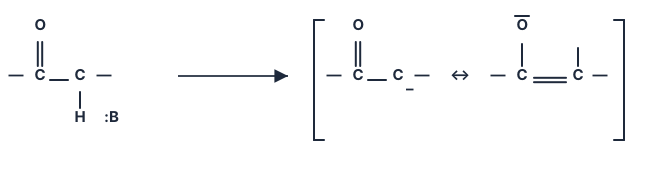
Drawn by us to help you understand the concept clearly, and verified to make sure it's accurate. For exams, practice from your NCERT textbook's own diagram.
Redrawn from the NCERT page with the structures, printed labels () and reagent placement exactly as the textbook prints them. Every element of this display was checked against the printed page during the sweep's blind-judge verification pass, so what …
Delocalisation of the negative charge onto oxygen substantially stabilises this conjugate base relative to an ordinary, non-resonance-stabilised carbanion, and it is this stabilisation — on top of the inductive pull of the carbonyl group — that accounts for the markedly enhanced acidity of α-hydrogens. This acidity is the entire basis for the two reaction types that follow.
(i) Aldol Condensation
Aldehydes and ketones possessing at least one α-hydrogen undergo a characteristic self-addition reaction in the presence of dilute alkali as catalyst: two molecules of the same carbonyl compound combine, one acting (after deprotonation at the α-carbon) as a nucleophile and adding to the electrophilic carbonyl carbon of the other. The immediate product is a β-hydroxy aldehyde (called an aldol, from aldehyde + alcohol, since the product contains both functional groups) when the starting material is an aldehyde, or a β-hydroxy ketone (a ketol) when it is a ketone. This addition reaction is called the Aldol reaction.
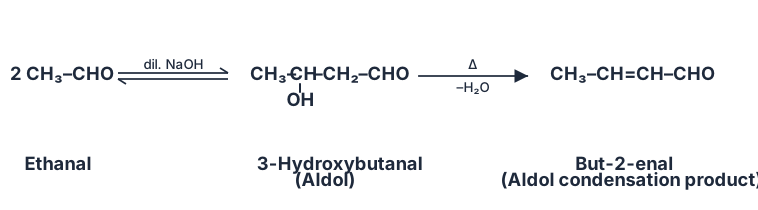
Drawn by us to help you understand the concept clearly, and verified to make sure it's accurate. For exams, practice from your NCERT textbook's own diagram.
Redrawn from the NCERT page with the structures, printed labels (2 CH₃–CHO, CH₃–, CH, –CH₂–CHO, CH₃–CH=CH–CHO) and reagent placement exactly as the textbook prints them. Every element of this display was checked against the printed page during the sweep's blind-judge verification pass, so …
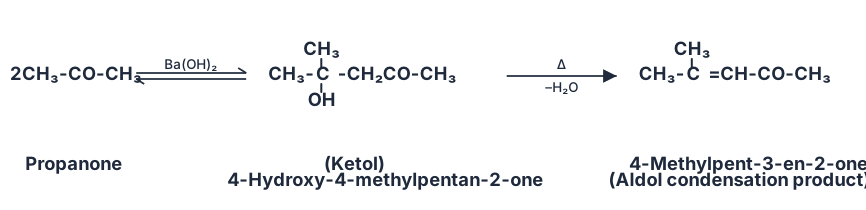
Drawn by us to help you understand the concept clearly, and verified to make sure it's accurate. For exams, practice from your NCERT textbook's own diagram.
Redrawn from the NCERT page with the structures, printed labels (2CH₃-CO-CH₃, CH₃-, C, -CH₂CO-CH₃, =CH-CO-CH₃) and reagent placement exactly as the textbook prints them. Every element of this display was checked against the printed page during the sweep's blind-judge verification pass, so …
The aldol/ketol product readily undergoes dehydration — loss of a molecule of water — on heating, to give an α,β-unsaturated carbonyl compound; this dehydration step, and the overall two-step sequence (addition then dehydration), is what is properly called Aldol condensation:
Although the name "aldol condensation" derives specifically from aldehyde-ol products, the same reaction sequence — self-addition followed by dehydration — occurs equally with ketones bearing an α-hydrogen (giving ketols and then α,β-unsaturated ketones), and the term "aldol condensation" is used generically for the ketone version too, reflecting the underlying similarity of ketone and aldehyde chemistry rather than any restriction to true aldols.
(ii) Cross Aldol Condensation …
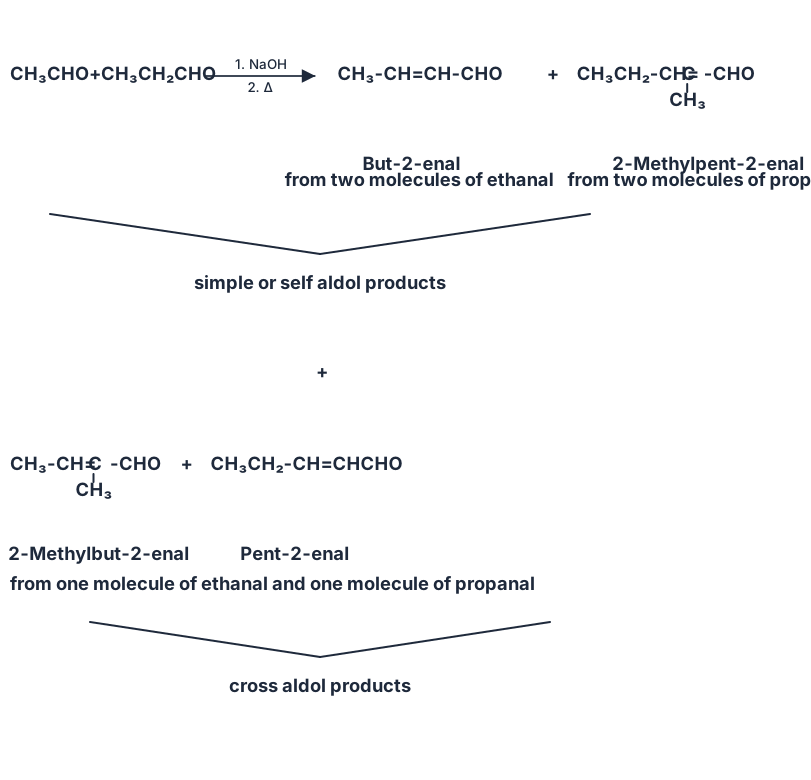
Drawn by us to help you understand the concept clearly, and verified to make sure it's accurate. For exams, practice from your NCERT textbook's own diagram.
Redrawn from the NCERT page with the structures, printed labels (CH₃-CH=CH-CHO, CH₃CH₂-CH=, C, -CHO, CH₃-CH=, CH₃CH₂-CH=CHCHO) and reagent placement exactly as the textbook prints them. Every element of this display was checked against the printed page during the sweep's blind-judge verification pass, …
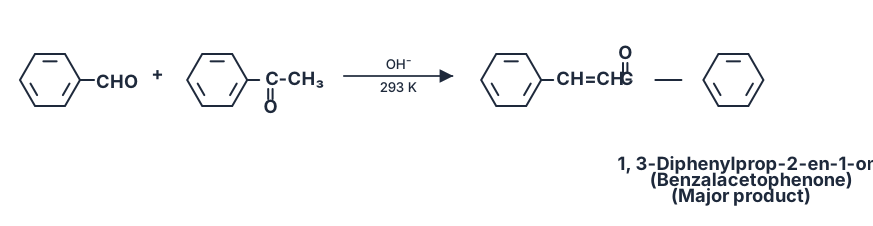
Drawn by us to help you understand the concept clearly, and verified to make sure it's accurate. For exams, practice from your NCERT textbook's own diagram.
Redrawn from the NCERT page with the structures, printed labels (CHO, C, -CH₃, CH=CH-) and reagent placement exactly as the textbook prints them. Every element of this display was checked against the printed page during the sweep's blind-judge verification pass, so wh …
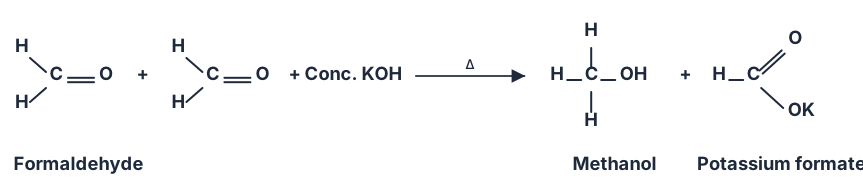
Drawn by us to help you understand the concept clearly, and verified to make sure it's accurate. For exams, practice from your NCERT textbook's own diagram.
Redrawn from the NCERT page with the structures, printed labels () and reagent placement exactly as the textbook prints them. Every element of this display was checked against the printed page during the sweep's blind-judge verification pass, so what …
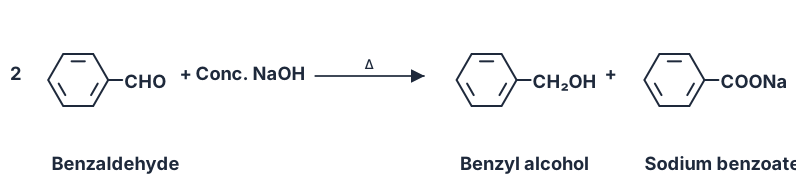
Drawn by us to help you understand the concept clearly, and verified to make sure it's accurate. For exams, practice from your NCERT textbook's own diagram.
Redrawn from the NCERT page with the structures, printed labels (CHO, CH₂OH, COONa) and reagent placement exactly as the textbook prints them. Every element of this display was checked against the printed page during the sweep's blind-judge verification pass, so wha …
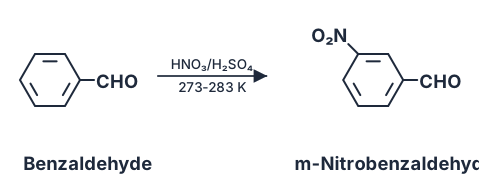
Drawn by us to help you understand the concept clearly, and verified to make sure it's accurate. For exams, practice from your NCERT textbook's own diagram.
Redrawn from the NCERT page with the structures, printed labels (CHO, O₂N) and reagent placement exactly as the textbook prints them. Every element of this display was checked against the printed page during the sweep's blind-judge verification pass, so what …