Chemistry · Ch 8 — Aldehydes, Ketones and Carboxylic Acids
Physical Properties
Physical Properties
Physical State and Odour
Aliphatic carboxylic acids with up to nine carbon atoms are colourless liquids at room temperature and carry a sharp, unpleasant (pungent/sour) smell — acetic acid, for instance, is the sour-smelling acid behind ordinary vinegar. Once the chain grows beyond nine carbons, the acids turn into wax-like solids. These higher members are practically odourless, simply because they are far too non-volatile for their vapour to reach the nose.
Why Carboxylic Acids Boil So High
Carboxylic acids boil at noticeably higher temperatures than aldehydes, ketones, and even alcohols of a comparable molecular mass. The reason lies in how thoroughly carboxylic acid molecules associate with one another through hydrogen bonding.
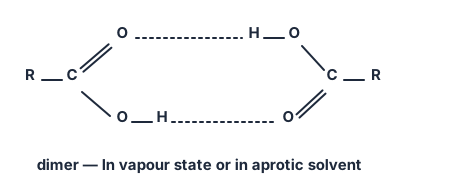
A single —COOH group offers both a hydrogen-bond donor (the O–H) and two hydrogen-bond acceptor sites (the carbonyl O and the hydroxyl O). Two carboxylic acid molecules can therefore hydrogen-bond to each other from both sides at once: the O–H of one molecule bonds to the C=O of the other, and vice versa. This mutual, double hydrogen-bonding locks the pair into a closed, ring-shaped dimer:
Drawn by us to help you understand the concept clearly, and verified to make sure it's accurate. For exams, practice from your NCERT textbook's own diagram.
Redrawn from the NCERT page with the structures, printed labels () and reagent placement exactly as the textbook prints them. Every element of this display was checked against the printed page during the sweep's blind-judge verification pass, so what …
Because the two hydrogen bonds close the ring on both sides simultaneously, this dimer is unusually stable — so stable that it survives well beyond the liquid state. Most carboxylic acids exist as this dimer even in the vapour phase and in solvents that cannot themselves hydrogen-bond (aprotic solvents); the hydrogen bonds are never completely broken.
In effect, the vaporizing "particle" is not one R–COOH molecule but the doubly hydrogen-bonded pair of them — so a much larger effective mass must be lifted into the vapour phase, and boiling point rises accordingly.
Solubility in Water and Organic Solvents
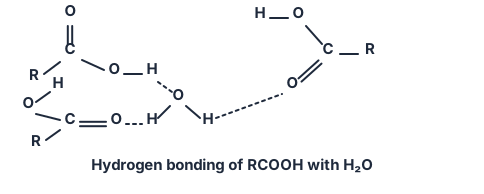
When a carboxylic acid dissolves in water, its molecules hydrogen-bond with water molecules instead of with each other, through both the carbonyl oxygen and the O–H group:
Drawn by us to help you understand the concept clearly, and verified to make sure it's accurate. For exams, practice from your NCERT textbook's own diagram.
Redrawn from the NCERT page with the structures, printed labels () and reagent placement exactly as the textbook prints them. Every element of this display was checked against the printed page during the sweep's blind-judge verification pass, so what …
Simple aliphatic carboxylic acids with up to four carbon atoms are completely miscible with water, since the hydrocarbon part is small enough that hydrogen bonding with water dominates. As the chain lengthens, the growing hydrocarbon portion behaves in an increasingly hydrophobic way, and this hydrophobic interaction competes with hydrogen bonding — so water-solubility falls steadily with each added carbon. …