Chemistry · Ch 6 — Haloalkanes and Haloarenes
Compounds Containing sp³ C—X Bond (X = F, Cl, Br, I)
Compounds Containing sp³ C—X Bond (X = F, Cl, Br, I)
When the halogen atom (X = F, Cl, Br, or I) is bonded to an -hybridised carbon, the resulting monohalo compound falls into one of three categories, depending on exactly what kind of carbon is holding the halogen.
(a) Alkyl Halides (Haloalkanes), R—X
Here the halogen is bonded to the carbon of a simple alkyl group, R. Alkyl halides form a homologous series with the general formula
They are further split into three types based on the nature of the carbon atom that bears the halogen:
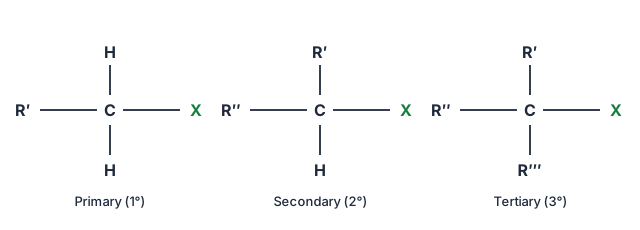
- Primary (1°) alkyl halide — the halogen is attached to a primary carbon, one bonded to only one other carbon, e.g. (one alkyl group, two hydrogens, on the carbon bearing X).
- Secondary (2°) alkyl halide — the halogen is attached to a secondary carbon, bonded to two other carbons, e.g. (two alkyl groups, one hydrogen).
- Tertiary (3°) alkyl halide — the halogen is attached to a tertiary carbon, bonded to three other carbons, e.g. (three alkyl groups, no hydrogen).
Drawn by us to help you understand the concept clearly, and verified to make sure it's accurate. For exams, practice from your NCERT textbook's own diagram.
The three alkyl-halide classes by the nature of the halogen-bearing carbon: primary (one alkyl group R prime, two hydrogens), secondary (two alkyl groups R prime and R double-prime, one hydrogen), tertiary (three alkyl groups R prime, R d …
In each case R′, R″, R‴ stand for the alkyl groups attached to that carbon; a primary halide has one such group and two hydrogens on the halogen-bearing carbon, a secondary halide has two such groups and one hydrogen, and a tertiary halide has three such groups and no hydrogen left on that carbon.
(b) Allylic Halides
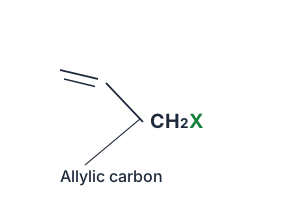
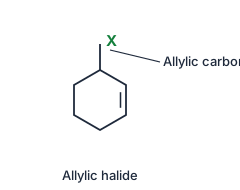
An allylic halide has the halogen bonded to an -hybridised carbon that sits immediately next to a carbon–carbon double bond () — that is, on the allylic carbon itself. The double bond is not touched by the halogen; it is the carbon adjacent to it that carries X. This class includes both open-chain and cyclic structures, such as a halomethyl group attached to a propene unit, or a halogen on the carbon next to a double bond within a ring.
Drawn by us to help you understand the concept clearly, and verified to make sure it's accurate. For exams, practice from your NCERT textbook's own diagram.
CH2=CH-CH2X, the simplest allylic halide: the halomethyl (CH2X) carbon sits immediately next to the C=C double bond and is itself the allylic carbon, while the double bond stays untouched by the halogen -- distinct from a vinylic halide, where X sits directl …
Drawn by us to help you understand the concept clearly, and verified to make sure it's accurate. For exams, practice from your NCERT textbook's own diagram.
The ring form of an allylic halide: X sits on the sp3 ring carbon immediately next to the ring's own C=C double bond (the 'Allylic carbon'), while the double bond itself is left untouched by the halogen -- the cyclic counterpart to the open-ch …
(c) Benzylic Halides …
Drawn by us to help you understand the concept clearly, and verified to make sure it's accurate. For exams, practice from your NCERT textbook's own diagram.
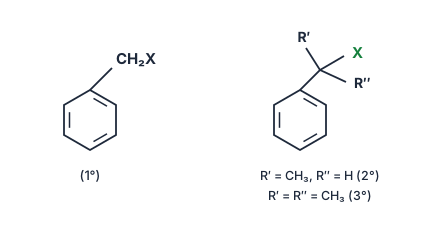
A benzylic halide has the halogen-bearing sp3 carbon attached directly to an aromatic ring: the simplest case is Ph-CH2X (1 degree, one hydrogen replaced), and the general case Ph-C(X)(R')(R'') covers the 2 degree (R'=CH3, R''=H) and 3 degree (R'=R' …