Q.Arrange each set of compounds in order of increasing boiling points.
You're viewing a preview — the full solution, concept, methods & PYQ mapping are locked.
Start your 14-day free trial to unlock the full solution →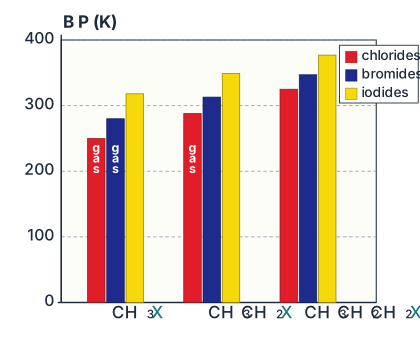
Boiling points of haloalkanes depend on molecular mass, branching, and halogen identity. For (i), the order is Chloromethane < Bromomethane < Dibromomethane < Bromoform. For (ii), the order is Isopropyl chloride < 1-Chloropropane < 1-Chlorobutane.
The Core Idea: What Controls Boiling Point in Haloalkanes?
Boiling point is the temperature at which the vapour pressure of a liquid equals the surrounding pressure. To boil, molecules must overcome the intermolecular forces holding them together. In haloalkanes, the dominant forces are van der Waals forces (London dispersion forces) and, to a lesser extent, dipole-dipole interactions from the polar C–X bond.
The key factors are:
- Molecular mass and size: Heavier, larger molecules have more electrons, leading to stronger temporary dipoles and greater dispersion forces. This usually raises the boiling point.
- Surface area and branching: A straight chain has a larger surface area for contact than a branched isomer. More branching means a more compact shape, weaker intermolecular forces, and a lower boiling point.
- Halogen identity: For the same alkyl group, boiling point increases with the size and polarizability of the halogen: . A larger halogen atom contributes more to dispersion forces.
Now, let's apply these principles to each set.
(i) Bromomethane, Bromoform, Chloromethane, Dibromomethane
Step 1: Identify the compounds and their molecular masses.
We have four methane derivatives. Let's list them with their molecular formulas and approximate molar masses.
| Compound | Formula | Molar Mass (g/mol) |
|---|---|---|
| Chloromethane | 50.5 | |
| Bromomethane | 95.0 | |
| Dibromomethane | 173.8 | |
| Bromoform | 252.7 |
Step 2: Apply the mass-size rule.
The most immediate trend is the increase in molecular mass. As we go from one halogen to two, then three, the molecule gets much heavier and larger. This dramatically increases the strength of London dispersion forces.
Therefore, the boiling points should increase with the number of halogen atoms (and thus mass). The lightest is Chloromethane, then Bromomethane, then Dibromomethane, and the heaviest is Bromoform.
A quick check: For simple haloalkanes, boiling point often increases with the number of halogen atoms on the same carbon. Each additional halogen adds significant mass and polarizability.
Step 3: Compare Chloromethane and Bromomethane.
Both are monohalomethanes. Bromomethane () has a bromine atom (atomic mass 80), while Chloromethane () has a chlorine atom (atomic mass 35.5). Bromomethane is nearly twice as heavy. Its larger electron cloud makes it much more polarizable, leading to stronger dispersion forces. So, Bromomethane has a higher boiling point than Chloromethane.
Step 4: Assemble the order.
Combining the mass trend, the order of increasing boiling points is:
Chloromethane < Bromomethane < Dibromomethane < Bromoform
A common mistake is to think that because chlorine is more electronegative, has stronger dipole-dipole forces and thus a higher boiling point than . While the dipole moment of is slightly larger, the polarizability of the larger bromine atom creates much stronger dispersion forces, which dominate the overall intermolecular attraction. Mass and size are the primary drivers here.
(ii) 1-Chloropropane, Isopropyl chloride, 1-Chlorobutane
Step 1: Identify the compounds and their structures.
All three are monochlorinated alkanes. Let's draw their structures.
- 1-Chloropropane (-propyl chloride): (a straight chain of 3 carbons).
- Isopropyl chloride (2-Chloropropane): (a branched chain of 3 carbons; the chlorine is on the middle carbon).
- 1-Chlorobutane (-butyl chloride): (a straight chain of 4 carbons). …
Unlock everything free for 14 days
- Full step-by-step solutions
- Concept-first explanations
- Methods, shortcuts & mistakes
- PYQ mapping + timed mock tests
Full access for 14 days. No credit card required.