Chemistry · Ch 1 — Solutions
Non-ideal Solutions
Non-ideal Solutions
When a solution fails to obey Raoult's law over the entire range of concentration, it is called a non-ideal solution. Its measured vapour pressure differs from the value the law predicts — it may come out either higher or lower. This mismatch is called a deviation, and there are two kinds:
- Positive deviation — the observed vapour pressure is higher than Raoult's law predicts.
- Negative deviation — the observed vapour pressure is lower than Raoult's law predicts.
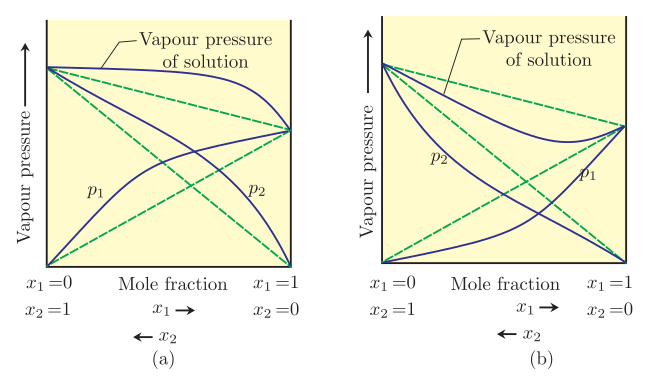
Drawn by us to help you understand the concept clearly, and verified to make sure it's accurate. For exams, practice from your NCERT textbook's own diagram.
What the Figure Shows
The figure presents two side-by-side graphs, labelled (a) and (b). Each graph plots vapour pressure (on the vertical -axis) against mole fraction (on the horizontal -axis). The composition axis runs from pure component 2 at the left (, ) to pure component 1 at the right (, ). In both panels, three dashed straight lines represent the ideal behaviour predicted by Raoult’s law: the partial pressure of component 1 (), the partial pressure of component 2 (), and the total vapour pressure (). These ideal lines are straight because Raoult’s law gives , where is the vapour pressure of the pure component.
In panel (a), three solid curves show the actual (non-ideal) partial pressures and total vapour pressure. All three curves lie above their corresponding dashed ideal lines — this is positive deviation from Raoult’s law. The topmost solid curve, labelled “vapour pressure of solution”, is the actual total vapour pressure. In panel (b), the three solid curves lie below their corresponding ideal dashed lines — this is negative deviation. The actual total vapour pressure is still the upper envelope of the solid curves (it is the sum ); what makes the deviation negative is that this solid total curve sags below the dashed ideal-total line.
Physical Idea Taught
The figure illustrates how real solutions deviate from the ideal behaviour assumed by Raoult’s law. The key idea is that the strength of intermolecular forces between unlike molecules (A–B) compared to like molecules (A–A and B–B) determines the direction of deviation.
- Positive deviation (panel a): A–B interactions are weaker than A–A and B–B interactions. Molecules escape more easily into the vapour phase, so the actual vapour pressure is higher than ideal. Examples: ethanol–acetone, acetone–carbon disulphide.
- Negative deviation (panel b): A–B interactions are stronger than A–A and B–B interactions. Molecules are held more tightly in the liquid, so the actual vapour pressure is lower than ideal. Examples: phenol–aniline, chloroform–acetone.
The figure also sets the stage for understanding azeotropes. Solutions with large positive deviation form minimum boiling azeotropes (e.g., ethanol–water at ~95% ethanol by volume). Solutions with large negative deviation form maximum boiling azeotropes (e.g., nitric acid–water at ~68% HNO₃ by mass, boiling at 393.5 K). At the azeotropic composition, the liquid and vapour have the same composition, so further separation by fractional distillation is impossible.
Key Formula Developed
The figure is built on Raoult’s law for an ideal solution:
where:
- = partial vapour pressure of component in the solution
- = mole fraction of component in the liquid phase
- = vapour pressure of pure component at the same temperature
For a binary ideal solution, the total vapour pressure is:
…
Both arise from the same root cause: how the unlike-molecule (A–B) attractions compare with the like-molecule (A–A and B–B) attractions in the mixture.
Positive deviation
Here the A–B interactions are weaker than the A–A and B–B interactions:
Because a molecule of A (or B) is held less tightly by its unlike neighbours than it was in the pure liquid, it can escape into the vapour more easily. The increased escaping tendency raises the vapour pressure above the ideal value — a positive deviation.
Examples.
- Ethanol + acetone. Pure ethanol molecules are held together by hydrogen bonds. Adding acetone slips its molecules between the ethanol molecules and breaks some of those hydrogen bonds. The weakened attractions let molecules escape more readily, so the vapour pressure rises.
- Acetone + carbon disulphide (CS₂). The dipolar attractions between the unlike solute–solvent molecules are weaker than the attractions within each pure liquid, again giving a positive deviation.
Negative deviation
Here the A–B interactions are stronger than the A–A and B–B interactions:
Now the unlike molecules cling to one another more firmly than they did in the pure liquids. This lowers the escaping tendency of both components, so the vapour pressure falls below the ideal value — a negative deviation.
Examples.
- Phenol + aniline. The hydrogen bond formed between the phenolic –OH proton and the lone pair on aniline's nitrogen is stronger than the hydrogen bonding within either pure liquid, pulling the vapour pressure down.
- Chloroform + acetone. The chloroform molecule forms a new hydrogen bond to the oxygen of acetone (its C–H acting as the donor to the carbonyl).
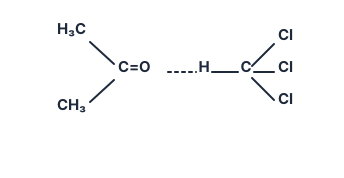
Drawn by us to help you understand the concept clearly, and verified to make sure it's accurate. For exams, practice from your NCERT textbook's own diagram.
Redrawn from the NCERT page with the structures, printed labels (H3C, CH3, C=O, Cl) and reagent placement exactly as the textbook prints them. Every element of this display was checked against the printed page during the sweep's blind-judge verification pass, so wha …
This extra attraction reduces the escaping tendency of both components, giving a negative deviation.
Azeotropes
Some liquid pairs, on mixing, form azeotropes — binary mixtures whose liquid and vapour phases have exactly the same composition, so the mixture boils at a constant temperature. Because the vapour that comes off has the same composition as the boiling liquid, the two components cannot be separated by fractional distillation. There are two types:
- Minimum-boiling azeotrope — formed by solutions showing a large positive deviation from Raoult's law at a particular composition. Its boiling point is lower than that of either pure component. Example: the ethanol–water system, whose azeotrope contains about 95% ethanol by volume (this is the composition obtained by fractional distillation of fermentation liquor — once reached, no further separation by distillation is possible). …