Chemistry · Ch 1 — Solutions
Osmosis and Osmotic Pressure
Osmosis and Osmotic Pressure
Many everyday observations share a hidden common cause: raw mangoes shrivel when pickled in brine, wilted flowers revive in fresh water, and blood cells collapse in saline water. In each case the material is bounded by a membrane. Such membranes — pig's bladder, parchment, cellophane — look like continuous films but actually carry a network of submicroscopic pores.
Drawn by us to help you understand the concept clearly, and verified to make sure it's accurate. For exams, practice from your NCERT textbook's own diagram.
What the Figure Shows
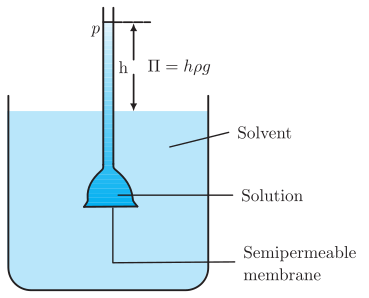
The schematic depicts an inverted thistle funnel placed in a beaker of pure solvent. The funnel’s wide mouth is sealed with a semipermeable membrane (SPM), and the funnel itself contains the solution. The key visual feature is that the solution level inside the funnel stands visibly higher than the solvent level in the beaker. This height difference is labelled , and the annotation appears beside it, where is the density of the solution and is the acceleration due to gravity.
The Physical Idea
The figure illustrates osmosis — the spontaneous net flow of solvent molecules from the pure solvent (lower solute concentration) into the solution (higher solute concentration) across the SPM. As solvent enters the funnel, the solution level rises, creating a hydrostatic pressure difference. This rising continues until the hydrostatic pressure () exerted by the extra column of solution exactly balances the tendency of solvent to flow in. At that equilibrium, the applied pressure needed to prevent further solvent entry is the osmotic pressure of the solution. The figure thus shows that osmotic pressure can be measured as the excess pressure required to stop osmosis, which equals in this simple setup.
Key Formula Developed
The textbook uses this concept to derive the van’t Hoff equation for dilute solutions:
where:
- = osmotic pressure (in bar or atm)
- = molarity of the solution (mol L)
- = gas constant (0.083 L bar mol K)
- = absolute temperature (K)
Since (with = moles of solute, = volume of solution in litres), this becomes:
…
Semipermeable membranes and osmosis
Small solvent molecules (like water) can slip through these pores, while larger solute molecules are held back. A membrane with this selective behaviour is a semipermeable membrane (SPM).
Place an SPM between pure solvent and a solution and assume only solvent can pass. Solvent molecules then flow from the pure solvent into the solution.
The net flow of solvent through a semipermeable membrane, from pure solvent (or a dilute solution) into a solution (or a more concentrated solution), is called osmosis. Solvent always moves from lower solute concentration towards higher solute concentration.
Osmotic pressure
The flow does not go on forever. It can be halted by applying extra pressure on the solution side.
The osmotic pressure of a solution is the excess pressure that must be applied to the solution to just prevent osmosis — i.e. to stop solvent molecules from passing through the membrane into it.
Osmotic pressure is a colligative property: it depends on the number of solute particles, not on their identity.
Drawn by us to help you understand the concept clearly, and verified to make sure it's accurate. For exams, practice from your NCERT textbook's own diagram.
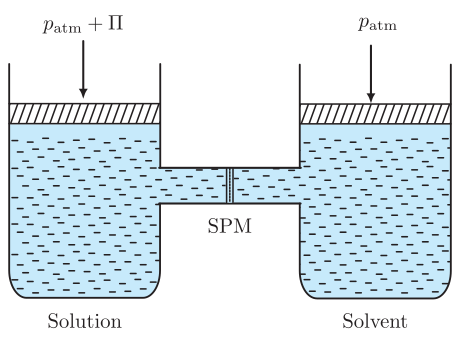
The figure is a schematic diagram of an apparatus used to demonstrate osmotic pressure. It shows two vertical containers connected by a horizontal tube. A semipermeable membrane (SPM) is placed inside this connecting tube, separating the two containers.
- The left container holds the solution (solute + solvent).
- The right container holds the pure solvent (only solvent molecules).
The diagram labels the pressure acting on the free surface of each liquid:
- On the solvent side, the surface is exposed only to atmospheric pressure, labelled .
- On the solution side, an additional pressure is applied. The total pressure on the solution surface is labelled , where is the osmotic pressure.
The key physical idea is that this extra pressure is exactly enough to stop the net flow of solvent molecules from the pure solvent side into the solution side through the SPM. Without this extra pressure, solvent would flow spontaneously from the pure solvent (higher solvent concentration) into the solution (lower solvent concentration) — a process called osmosis. The figure illustrates the equilibrium condition where the applied excess pressure balances the tendency for osmosis.
The textbook uses this figure to introduce the van't Hoff equation for dilute solutions:
where:
- = osmotic pressure (in bar or atm)
- = molarity of the solution (in mol/L)
- = gas constant ()
- = absolute temperature (in K)
Since (where = moles of solute, = volume of solution in litres), the equation can be rewritten as:
For a solute of mass grams and molar mass , , giving the form used for molar mass determination: …
The osmotic pressure equation
For dilute solutions, experiment shows that the osmotic pressure is proportional to the molarity of the solution at a given temperature :
where is the osmotic pressure and is the gas constant. Writing molarity as moles of solute per unit volume, :
Here is the volume of solution (in litres) containing moles of solute.
Determining molar mass
If gram of solute of molar mass is dissolved, then , and
Rearranging gives the molar mass directly from osmotic-pressure data:
So measuring (with , and known) yields the molar mass of the solute.
Why osmotic pressure suits macromolecules
Osmotic pressure is the preferred method for finding the molar masses of proteins, polymers and other macromolecules, for several reasons:
- Pressure is measured near room temperature — biomolecules are often unstable at higher temperatures.
- Molarity is used rather than molality.
- The osmotic pressure is large in magnitude even for very dilute solutions, making it measurable where other colligative effects would be too tiny — a real advantage since polymers dissolve poorly.
Isotonic, hypertonic and hypotonic solutions
Two solutions with the same osmotic pressure at a given temperature are isotonic. When separated by an SPM, no net osmosis occurs between them.
For example, the fluid inside a blood cell has the osmotic pressure of a 0.9% (mass/volume) sodium chloride solution — called normal saline, which is safe to inject intravenously.
- A solution more concentrated than 0.9% NaCl is hypertonic: water flows out of the cells and they shrink.
- A solution less concentrated than 0.9% NaCl is hypotonic: water flows into the cells and they swell.
Everyday phenomena explained by osmosis
The observations this section opened with all follow from osmosis:
- A raw mango placed in brine loses water to the concentrated salt solution …