Chemistry · Ch 1 — Solutions
Solubility of a Gas in a Liquid
Solubility of a Gas in a Liquid
Many gases dissolve in liquids, though to very different extents. Oxygen dissolves in water only slightly — yet that small amount of dissolved oxygen is what supports all aquatic life. Hydrogen chloride gas, by contrast, is extremely soluble in water. For gases, solubility is strongly controlled by both pressure and temperature.
Effect of pressure
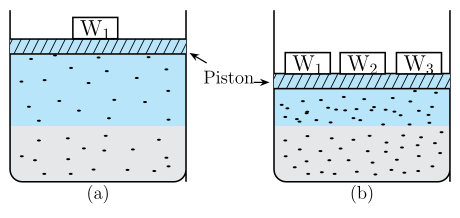
Consider a gas sitting above a liquid in a closed vessel, at pressure and temperature , with the dissolved gas and the gas above the liquid in dynamic equilibrium — gas particles enter the solution as fast as they leave it. Now compress the gas into a smaller volume. This packs more gas particles into each unit of volume above the liquid, so they strike the liquid surface more often and enter the solution faster. More gas dissolves until a new equilibrium is set up at the higher pressure. In short, the solubility of a gas increases as the pressure of the gas above the liquid increases.
Drawn by us to help you understand the concept clearly, and verified to make sure it's accurate. For exams, practice from your NCERT textbook's own diagram.
What the Figure Shows
The figure is a two-part schematic, labelled (a) and (b), of a vessel closed by a
movable piston (the hatched band). Below the piston there are two regions:
- Upper region — the gaseous phase: gas particles (dots) at pressure , directly beneath the piston.
- Lower region — the solution: the liquid, with the dots inside it showing the gas that has dissolved.
In panel (a), a single weight rests on the piston and the system is at
dynamic equilibrium — gas particles enter and leave the solution at the same
rate. In panel (b), three weights (, , ) sit side by side on the
piston. The piston has moved down, compressing the gas into a thinner band, so
the gas particles above the solution are visibly closer together — and more dots now appear inside the solution: more gas has dissolved.
The Physical Idea
Compressing the gas increases the number of gaseous particles per unit volume
over the solution, and with it the rate at which particles strike the liquid
surface and enter it. Dissolving therefore outpaces escape until a new equilibrium is reached at a higher dissolved-gas concentration — the
solubility of the gas increases with pressure.
The key takeaway: higher pressure → higher concentration of dissolved gas.
The Key Formula
This proportionality is Henry's law, stated quantitatively in the text:
where:
- = partial pressure of the gas in the vapour phase …
Henry's law
Henry was the first to put this relationship on a quantitative footing. His law states that, at constant temperature, the solubility of a gas in a liquid is directly proportional to the partial pressure of the gas above the surface of the liquid. (Dalton, working at the same time, reached the same conclusion independently.)
If the mole fraction of the dissolved gas is used as the measure of its solubility, Henry's law can be stated in its most commonly used form: the partial pressure of a gas in the vapour phase is proportional to the mole fraction of that gas in the solution.
where
= partial pressure of the gas above the solution,
= mole fraction of the gas dissolved in the solution,
= Henry's law constant.
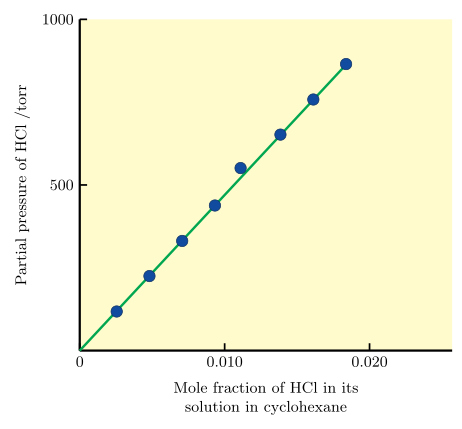
A plot of the partial pressure of the gas against its mole fraction in solution is therefore a straight line, and the slope of that line is .
Drawn by us to help you understand the concept clearly, and verified to make sure it's accurate. For exams, practice from your NCERT textbook's own diagram.
The figure is a linear graph with a best-fit straight line passing through the origin.
- x-axis: Mole fraction of HCl in its solution in cyclohexane, ranging from 0 to 0.020.
- y-axis: Partial pressure of HCl gas above the solution, in torr, ranging from 0 to 1000.
- Data points: Experimental scatter points lying close to the best-fit straight line (one point sits visibly just above it — real data, not a perfect fit).
- Slope of the line: The Henry’s law constant, , for HCl in cyclohexane at 293 K.
Physical idea: The graph demonstrates Henry’s law — at constant temperature, the partial pressure of a gas above a liquid is directly proportional to its mole fraction in the liquid. The straight line through the origin confirms this proportionality: as the mole fraction of dissolved HCl doubles, its partial pressure also doubles.
Key formula from the textbook:
where:
- = partial pressure of the gas in the vapour phase (in torr or bar)
- = mole fraction of the gas in the solution …
Meaning of the Henry's law constant
Different gases have different values at the same temperature, so depends on the nature of the gas (representative values for various gases in water are collected in the accompanying table).
| Gas | Temperature/K | /kbar |
|---|---|---|
| He | 293 | 144.97 |
| 293 | 69.16 | |
| 293 | 76.48 | |
| 303 | 88.84 | |
| 293 | 34.86 | |
| 303 | 46.82 | |
| Argon | 298 | 40.3 |
| 298 | 1.67 | |
| Formaldehyde | 298 |
The size of tells us how soluble a gas is. Rearranging Henry's law,
shows that, at a given pressure, a larger means a smaller mole fraction dissolved — that is, a lower solubility. So a high corresponds to a poorly soluble gas.
Temperature dependence of
also changes with temperature. For gases such as and , rises as the temperature is raised. Since a higher means lower solubility, this tells us that the solubility of these gases falls as the temperature increases — dissolved gas escapes more readily from warmer water.
Effect of temperature
The temperature trend for gases is the opposite of the endothermic-solid case. When a gas dissolves, its molecules pass from the gas phase into the liquid — a process much like condensation, which releases heat, so dissolution of a gas is generally exothermic. Treating this as a dynamic equilibrium and applying Le Chatelier's principle, raising the temperature drives the exothermic dissolution backwards, and solubility decreases as temperature rises.
This is why aquatic organisms fare better in cold water than in warm water: cold water holds more dissolved oxygen.
Applications of Henry's law
Henry's law explains several everyday, industrial and biological observations:
- Carbonated drinks: To force more into soft drinks and soda water, the bottle is sealed under high pressure, which raises the gas's solubility. Opening the bottle drops the pressure and the excess gas fizzes out. …