Economics · Ch 2 — Consumption Analysis
Ordinal Utility Approach — Indifference Curves and the Marginal Rate of Substitution
Ordinal Utility Approach — Indifference Curves and the Marginal Rate of Substitution
The Cardinal Approach's assumption that satisfaction can be measured in precise numerical utils is unrealistic — no one can genuinely say that one cup of coffee gives "exactly 14 utils." The Ordinal Utility Approach, developed by Hicks and Allen, avoids this problem: it assumes a consumer can only RANK combinations of goods as giving more, less, or equal satisfaction, never a precise numerical amount.
An Indifference Curve (IC) is the locus of all combinations of two goods that give the consumer the SAME level of total satisfaction, so that he is indifferent between any two points on it. The underlying indifference schedule simply lists such equally-satisfying combinations — for example, a consumer may be equally satisfied with 1 unit of X and 12 of Y, or with 2 of X and 8 of Y, and so on.
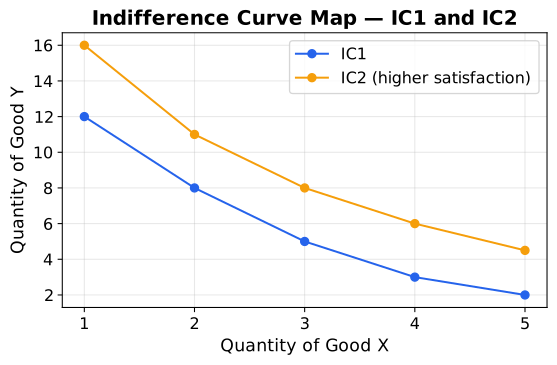
Indifference curves have four key properties: (1) they slope downward from left to right — to keep satisfaction unchanged, gaining more of one good must be compensated by giving up some of the other; (2) they are convex to the origin — this reflects the fact that, as a consumer holds more and more of X, he is willing to give up successively SMALLER amounts of Y for each additional unit of X, a property called diminishing Marginal Rate of Substitution; (3) a higher indifference curve represents a higher level of satisfaction, since it contains combinations with more of both goods; and (4) two indifference curves can never intersect, because an intersection would imply that the SAME combination (the point of intersection) simultaneously belongs to two different satisfaction levels — a logical contradiction.
The Marginal Rate of Substitution () is the precise measure of the rate of exchange between the two goods along an indifference curve: it is the amount of Y a consumer is willing to give up in exchange for one additional unit of X, while remaining on the same indifference curve (i.e. keeping total satisfaction unchanged): …
The locus of all combinations of two goods that yield the same level of total satisfactio …
The amount of good Y a consumer is willing to give up for one additional unit of good X, while remaining on the sam …