Physical Education · Ch 8 — Fundamentals of Kinesiology and Biomechanics in Sports
Types of Body Movements
Types of Body Movements
From the fundamentals of movement we can now name the eight basic types of body movement produced at the joints. Every sporting skill is a combination of these.
Drawn by us to help you understand the concept clearly, and verified to make sure it's accurate. For exams, practice from your textbook's own diagram.
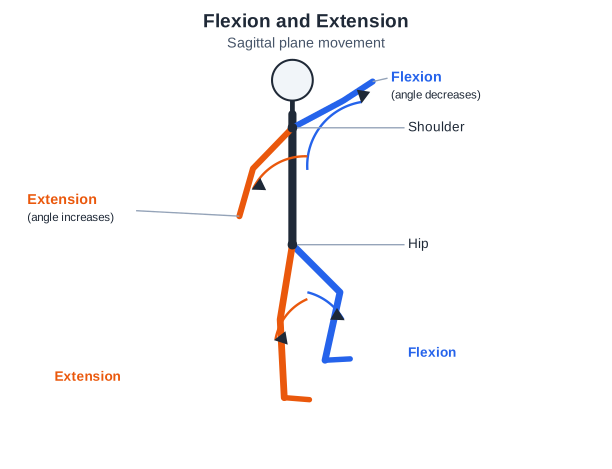
Side view of a standing figure showing flexion and extension: at the shoulder the arm swings forward (flexion, the joint angle decreasing) and backward (extension, the joint angle increasing); the same bending-versus-straightening is shown at the hip and in the trunk, with curved arrows marking the decreasing …
- Flexion — the bending or flexing of a limb; it closes (decreases) the angle at the moving joint. Example: bending the elbow in a biceps curl. Flexion is possible mainly at hinge joints (the elbow, the knee) and ball-and-socket joints (the shoulder, the hip) — a sprinter flexing the knee during the recovery phase of the running action is a direct application.
- Extension — the straightening or extending of a limb; it opens (increases) the angle at the joint. It is the opposite of flexion. Example: straightening the knee to kick a ball. Extending a joint beyond its normal range is called hyperextension and is a common cause of ligament injury — for instance, hyperextending the knee on a bad landing — which is why coaches stress controlled, not forced, extension.
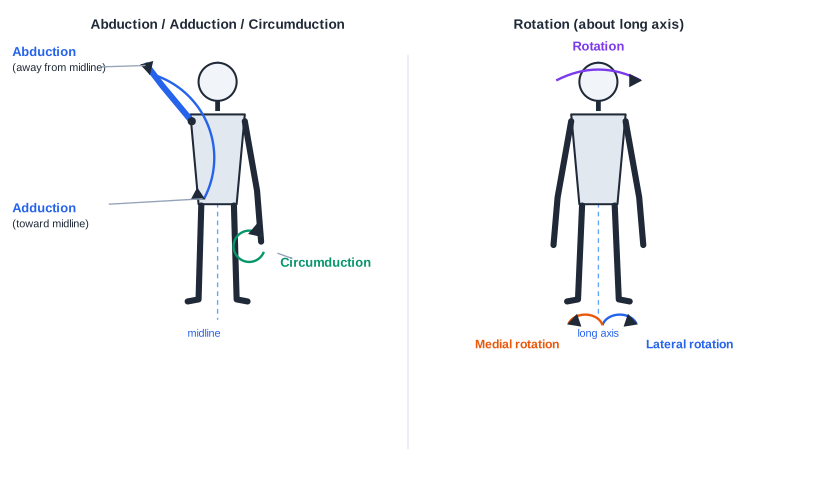
- Abduction — moving a limb away from the body's centreline (midline). Example: raising the arm sideways in a lateral raise. In swimming, the recovery phase of a breaststroke arm pull is a sustained abduction movement.
- Adduction — moving a limb towards the body's centreline. Example: bringing the raised arm back to the side. A footballer's leg swinging inward across the body while striking the ball uses adduction at the hip.
- Rotation — movement around the long (longitudinal) axis of a bone. Example: turning the arm inward or outward, or twisting the trunk. Rotation is further described as medial (internal) rotation, turning towards the midline, and lateral (external) rotation, turning away from it — both are used repeatedly in throwing actions such as the javelin and the discus.
Drawn by us to help you understand the concept clearly, and verified to make sure it's accurate. For exams, practice from your textbook's own diagram.
Front view of a standing figure: one arm is raised sideways away from the midline (abduction) and brought back toward the body (adduction); a circular arrow at a limb shows circumduction; a second figure shows the arm (or leg) turning inward (medial rotation) and …
- Circumduction — a circular movement that combines flexion, extension, abduction and adduction in sequence. It usually occurs at the ball-and-socket joints such as the shoulder and hip, which allow the greatest freedom of movement of any joints in the body. Example: the full circular arm action of a bowler, or drawing a large circle in the air with an outstretched arm.
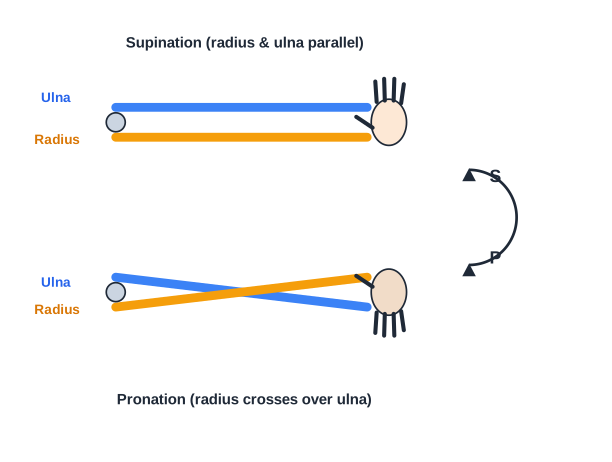
- Pronation — turning the palm down; it occurs at the radio-ulnar joint of the forearm. Example: the forearm action in a table-tennis topspin stroke.
- Supination — turning the palm up, also at the radio-ulnar joint. Example: carrying a tray on an open palm, or the forearm position at the top of a biceps curl.
Drawn by us to help you understand the concept clearly, and verified to make sure it's accurate. For exams, practice from your textbook's own diagram.
Diagram of the forearm bones in two positions: supination, with the radius and ulna lying parallel and the palm turned up; and pronation, with the radius crossing over the ulna and the palm turned down, with curved arrows (S and P) showing the tw …