Business Mathematics and Statistics · Ch 3 — Integral Calculus – II (Area under curves; Application of Integration in Economics and Commerce)
Area Under a Curve Using Definite Integrals
Area Under a Curve Using Definite Integrals
This Tamil Nadu HSC Class 12 Business Mathematics and Statistics chapter builds directly on the previous chapter's integration techniques, turning the definite integral into a genuinely practical tool: measuring the area under a curve, recovering total cost/revenue from marginal functions, and computing consumer's and producer's surplus — core commerce and economics applications.
The area formula
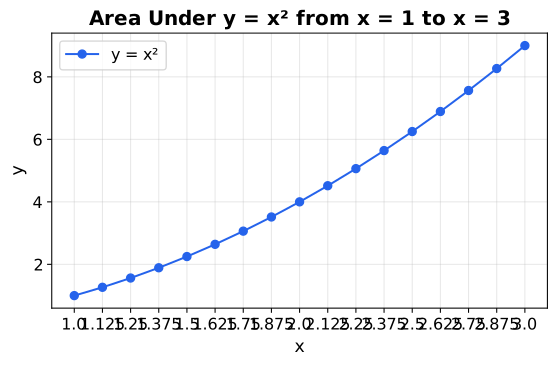
For a curve that is non-negative on , the area enclosed between the curve, the -axis, and the vertical lines is
When finding the area BETWEEN two curves (upper) and (lower) over , subtract:
Worked reasoning
For the area between and from to (where the line lies above the parabola on this interval, since for ):
Always check WHICH curve is on top before subtracting
Subtracting the curves in the wrong order gives a NEGATIVE area — a definite integral computing an area between two curves must always be set up as (upper lower), confirmed by checking which function has the larger value somewhere in the interval.
For on , the area between the curve , the x-axis, and is . Between two curves, it is with the upper curve.