Informatics Practices · Ch 5 — Internet and Web
Star Topology
Star Topology
In a star topology, every device on the network is connected directly to a central node. That central node is a networking device — typically a hub or a switch. The name comes from the visual shape: the central device sits in the middle, and the cables to each device radiate outward like the points of a star.
This layout is considered very effective, efficient, and fast. The reason is straightforward: each device has its own dedicated connection to the centre. Data does not have to travel through other devices to reach its destination, which keeps the network speedy and reduces collisions.
A key advantage is that a problem in one device does not affect the rest of the network. If a computer or printer fails, the other devices continue to communicate normally through the central node. However, this strength comes with a critical weakness: the central networking device is a single point of failure. If the hub or switch at the centre stops working, the entire network goes down — no device can communicate with any other.
The central node can operate in one of two modes:
- Broadcasting device — data sent from one device is transmitted to all devices on the network, even if only one destination is intended. …
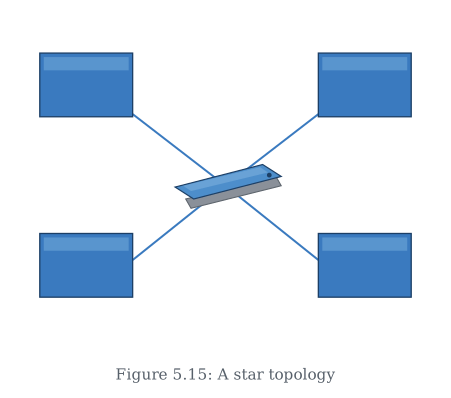
Drawn by us to help you understand the concept clearly, and verified to make sure it's accurate. For exams, practice from your textbook's own diagram.
The diagram places a single networking device — either a hub or a switch — at the exact centre of the figure. Around it, arranged in a rough circle, are five individual computers or workstations. Each computer is connected to the central device by its own dedicated cable, drawn as a straight line radiating outward like the point of a star. No cables run directly between any two computers; every link passes through the centre.
The central node is labelled generically as a networking device, and the surrounding nodes are labelled as communicating devices. The layout makes the hierarchy immediately visible: the centre is the single point of control and failure, while the outer nodes are all equal in distance and dependence on that centre.
What this teaches is the core logic of a star topology. Because each device has its own cable to the hub or switch, a break in one cable or a fault in one computer affects only that single connection — the rest of the network keeps working. That is the key advantage over a bus or ring topology. But the diagram also makes the vulnerability obvious: if the central device fails, every cable leads to a dead centre, and no device can communicate with any other. The entire network collapses. …