Informatics Practices · Ch 6 — Societal Impacts
Communication Etiquettes
Communication Etiquettes
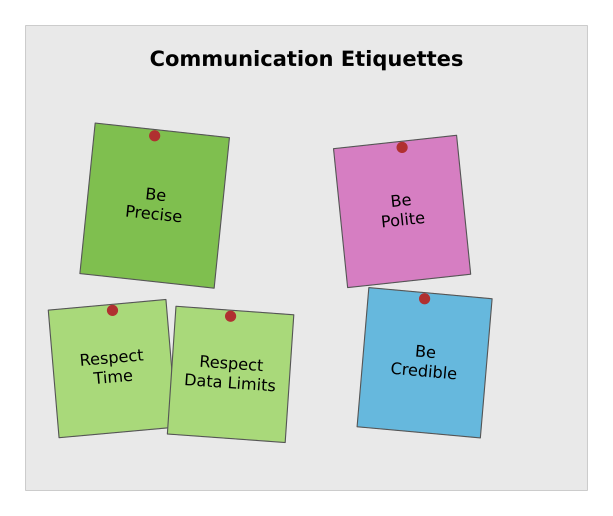
Digital communication takes many forms — email, texting, instant messaging, talking on the cell phone, audio or video conferencing, posting on forums, social networking sites, and more. All of these are great ways to connect with people in order to exchange ideas and to share data and knowledge. Good communication over email, chat rooms and other such forums, however, requires a digital citizen to abide by certain communication etiquettes, which the textbook summarises in Figure 6.3: Be Precise (which covers respecting time and respecting data limits), Be Polite …
Drawn by us to help you understand the concept clearly, and verified to make sure it's accurate. For exams, practice from your textbook's own diagram.
Figure 6.3 is drawn as a grey corkboard with the title "Communication Etiquettes" at the top, and five colourful sticky notes pinned to it with small red pushpins -- not a radial hub-and-spoke diagram. The notes are, reading left to right: two green notes, Be Precise (larger, upper) and underneath it two smaller green notes side by side, Respect Time and Respect Data Limits; a pink note, Be Polite; and a blue note, Be Credible. The notes are set at slightly dif …
Be Precise
Being precise in digital communication is really an economy of two scarce resources — the other person's time, and bandwidth:
-
Respect time — we should not waste precious time responding to unnecessary emails or comments unless they have some relevance for us. Equally, we should not always expect an instant response from others: the recipient may have other priorities.
-
Respect data limits — out of concern for data and bandwidth, very large attachments are best avoided. Instead, send compressed files, or share a link to the files through cloud shared storage such as Google Drive, Microsoft OneDrive or Yahoo Dropbox. …
Be Polite
Politeness applies to every form of digital communication — whether it happens live (synchronous exchanges such as chat or audio/video calls) or with a delay (asynchronous exchanges such as email, a forum post, or comments). In both modes the expectation is the same: keep the tone courteous and non-aggressive. …
Be Credible
Every comment we make, every reply we send, and every email or forum post we write contributes to how credible we appear to others online. Credibility is not established by a single post — it is built (or damaged) gradually, over a period of time, by the pattern of what we write. That is why we must be cautious each time we comment, reply, or write an email or a forum post: every such act adds to the record by which others judge us.
The textbook illustrates this with the way we ourselves behave on discussion forums:
- We choose to follow the forum posts of some particular person while ignoring the posts of other members. The difference between the two is the credibility each member has earned through their history of posts.
- Before relying on a person's comments, we usually go through that person's previous comments and judge their credibility from them. …