Informatics Practices · Ch 6 — Societal Impacts
Net Etiquettes
Net Etiquettes
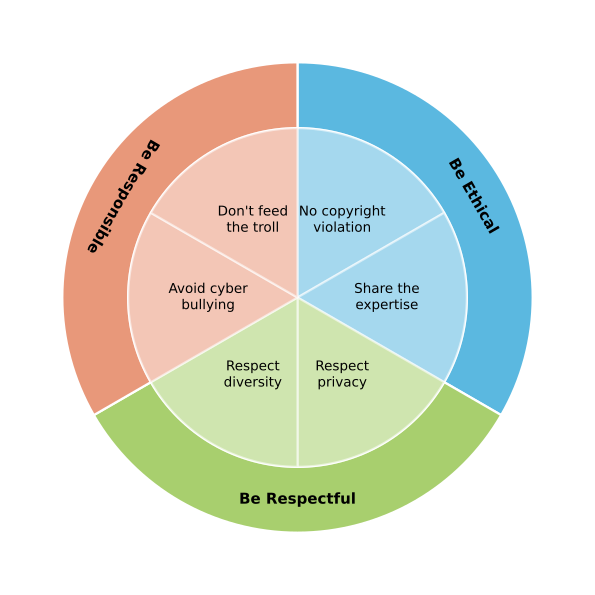
Just as we follow certain etiquettes in our everyday social interactions, we need to exhibit proper manners and etiquette while being online (the textbook pictures this in Figure 6.2). The rule of thumb is compact: while surfing the Internet, one should be ethical, respectful and responsible.
The textbook adds two prompts for self-inquiry alongside: a Think and Reflect question — can your digital footprints be used to judge your attitude and work ethics? — and Activity 6.1, which asks you, as a digital citizen, to list the various services you avail online. …
Drawn by us to help you understand the concept clearly, and verified to make sure it's accurate. For exams, practice from your textbook's own diagram.
Figure 6.2 is a circular wheel (donut chart), not a set of boxes. The wheel is split into three equal outer arcs, one per broad principle: Be Ethical (blue, top-right), Be Respectful (green, bottom), and Be Responsible (orange/salmon, top-left). Each of these three outer arcs is further split into two inner wedges reaching to the centre of the wheel:
- Be Ethical splits into No copyright violation and Share the expertise.
- Be Respectful splits into Respect privacy and Respect diversity.
- Be Responsible splits into Avoid cyber bullying and Don't feed the troll. …
Be Ethical
Being ethical online, as the textbook frames it, comes down to two habits:
- No copyright violation — we should not use copyrighted materials without the permission of the creator or owner. An ethical digital citizen has to be careful while streaming audio or video, and while downloading images and files from the Internet, since much of that content is someone's protected work. (Copyright itself is taken up in detail in Section 6.4.) …
Be Respectful
Respect, in the online world, runs in two directions — towards individuals and towards groups:
- Respect privacy — as good digital citizens we have the right to privacy and the freedom of personal expression. At the same time, we must recognise that every other digital citizen has exactly the same rights and freedoms. Our personal communication with another digital citizen may include images, documents, files and the like that are private to both of us. We should respect this privacy and never share those images, documents or files with any other digital citizen without each other's consent. …
Be Responsible
Being responsible online means, above all, doing no harm to others. The textbook singles out two behaviours to guard against:
-
Avoid cyber bullying — any insulting, degrading or intimidating online behaviour is termed cyber bullying: repeated posting of rumours, giving threats online, posting the victim's personal information, sexual harassment, or comments aimed at publicly ridiculing a victim. Its defining feature is repeatedly targeting someone with the intention to hurt or embarrass. New or non-frequent users of the Internet sometimes feel that things done online have no effect in the real world; in truth, bullying online can have very serious implications for the other person (the victim). And remember — the digital footprint we leave means whatever we do online can later be traced to us.
-
Don't feed the troll — a troll is someone whose whole purpose online is to stir up conflict for fun — picking fights, provoking or upsetting people, and dropping inflammatory or irrelevant posts into a community. Since trolls thrive on attention, the best way to discourage a troll is not to pay any attention to their comments. …