Physical Education · Ch 3 — Yoga as Preventive Measure for Lifestyle Disease
Bhujangasana
3.2.3
Bhujangasana
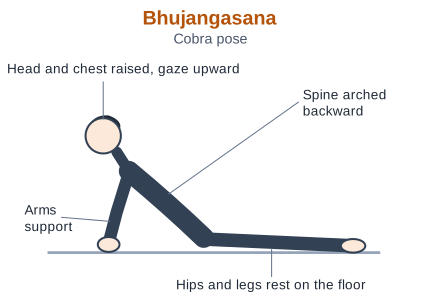
In Sanskrit the word Bhujanga means cobra. Because the final position of this asana resembles a hooded snake raising its head, it is called Bhujangasana, or the cobra pose.
Figure 3.11Line drawing of a person lying prone with the chest and head lifted and arched back on straight supporting arms, hips and legs resting on the floor - Bhujangasana (cobra pose).
Drawn by us to help you understand the concept clearly, and verified to make sure it's accurate. For exams, practice from your textbook's own diagram.
A side-profile line drawing of a person in the prone position. The chest and head are raised and arched backward, supported on the arms, while the hips, legs and feet stay flat on the ground - the hooded-cobra s …
Technique
- Lie down in the prone (face-down) position with the legs together, toes together and pointing outward, hands by the sides of the body, fingers together, palms facing upward and the forehead resting on the ground.
- Fold the hands at the elbows and place the palms on the ground near each side of the shoulders, keeping the thumbs under the armpits.
- Bring the chin forward and place it on the ground, with the gaze directed to the front.
- Raise the chin and turn the head backward as far as possible. Raise the thorax, turning the spine backward up to the level of the navel - but do not lift the navel off the ground.
- Hold the posture for a short while, then slowly lower the body back down, starting from the upper part near the navel, then the thorax, shoulders and chin, and finally rest the forehead on the ground.
- Relax the hands and place them beside the thighs.
Breathing Awareness
- Inhale while raising the torso.
- Breathe normally in the final position.
- Exhale while lowering the torso.
- Breathing and movement should be synchronised and smooth.
Benefits
- Strengthens and increases the flexibility of the spine and vertebral column.
- Opens the chest, shoulders, heart region and ribcage.
- Tones and strengthens the entire spinal extensor group of back muscles.
- Stimulates the endocrine system and the digestive organs - which is why it is useful in the management of diabetes.
- Is helpful for kyphosis (a rounded upper back).
Contraindications
- Women should avoid this asana during pregnancy. …