Q.(a) Write the significance of pentose phosphate pathway. OR
You're viewing a preview — the full solution, concept, methods & PYQ mapping are locked.
Start your 14-day free trial to unlock the full solution →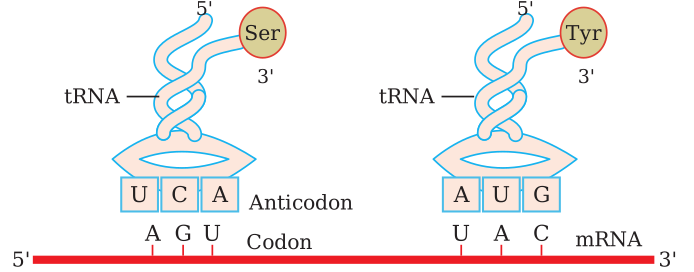
(a) The pentose phosphate pathway supplies NADPH and pentose sugars for biosynthesis; (b) t-RNA's cloverleaf structure has an acceptor stem, D-arm, anticodon arm, variable loop and T-psi-C arm.
(a) Significance of the pentose phosphate pathway (PPP / hexose monophosphate shunt)
The pentose phosphate pathway is an alternative route of glucose oxidation that occurs in the cytoplasm, running alongside glycolysis. Its significance:
- It generates NADPH, the reduced coenzyme required as reducing power for reductive biosynthetic reactions such as fatty-acid and steroid synthesis, and for maintaining reduced glutathione, which protects cells against oxidative damage.
- It produces pentose sugars, particularly ribose-5-phosphate, which are essential building blocks for the synthesis of nucleotides and nucleic acids (DNA and RNA), as well as for nucleotide coenzymes such as ATP, NAD and FAD.
- Unlike glycolysis, it does not directly yield ATP, but some of its intermediates (fructose-6-phosphate, glyceraldehyde-3-phosphate) can re-enter glycolysis.
- In plants specifically, it supplies erythrose-4-phosphate, a precursor (via the shikimic acid pathway) for the synthesis of aromatic amino acids, lignin and various phenolic secondary metabolites.
- It is especially active in tissues with high biosynthetic demand, such as actively growing/germinating tissue and oil- or steroid-synthesising tissue.
(b) Structure of t-RNA (cloverleaf model), described
Transfer RNA (t-RNA) is a small, single-stranded RNA molecule (roughly 75-90 nucleotides) that folds back on itself through intramolecular base pairing to form a two-dimensional structure resembling a cloverleaf, made up of the following labelled regions:
- Acceptor stem (amino-acid arm): formed by base pairing between the 5' and 3' ends of the molecule; the 3' end characteristically terminates in an unpaired -CCA sequence, to which the specific amino acid gets covalently attached (aminoacylation) during translation.
- D-arm (dihydrouridine arm): a stem-loop containing the modified base dihydrouridine; it is important for recognition of the t-RNA by the correct aminoacyl-t-RNA synthetase enzyme. …
Unlock everything free for 14 days
- Full step-by-step solutions
- Concept-first explanations
- Methods, shortcuts & mistakes
- PYQ mapping + timed mock tests
Full access for 14 days. No credit card required.