Oxoacids of Phosphorus – From Intuition to Precision
Think of phosphorus as an atom that loves to bond with oxygen. But unlike carbon or nitrogen, phosphorus has a quirk: it can form P–H bonds that are unusually stable. That single fact is the key to understanding why oxoacids of phosphorus behave so differently from, say, oxoacids of sulphur or chlorine.
When you see an oxoacid of phosphorus, the first question is not "how many hydrogens does it have?" but "how many of those hydrogens are attached to oxygen, and how many are attached directly to phosphorus?" That distinction decides everything — the acid's basicity, its reducing power, and its structure.
The core idea: P–OH vs P–H
In an oxoacid, the acidic hydrogens are always the ones on –OH groups. A hydrogen attached directly to phosphorus (P–H) is not acidic — it does not ionise in water. So the basicity of a phosphorus oxoacid is simply the number of P–OH groups, not the total number of hydrogens.
Take two famous examples:
- H3PO4 (orthophosphoric acid) — all three hydrogens are on oxygen: HO–P(=O)(OH)2. Basicity = 3.
- H3PO3 (phosphorous acid) — only two hydrogens are on oxygen; the third is directly on phosphorus: HP(=O)(OH)2. Basicity = 2.
A common mistake is to assume H3PO3 is tribasic because it has three hydrogens. It is dibasic — the P–H hydrogen never dissociates.
The structural pattern
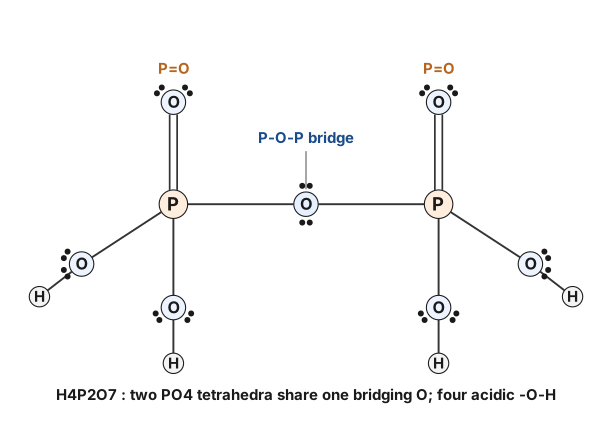
All oxoacids of phosphorus share a common skeleton: a central phosphorus atom with at least one P=O double bond and one or more P–OH groups. The remaining valency is satisfied by either P–H bonds or additional P–OH groups.
Here is the family in order of increasing oxidation state of phosphorus:
| Acid | Formula | Oxidation state of P | Number of P–OH | Number of P–H | Basicity |
|---|
| Hypophosphorous | H3PO2 | +1 | 1 | 2 | 1 |
| Phosphorous | H3PO3 | +3 | 2 | 1 | 2 |
| Orthophosphoric | H3PO4 | +5 | 3 | 0 | 3 |
| Pyrophosphoric | H4P2O7 | +5 | 4 | 0 | 4 |
| Hypophosphoric | H4P2O6 | +4 | 4 | 0 | 4 |
As the oxidation state increases, P–H bonds disappear. Only the lower oxoacids (H3PO2 and H3PO3) have P–H bonds. These are also good reducing agents — the P–H bond is easily oxidised.
Why does this happen?
Phosphorus in its +3 or +1 oxidation state is not fully oxidised. It can still be oxidised further, and the P–H bond provides a ready source of electrons. That is why H3PO3 reduces Ag+ to silver metal, while H3PO4 does not.
The structure also explains the dibasic nature of H3PO3 experimentally. Titrate it with NaOH: you get only two equivalence points, not three. The third hydrogen simply refuses to leave.
Basicity of a phosphorus oxoacid = number of P–OH groups.
Never count total hydrogens. Always draw the structure first.
How to draw the structures (the quick way) …