Mathematics · Ch 7 — Applications of Differential Calculus
Lagrange's Mean Value Theorem
Lagrange's Mean Value Theorem
Theorem 7.3 (Lagrange's Mean Value Theorem). Let be continuous on the closed interval and differentiable on the open interval (where are not necessarily equal). Then there exists at least one point such that
If , Lagrange's Mean Value Theorem reduces exactly to Rolle's Theorem (right side ) — it is sometimes called the "rotated Rolle's Theorem."
Physical meaning. is the average rate of change of over , while is an instantaneous rate of change; LMVT says these two must coincide at some interior instant.
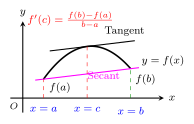
Geometric meaning. The secant joining and has exactly the same slope as the tangent at some interior point — the tangent at is parallel to that secant. (For instance, a car accelerating from rest that covers 200 m in 8 s has an average velocity of m/s; the Mean Value Theorem guarantees that at some instant during the trip the speedometer reads exactly m/s km/h.)
Theorem 7.4 (a monotonicity consequence, restated in §7.6.1's language). If is continuous on , differentiable on , and for every , then for any in , — proved directly from LMVT: pick between with ; since and , the right side is positive.
Three further consequences of LMVT, used throughout the rest of the chapter: …
![Fig. 7.13 — Lagrange's Mean Value Theorem: a curve y = f(x) on [a,b] has an interior point c where the tangent slope f'(c) equals the average rate (f(b)-f(a))/(b-a).](/figures/applications-of-differential-calculus/lagrange-mvt-tangent-parallel-secant-fig-7-13.svg)
Drawn by us to help you understand the concept clearly, and verified to make sure it's accurate. For exams, practice from your textbook's own diagram.
What this figure shows. Lagrange's Mean Value Theorem: a curve y = f(x) on [a,b] has an interior point c where the tangent slope f'(c) equals the average rate (f(b) …
Drawn by us to help you understand the concept clearly, and verified to make sure it's accurate. For exams, practice from your textbook's own diagram.
What this figure shows. Geometric meaning of the Mean Value Theorem: the secant joining (a, f(a)) and (b, f(b)) is parallel to the tangent of the curve y = f(x) at an int …