Mathematics · Ch 7 — Applications of Differential Calculus
Rolle's Theorem
Rolle's Theorem
Theorem 7.2 (Rolle's Theorem). Let be continuous on the closed interval and differentiable on the open interval . If , then there is at least one point where .
Geometric meaning. If the tangent is imagined moving along the curve from to , and the curve starts and ends at the same height (), then somewhere in between there must be a point at which the tangent is parallel to the -axis.
Working procedure to find the guaranteed : verify is continuous on and differentiable on , check , solve , and select the root(s) that actually lie in the open interval (a formula may produce extra roots outside the interval, which must be discarded).
Using Rolle's theorem indirectly — counting real roots. Rolle's theorem can also bound the number of real roots of an equation without solving it: for a polynomial , if are two of its real zeros, then Rolle's theorem (applied to on ) forces some with — i.e. between any two distinct real zeros of there is a zero of . Conversely, if can be shown to have no zero in some interval, can have at most one zero there; combined with the Intermediate Value Theorem (a sign change of across the interval), this pins down that has exactly one real root there.
Functions for which Rolle's theorem fails to apply (the hypotheses are violated, even if happens to hold):
- : , but is not differentiable at .
- A function defined piecewise with a jump is not continuous at the jump point, even if the two endpoint values agree. …
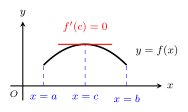
Drawn by us to help you understand the concept clearly, and verified to make sure it's accurate. For exams, practice from your textbook's own diagram.
What this figure shows. Geometric meaning of Rolle's theorem: a curve y = f(x) with f(a) = f(b) has a point c in (a,b) where the tangent is horizontal, so …