Mathematics · Ch 8 — Differentials and Partial Derivatives
Recall of Limit and Continuity of Functions of One Variable
Recall of Limit and Continuity of Functions of One Variable
Before extending limits and continuity to two variables, it helps to restate the one-variable definitions (from Class XI) in the language of neighbourhoods, since that is the form that generalizes cleanly.
Recall — Definition (Limit, one variable). has limit at , written , if: for every neighbourhood , , of , there exists a neighbourhood , , of , such that whenever . Equivalently, in modulus notation: for every there is such that whenever .
This is also characterised by matching one-sided limits: has a limit at (where is defined near, but not necessarily at, ) iff the right-hand limit exists, the left-hand limit exists, and (then ). Continuity at (where is defined) additionally requires .
Neighbourhoods in the plane. The one-variable neighbourhood of is the interval , . To do the same for a point , define the -neighbourhood of as the open disc
…
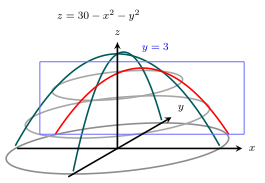
Drawn by us to help you understand the concept clearly, and verified to make sure it's accurate. For exams, practice from your textbook's own diagram.
What this figure shows. Fig. 8.5 — the surface intersected by the plane , whose cross-section is the parabola (oblique …
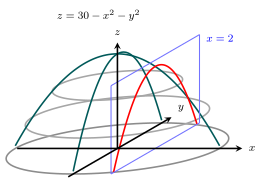
Drawn by us to help you understand the concept clearly, and verified to make sure it's accurate. For exams, practice from your textbook's own diagram.
What this figure shows. Fig. 8.6 — the surface intersected by the plane , whose cross-section is the parabola (oblique …