Mathematics · Ch 4 — Inverse Trigonometric Functions
Introduction
Introduction
Indirect measurement — finding a length or an angle without physically measuring it — is one of the oldest applications of trigonometry, and inverse trigonometric functions are the tool that makes it possible whenever the UNKNOWN quantity is an angle rather than a side. Trigonometric functions and their inverses are widely used in engineering and in other sciences including physics, and beyond solving triangles, they also let us evaluate certain families of integrals in calculus.
Three motivating pictures.
- Slope problem. A line makes an angle with the -axis. Since slope is , recovering from the known slope needs the inverse tangent function.
- Movie-theatre viewing angle. A screen m tall has its bottom m above eye level; a viewer sits m from the screen. The viewing angle is — a genuine function of , built entirely from inverse tangents.
- Drawbridge. Two m leaves of a drawbridge must open wide enough to let a m-wide ship through; finding the minimum opening angle again needs an inverse trigonometric function.
The notation (equivalently ) for the inverse of sine was introduced by the British mathematician John F. W. Herschel in 1826, for which — together with work with his father William Herschel — he received the Gold Medal of the Royal Astronomical Society. The in denotes the inverse function, never the reciprocal (that is written or ).
Inverse trigonometric functions also show up inside calculus, in integrals such as and , whose antiderivatives are and expressions respectively — a preview of why this chapter matters well beyond angle-finding.
A more everyday picture. An oscilloscope — the electronic instrument that turns an electrical signal into a graph shaped like a sine curve, whose controls let you change that curve's amplitude, period and phase shift — is used, among other things, to measure human heartbeats; trigonometric functions play the dominant role in reading a trace like that.
Chapter roadmap. Building on Class XI's study of the six trigonometric functions of a real number (periodicity, domain, range), this chapter (i) defines each inverse trigonometric function, (ii) draws its graph, and (iii) develops and applies its properties to evaluate expressions and solve equations. Throughout, denotes the real numbers and the integers.
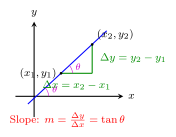
Drawn by us to help you understand the concept clearly, and verified to make sure it's accurate. For exams, practice from your textbook's own diagram.
What this figure shows. Illustration 1 (slope problem): the angle a line makes with the x-axis, where .
Figure 4.1.
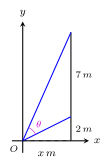
Drawn by us to help you understand the concept clearly, and verified to make sure it's accurate. For exams, practice from your textbook's own diagram.
What this figure shows. Illustration 2 (movie theatre): the viewing angle at the eye to a 7 m screen whose base is 2 m above eye level, m away.
Figure 4.2.
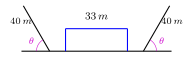
Drawn by us to help you understand the concept clearly, and verified to make sure it's accurate. For exams, practice from your textbook's own diagram.
What this figure shows. Illustration 3 (drawbridge): the minimum opening angle of each 40 m leaf for a 33 m wide ship to pass through.
Figure 4.3.