Q.(a) Solve the equation OR
You're viewing a preview — the full solution, concept, methods & PYQ mapping are locked.
Start your 14-day free trial to unlock the full solution →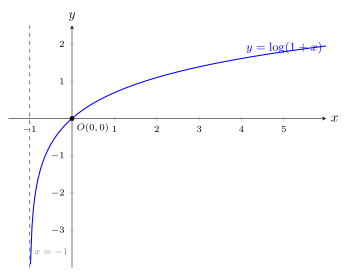
(a) Pairs the four linear factors so both products share the quadratic , substitutes to reduce to a quadratic in that expression, and solves; (b) analyses domain, intercepts, asymptote, monotonicity and concavity of to describe its sketch. Both alternatives answered below.
(a) Solve
1. Pair the factors to share a common quadratic.
Both contain .
2. Substitute . The equation becomes
3. Expand.
4. Solve the quadratic in .
5. Case : solve .
6. Case : solve .
7. All four roots: .
(b) Sketch the curve
1. Domain. Need .
2. Vertical asymptote. As , , so . The line is a vertical asymptote.
3. Intercepts. At : , so the curve passes through the origin — this is the only intercept (the curve never touches ).
4. Monotonicity. for all , so the curve is strictly increasing throughout its domain.
5. Concavity. for all , so the curve is concave down (convex upward) everywhere — no points of inflection.
…
Unlock everything free for 14 days
- Full step-by-step solutions
- Concept-first explanations
- Methods, shortcuts & mistakes
- PYQ mapping + timed mock tests
Full access for 14 days. No credit card required.